Britain and the United States are taking a major step towards closer cooperation on fusion energy by exploring plans to connect two advanced artificial intelligence supercomputing
platforms across the Atlantic.
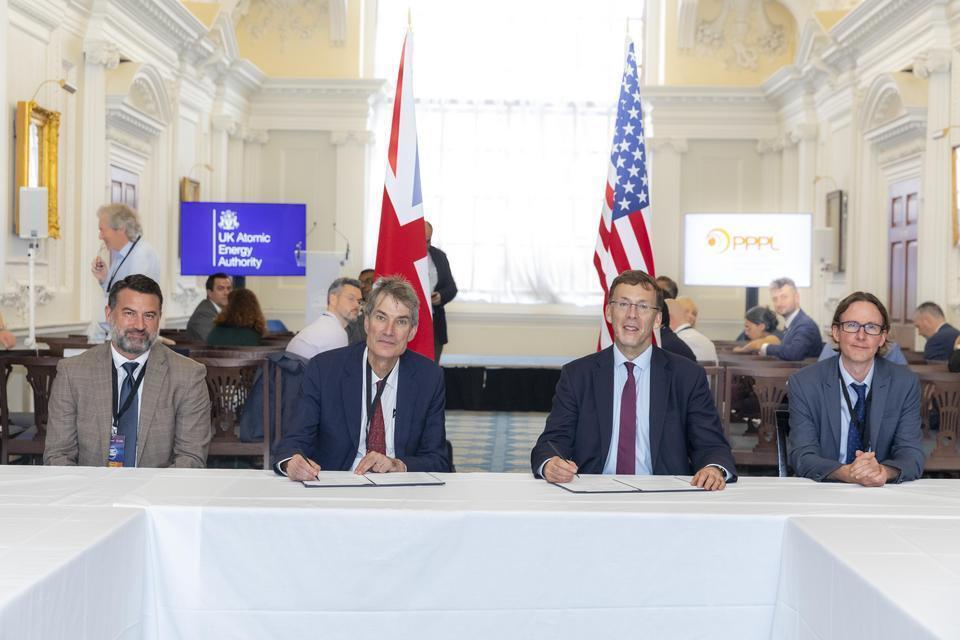
The UK Atomic Energy Authority (UKAEA) and the US Department of Energy’s Princeton Plasma Physics Laboratory (PPPL) have signed a Joint Declaration of Intent to develop the proposed SUNRISE–STELLAR-AI Federation, creating a shared computing capability for fusion research.
The agreement was announced at the Global Fusion Policy Summit in London on 14 September, where governments, scientists and industry leaders are discussing how international cooperation and regulatory alignment can help bring commercially viable fusion energy closer to reality.
Under the proposed partnership, UKAEA’s SUNRISE AI supercomputer would be linked with PPPL’s STELLAR-AI high-performance computing platform. Researchers in Britain and the US would be able to combine experimental data, computing resources and artificial intelligence models to investigate some of the most difficult engineering and scientific problems facing fusion development.
The initiative is designed to make it possible for AI systems to learn from experiments carried out at both institutions rather than relying on data from a single fusion facility.
That could improve the ability of machine-learning models to understand the behaviour of plasma under different conditions, potentially reducing the time required to design and test future fusion power plants.
The collaboration will draw on experimental data from UKAEA’s MAST Upgrade facility in Oxfordshire and PPPL’s NSTX-U facility in New Jersey. Both are compact spherical tokamaks with broadly similar configurations, making them particularly suitable for developing AI models capable of working across different machines.
Joe Milnes, Executive Director for Engineering and Computing at UKAEA, said international collaboration would be essential to tackling the complexity of fusion.
“Fusion is one of the great scientific and engineering challenges of our time,” he said. “The US and UK are two global leaders in fusion research, and the federation of SUNRISE and STELLAR-AI would build on a long history of transatlantic cooperation to further advance fusion development.”
Jonathan Menard, Chief Scientist at PPPL, said no single country or research institution was likely to develop a commercial fusion reactor independently.
“A fusion power plant is one of the most complex machines humanity has ever tried to build and no single laboratory or nation will design it alone,” he said.
He added that connecting the two computing platforms would allow scientists to train AI systems using data from two major fusion facilities and accelerate the development of more compact fusion power plant concepts.
AI could transform the pace of fusion research
Fusion promises a potentially abundant source of low-carbon energy by replicating the physical process that powers the Sun. But creating conditions in which fusion can occur on Earth and then converting the resulting energy into commercially viable electricity remains a formidable scientific and engineering challenge.
Advanced computing is increasingly being used to address that challenge, from modelling plasma behaviour to simulating reactor components and predicting how machines will respond to different operating conditions.
The proposed SUNRISE–STELLAR-AI Federation would allow researchers to train common AI models using much larger and more diverse datasets.
Models trained exclusively on data from one machine can struggle when applied to another facility because of differences in operating conditions, hardware and experimental environments. Combining datasets from MAST Upgrade and NSTX-U could help researchers develop models that better identify the fundamental physics shared by different spherical tokamaks.
The resulting technology could support future programmes including the UK's Spherical Tokamak for Energy Production (STEP Fusion) and US reactor concepts such as PPPL's Spherical Tokamak Advanced Reactor (STAR).
UKAEA Director of Computing Programmes and Senior Fellow Rob Akers said the partnership could also enable researchers to create sophisticated digital representations of fusion machines.
Experimental results could be combined with simulations to fill gaps in existing datasets and model conditions that have not yet been tested directly.
The aim would be to develop digital twins of the two facilities — detailed virtual representations that can be continually updated using experimental data. Researchers could then use them to test scenarios and predict machine behaviour before carrying out corresponding experiments on physical equipment.
“The real power will come from working as one team,” Akers said. “Together, we can learn faster and learn more, extracting maximum insight.”
Turning two supercomputers into one research engine
A key part of the proposed federation will be developing the technical infrastructure required to move computing workloads between the British and American systems.
Because SUNRISE and STELLAR-AI use different hardware architectures, researchers will need to establish ways for computational jobs to be transferred efficiently between them, allowing scientists to select whichever platform is best suited to a particular task.
Shantenu Jha, Head of Computational Sciences at PPPL, described the ambition as creating a shared engine for scientific discovery.
“Our goal is to let models and experiments move freely between the two systems,” he said. “We will turn a collection of supercomputers into a single engine for fusion discovery.”
The partnership could also create opportunities for a new generation of scientists and engineers working at the intersection of fusion, artificial intelligence and high-performance computing.
Plans under consideration include joint training programmes, technical workshops, research opportunities and wider international collaborations aimed at developing specialist skills required by the emerging fusion industry.
Building on a wider UK-US fusion partnership
The proposed federation follows a memorandum of understanding signed by UKAEA and PPPL in June, establishing a framework for expanded cooperation between the two organisations.
SUNRISE is the UK's first AI supercomputer specifically dedicated to fusion research and has received £45 million in UK government funding. It forms part of the computing infrastructure being developed at UKAEA's Culham Campus, which is also at the centre of the UK's first AI Growth Zone.
STELLAR-AI is PPPL's artificial intelligence and high-performance computing platform, operated with support from Princeton University.
Following discussions at the Global Fusion Policy Summit in London, the two organisations are now considering the practical steps required to establish the federation, including potential work on digital twins and the infrastructure needed to connect their computing environments.
If delivered, the initiative would give British and American fusion researchers access to a shared AI and supercomputing ecosystem, allowing experimental data and computational resources to be combined across the Atlantic.
The ultimate objective is to turn the enormous volumes of data generated by fusion experiments into faster scientific breakthroughs — helping move fusion technology from laboratory research towards the design and construction of future power plants.