The United Kingdom is stepping up its military-industrial partnership with Ukraine, agreeing to manufacture Ukrainian-designed strike drones on British soil as both countries seek to
strengthen Kyiv’s ability to withstand Russia’s continuing invasion.
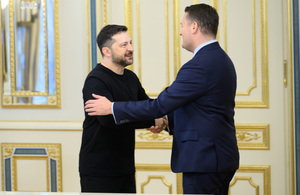
The agreement was announced on 21 November following a visit to Kyiv by UK Defence Secretary Wes Streeting, who held talks with Ukrainian President Volodymyr Zelenskyy and Defence Minister Khmara. The discussions focused on expanding military cooperation, strengthening Ukraine’s defence industry and ensuring that the country has the weapons and resources needed to resist Russian attacks, particularly during the winter months.
The new arrangements mark a further development in the UK’s approach to supporting Ukraine: moving beyond the delivery of military equipment towards deeper industrial integration, joint production and more resilient defence supply chains.
Under the agreements, Ukrainian-designed strike drones will be manufactured in the United Kingdom for delivery to the Ukrainian Armed Forces. The initiative is intended to increase production capacity, reduce pressure on Ukrainian manufacturing facilities exposed to Russian attacks and make it easier to maintain a reliable supply of modern weapons.
The announcement comes as Russia continues to target Ukrainian cities, energy facilities and other critical infrastructure. With temperatures falling, Moscow’s attacks on electricity, heating and water networks have added to the humanitarian pressure on the Ukrainian population, making air defence and the protection of essential services increasingly urgent.
Britain commits £500 million to Ukraine’s winter defence
The drone manufacturing agreement forms part of a wider £500 million military assistance package announced by London this week. The funding is intended to address urgent military requirements identified by Kyiv, with particular emphasis on protecting Ukrainian cities and infrastructure from Russian missile and drone attacks.
The package is divided into two major components.
The first, worth £240 million, was announced by Streeting on 17 November during a meeting of the Ukraine Defence Contact Group at NATO headquarters in Brussels. It includes more than 1,000 additional short-range air-defence missiles and launchers, together with more than a dozen radar systems designed to detect incoming attacks. The missiles have demonstrated their effectiveness against jet-powered Shahed drones used extensively by Russian forces. Deliveries are expected to begin in mid-December.
The remaining £260 million was announced by Prime Minister Andy Burnham at the Coalition of the Willing meeting in Berlin on 18 November. It will finance the delivery of more than 1,000 long-range strike drones, including systems capable of reaching targets more than 1,000 kilometres away. The package will also include maritime, surveillance and logistics drones, as well as communications and electronic-warfare equipment.
More than 80 per cent of the funding is expected to be spent with British companies, including small and medium-sized enterprises, creating opportunities for the UK's defence industry while supporting Ukraine's military requirements.
The latest commitments demonstrate how military assistance is increasingly becoming a two-way industrial partnership. Ukrainian battlefield experience and technological innovation are being combined with British manufacturing capacity, investment and access to international supply chains.
UK-Ukraine relations strengthen amid wider strategic cooperation
The latest developments follow a series of high-level diplomatic and military contacts between London and Kyiv over the past two months, reflecting the growing importance of Ukraine in British foreign and security policy.
On 13–14 October, President Zelenskyy visited London for talks with Prime Minister Andy Burnham at Downing Street. The discussions focused on increasing military assistance, accelerating the delivery of air-defence systems and coordinating international pressure on Moscow. Burnham also pledged to develop additional military and financial support measures and emphasised the importance of maintaining sanctions against Russia.
The leaders discussed new ways of adapting British military technology for Ukrainian battlefield requirements, including integrating British capabilities into equipment supplied by other international partners.
A particularly significant step followed on 28 October, when the British government announced an additional £10 billion in economic and military support for Ukraine, described as the largest financial assistance package London has committed to the country.
The programme includes £7 billion in economic support over three years, including World Bank guarantees and financial assistance intended to maintain Ukraine's economic stability and essential public services. A further £500 million was allocated to winter air defence, while another £3 billion was added to the capacity of UK Export Finance, bringing the total export-finance cover available for Ukraine to £6.5 billion.
The government said the financial support would help Ukraine maintain public services, strengthen its defence capabilities and create conditions for economic recovery despite the continuing war.
The scale of Britain's overall commitment is also substantial. According to the Ministry of Defence's updated figures published on 6 November, the UK has committed more than £35.5 billion in military and non-military support, including £16.5 billion in military assistance and up to £12.6 billion in non-military support, alongside £6.5 billion in export-finance guarantees.
Another important development was the UK-Ukraine Strategic Dialogue held in Kyiv on 11–12 November. The discussions covered defence cooperation, energy security, sanctions enforcement, reconstruction, European integration and the international response to Russian aggression.
Both governments reaffirmed their commitment to the 100-Year Partnership signed in January 2025, which provides a long-term framework for cooperation in defence, technology, economic development, education, transport and cultural relations.
London also reiterated its support for Ukraine's aspirations to join the European Union and NATO, while pledging to help strengthen Ukrainian institutions and implement reforms required for closer integration with European and Euro-Atlantic structures.
Preparing for Ukraine's post-war security
Military cooperation between the two countries is also extending beyond the immediate needs of the battlefield. Britain and France are playing a leading role in preparations for a possible multinational security presence in Ukraine following a ceasefire.
From 9 to 22 November, the UK and France led Exercise Koalicja, the first major military exercise of the Multinational Force-Ukraine, in Poland. Approximately 2,800 military personnel from participating countries took part, including 300 British troops. The exercise tested how an international force could be deployed, supplied and protected while helping to rebuild Ukraine's armed forces and support the country's security after the end of hostilities. British aircraft and ground units participated in the manoeuvres.
The Multinational Force-Ukraine forms the military component of the Coalition of the Willing, established in March 2025 under British and French leadership. The initiative brings together 35 countries committed to strengthening Ukraine's future security and coordinating military, economic and diplomatic pressure on Russia.
The force was formally established in January 2026 following a declaration signed by the leaders of Britain, France and Ukraine. Its planning includes arrangements for a multinational headquarters and the coordination of military contributions from participating states.
The British government has stressed that preparations for such a mission are intended to provide credible security guarantees and prevent Russia from launching another invasion after any future peace agreement.
Sanctions, reconstruction and long-term security guarantees
The November Strategic Dialogue also demonstrated that British-Ukrainian cooperation is no longer limited to military assistance. Both governments agreed to intensify efforts to enforce sanctions against Russia, tackle sanctions evasion and work with the G7, the European Union and other international partners to increase economic pressure on Moscow.
The two sides also discussed the use of frozen Russian sovereign assets to help finance Ukraine's defence and reconstruction. They reaffirmed that Russia must ultimately bear responsibility for the destruction caused by its invasion.
London and Kyiv further agreed to continue working through international institutions to establish accountability mechanisms for Russian war crimes and the crime of aggression. Particular attention was given to the establishment of the Special Tribunal for the Crime of Aggression against Ukraine and the International Claims Commission.
The return of Ukrainian children unlawfully deported to Russia, the release of prisoners of war and civilian detainees, and the fate of missing persons were also identified as important priorities.
Both governments maintained that any future peace settlement must respect Ukraine's sovereignty and territorial integrity within its internationally recognised borders. They also insisted that security guarantees must be sufficiently strong and legally binding to prevent renewed Russian aggression.
Industrial partnership becomes a cornerstone of British support
Streeting's visit to Kyiv therefore represents another stage in the transformation of British-Ukrainian relations into a long-term strategic and industrial partnership.
For Ukraine, establishing production facilities in Britain offers an opportunity to expand the manufacture of domestically designed weapons while reducing the vulnerability of its defence industry to Russian attacks. It also provides access to British technology, investment and international supply chains.
For the United Kingdom, closer cooperation with Ukraine provides access to valuable battlefield experience and technological developments in drone warfare, electronic warfare and air defence. Ukrainian engineers and military specialists have gained considerable experience in adapting relatively inexpensive technologies to counter sophisticated Russian weapons systems.
The partnership also has an economic dimension. British defence manufacturers, technology companies and smaller suppliers stand to benefit from new contracts, joint development programmes and expanded production. The expectation that more than 80 per cent of the latest £260 million drone package will be spent in Britain illustrates how military assistance can simultaneously support domestic industrial development.
The UK government has repeatedly argued that Ukraine's security is directly connected to the security of Britain and the wider European continent.
Speaking during his meeting with Zelenskyy in Kyiv, Streeting said:
Ukraine’s front line is our front line for freedom and democracy.
He also praised the Ukrainian president's leadership and said Britain would continue helping Ukraine resist Russian aggression and prepare for the challenges of the coming winter.
Zelenskyy, in turn, welcomed Britain's continued commitment, emphasising that military assistance, air-defence systems and direct diplomatic engagement were particularly important as Russia intensified its attacks.
The latest agreements underline London's intention to remain one of Kyiv's principal international partners, not only during the current war but also during Ukraine's eventual reconstruction and the establishment of a sustainable European security architecture.
With annual military assistance of £3 billion committed for as long as necessary, and cooperation expanding into joint weapons production, intelligence, training and long-term security planning, the relationship between Britain and Ukraine is increasingly developing into a strategic partnership with implications for the future of European defence.