The British government has stepped in to prevent a major early work by Stanley Spencer from leaving the country, giving museums and galleries a limited window to secure the painting
for a permanent place in a UK public collection.
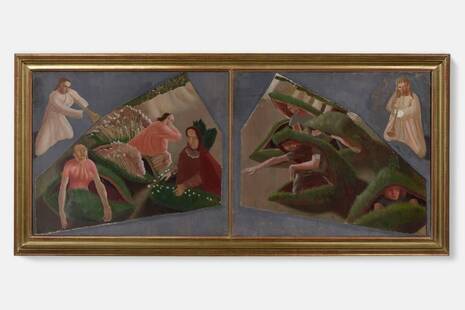
Arts Minister Ruth Mackenzie has imposed a temporary export bar on The Resurrection of the Good and the Bad, Spencer’s 1915 diptych, following advice from the Reviewing Committee on the Export of Works of Art and Objects of Cultural Interest (RCEWA). The decision is intended to give a British institution time to raise the £450,000 required to acquire the work.
The painting is regarded as an important milestone in the development of British Modernism and occupies a particularly significant position within Spencer’s artistic career. Created before the artist entered First World War service, it represents his first substantial treatment of the Resurrection — a subject that would become one of the defining themes of his work.
If acquired by a UK museum or gallery, the diptych would become the earliest publicly owned example of Spencer’s Resurrection paintings. Its inclusion in a national collection would provide researchers and the public with an important opportunity to examine the origins of an artistic theme that remained central to Spencer's work for decades.
Spencer, who lived from 1891 to 1959, is widely regarded as one of the leading British artists of the twentieth century. His distinctive combination of religious imagery, personal experience and recognisably British settings played an important role in shaping the country's modernist tradition.
The Resurrection of the Good and the Bad is particularly valuable because it predates Spencer’s direct experience of the First World War. Painted in 1915, as the conflict was beginning to transform British society and Spencer’s own life, the work offers an insight into the artist’s religious ideas at a crucial moment before wartime service influenced his later art.
The oil painting consists of two panels, each measuring approximately 80 by 63 centimetres. The left-hand panel depicts the Good rising on the Day of Judgement, while the Bad appear on the right.
The work also provides an early point of comparison with Spencer’s later Resurrection compositions, including The Resurrection, Cookham, painted between 1924 and 1927 and now held by Tate. In his mature work, Spencer repeatedly reimagined the biblical Resurrection through contemporary British environments, creating a highly individual visual language that combined theology, everyday life and modernity.
RCEWA member Mark Hallett said the 1915 diptych was fundamental to understanding the development of this central strand of Spencer’s artistic practice. He argued that retaining the work in Britain would allow substantially more research into the artist’s approach to the Resurrection and its place within his wider philosophy.
Arts Minister Ruth Mackenzie said the temporary export restriction could give the British public an opportunity to see the work rather than allowing it to disappear into a private or overseas collection.
The export decision has initially been deferred until 10 December 2026, allowing UK museums and galleries to register their interest in purchasing the painting.
If an institution makes an offer at the recommended price of £450,000, the owners will then have a 15-business-day consideration period. If an agreement is reached, a second deferral period of four months will begin under an Option Agreement.
The government hopes the process will ultimately result in the painting remaining in Britain and becoming accessible to the public and researchers as part of a permanent UK collection.