British museums and galleries have been given a limited window to secure a rare Renaissance sculpture valued at more than £4.6 million, after the Government temporarily halted its
export from the UK.
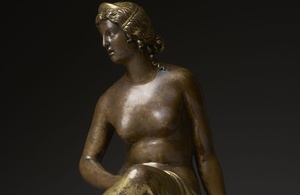
The decision concerns Seated Nymph, a small but exceptionally detailed bronze statuette created more than five centuries ago by the Italian Renaissance sculptor Pier Jacopo Alari Bonacolsi, better known as Antico. The work is considered one of the artist’s outstanding surviving creations.
The temporary export restriction, announced on 18 September, is intended to give a UK institution time to raise the funds necessary to acquire the sculpture and ensure that it remains accessible to the public.
Museums and galleries have until 17 December 2026 to express an interest in purchasing the work. The recommended purchase price is £4.6 million, plus VAT of £166,666.67.
A miniature Renaissance masterpiece
Measuring less than 20 centimetres in height, Seated Nymph was probably designed as a private object that could be held in the hand and rotated so that its craftsmanship could be viewed from different angles.
The statuette demonstrates Antico’s distinctive approach to Renaissance bronze sculpture. Its hair and drapery are decorated with mercury gilding, while the figure’s eyes feature silver inlay. A tiara or similar ornament on her head has led scholars to suggest that the woman could represent a classical deity, possibly Venus.
Antico built his reputation in the Mantuan court by combining Renaissance interest in classical antiquity with highly sophisticated bronze-casting and finishing techniques. His statuettes were produced for elite collectors and were prized for their luxurious surfaces and close engagement with ancient artistic models.
The Seated Nymph was rediscovered in the sculpture collection at Woburn Abbey, linking the object not only to Renaissance art history but also to the history of collecting in Britain.
Government seeks a UK buyer
The export restriction follows advice from the Reviewing Committee on the Export of Works of Art and Objects of Cultural Interest (RCEWA).
The committee concluded that the sculpture met the relevant Waverley criteria because of its exceptional aesthetic qualities and its importance for understanding the history of sculpture collecting in Britain. It also considered the work significant in relation to the Bedford collection and the connections between different models produced by Antico.
Arts Minister, Ruth Mackenzie said: “This statuette is small but mighty. The detail and refinement mark it out as an exceptional piece.
I very much hope this export bar can help keep this exquisite statue in the country where the public can also enjoy its beauty”.
RCEWA committee member Stuart Lochhead said the sculpture illustrated Antico’s mastery of Renaissance bronze production and his fascination with classical antiquity.
According to Lochhead, the combination of gilded hair and drapery and silver-inlaid eyes makes Seated Nymph particularly distinctive. He also argued that losing the work to an overseas collection would reduce public access to an exceptionally rare example of Antico’s work.
How the export deferral will work
The export licence application has initially been deferred until 17 December 2026. During this period, British museums and other appropriate institutions can put forward proposals to purchase the sculpture at the recommended price.
Once the first deferral period ends, the owners will have 15 business days to consider any qualifying offer at the recommended price.
If an option agreement is subsequently signed, a second deferral period of five months will begin, providing additional time for the prospective UK purchaser to complete the acquisition.
The Government’s intervention therefore does not permanently prevent the sculpture from leaving Britain. Instead, it creates an opportunity for a UK institution or suitable purchaser to secure the work before an export licence can proceed.
For British museums, the case highlights the continuing challenge of retaining internationally significant works of art when their market value places them beyond the budgets of many public institutions.