China is defending its economic model ahead of expected trade negotiations with the United States and European Union, signalling that it is unlikely to make major changes to policies that
prioritise manufacturing and advanced industries.
President Xi Jinping and US President Donald Trump are expected to hold several face-to-face meetings this year, while the EU has set an October deadline for Beijing to address trade disputes.
The talks come as concern grows in Western capitals over China's large trade surplus, which has exceeded $1tn.
The US and EU have accused China of pursuing policies that favour producers over consumers and contribute to an oversupply of relatively cheap goods on global markets.
They argue that China's approach is putting pressure on manufacturers in countries seeking to rebalance their economies towards domestic consumption.
But a meeting of China's top Communist Party leaders this week indicated that Beijing intends to maintain its current economic strategy.
The leadership called for targeted support for the economy, rather than the broad consumer-focused stimulus and structural reforms that Western governments and many economists have urged.
China's commerce ministry has also rejected claims that its industrial policies have created "overcapacity", accusing Western governments of using the issue to justify protectionist measures.
The Communist Party's main theoretical journal, Qiushi, went further in July by arguing that China's relatively low household consumption was a historically justified consequence of an investment-led development model.
Xu Tianchen, a senior economist at the Economist Intelligence Unit, said the statements were designed partly to explain China's position to foreign governments while also establishing limits on what Beijing was prepared to accept.
"Better mutual understanding helps in negotiations," he said.
"But it is also about drawing a red line."
The commerce ministry's position paper, he added, made clear that China would oppose what it considered discriminatory measures against its companies and exports.
Beijing challenges 'China shock' fears
Chinese officials argue that the country's economic model reflects the needs of a developing economy still catching up with richer nations.
Beijing says its companies are producing increasingly sophisticated goods, while investment in technology and scientific research could provide benefits internationally.
Premier Li Qiang has sought to counter warnings of a new "China shock" - the prospect that Chinese companies could displace Western manufacturers in industries such as electric vehicles, batteries and other advanced technologies.
Instead, he has promoted the idea of a "China opportunity", arguing that China's industrial development can create opportunities for the wider global economy.
But that message has struggled to convince countries facing a surge in Chinese imports, according to Eswar Prasad, a professor of trade policy at Cornell University and former China director at the International Monetary Fund.
He said China's reliance on exports at a time of weak domestic demand made it difficult for Beijing to present its exports simply as a benefit to consumers elsewhere.
The US attempted to put pressure on China last year through tariffs of more than 100% on some goods. Beijing responded by using its dominant position in the production of rare earths, which are critical to industries ranging from electronics to defence.
The confrontation ultimately resulted in negotiations rather than a fundamental restructuring of the economic relationship.
EU prepares its own response
The European Union is now taking a tougher approach of its own.
The bloc's trade deficit with China averaged about $1bn a day last year, prompting Brussels to pursue measures aimed at protecting European industry and encouraging domestic procurement.
German Chancellor Friedrich Merz has also criticised Beijing over what he described as an undervalued Chinese currency.
Yet recent statements from Beijing suggest Chinese leaders believe they can manage growing trade tensions without making substantial concessions.
"The US tariff episode appears to have supplied a template of managed engagement that Beijing is also applying to Europe - essentially buying time," said Alicia Garcia-Herrero, chief Asia-Pacific economist at Natixis.
She said Beijing's defence of its economic model appeared "more confident and tightly framed" than it had been a year or two ago.
China has made some adjustments, including slowing investment and increasing scrutiny of local government spending.
But analysts say these measures have so far fallen short of the deeper shift towards household consumption and away from industrial investment sought by many of China's trading partners.
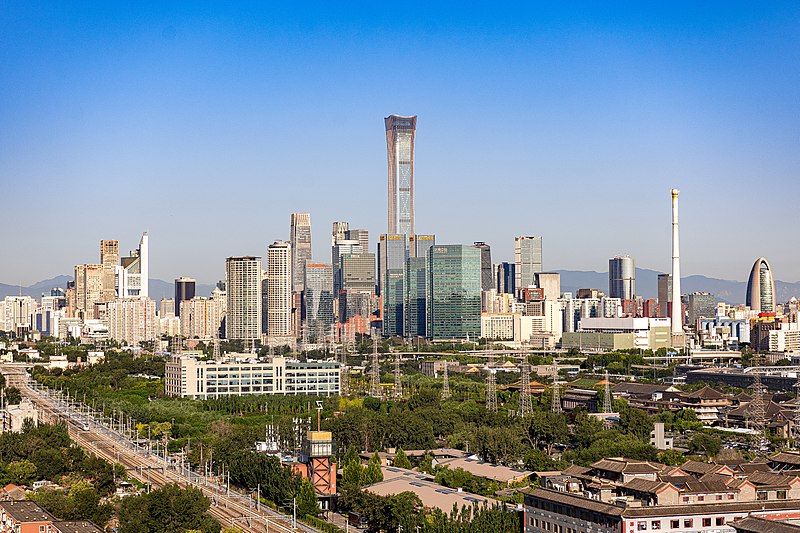
That leaves the structure of China's economy at the centre of upcoming trade negotiations, with both the US and EU seeking greater access to the Chinese market while Beijing appears determined to protect the policies it sees as central to its economic and technological ambitions. Photo by N509FZ, Wikimedia commons.