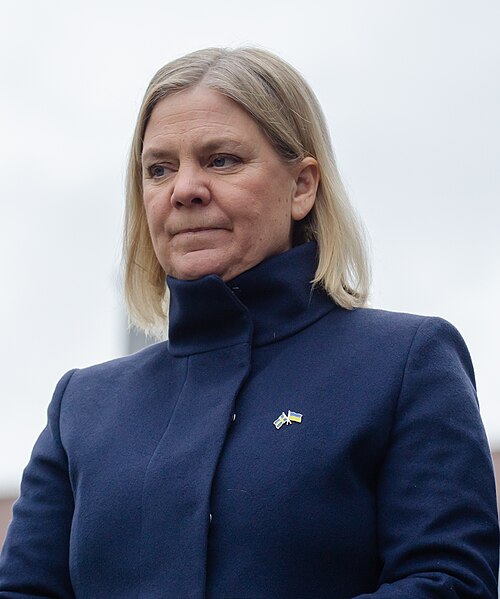
Swedish Social Democratic leader Magdalena Andersson has been given another opportunity to form a government following the country’s closely contested September parliamentary
election, despite previously declaring that she could not secure sufficient political support.
The decision, announced by parliament speaker Andreas Norlén on Friday, reopens negotiations after Andersson abandoned her initial attempt earlier this week. She now has until October 12 to report on her progress or request additional time.
Sweden held its general election on September 13, with the centre-left opposition securing a narrow majority in the 349-seat Riksdag. The four-party bloc, comprising the Social Democrats, Centre Party, Green Party and Left Party, won 176 seats, compared with 173 for the centre-right grouping.
The Social Democrats emerged as the largest political force, securing 99 parliamentary seats. The Moderates, led by outgoing Prime Minister Ulf Kristersson, won 70 seats, while the anti-immigration Sweden Democrats received 62. The Left Party secured 30 seats, followed by the Centre Party with 25 and the Greens and Christian Democrats with 22 each. The Liberals won 19 seats.
Despite the centre-left's parliamentary advantage, the election result has not translated into an agreement on forming a government. Disagreements between potential coalition partners have exposed significant divisions within the opposition bloc.
Andersson's difficulties became particularly evident after the Left Party decided over the weekend to support a Moderate Party candidate for parliamentary speaker. She argued that the move had undermined the political arrangements needed to establish a new administration.
The Centre Party has also complicated negotiations by refusing to support a government involving the Left Party, while the latter has demanded a more substantial role in the new administration, including ministerial representation.
The election marked a setback for Kristersson's governing camp, which had relied on parliamentary support from the Sweden Democrats. The vote was widely viewed as a test of public support for the participation of the anti-immigration party in government.
Following the result, Kristersson stepped down, clearing the way for Andersson, who previously served as Sweden's prime minister between November 2021 and October 2022, to explore the formation of a new government.
However, the centre-right bloc also faces difficulties in securing a parliamentary majority, leaving Sweden with an uncertain political outlook.
Under the country's parliamentary system, the speaker can nominate candidates for prime minister, who must be accepted by parliament. A maximum of four candidates can be rejected before a new general election must be held.
The latest mandate gives Andersson additional time to negotiate with potential partners and establish whether a workable governing arrangement can be reached.
The election has also been followed by investigations into suspected irregularities. Swedish police have opened preliminary investigations into five complaints concerning possible election fraud in the Stockholm area, while a separate investigation in Borlänge could potentially affect up to 11 parliamentary seats if authorities order a rerun.
With neither political bloc having secured a comfortable majority, the outcome of the government formation process will depend not only on the election results but also on whether parties can overcome their differences and agree on a parliamentary arrangement capable of sustaining a new administration. Photo by FrankieF, Wikimedia commons.