The UK government has imposed a temporary export ban on an exceptionally rare Anglo-Saxon metal mount, giving museums and galleries time to raise funds to keep the historic
object in Britain.
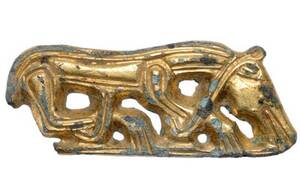
The tiny artefact, believed to date from the late fifth or early sixth century, was discovered by a metal detectorist at Holme Hale in Norfolk in 2024. Measuring just over 3cm and weighing approximately 5 grams, it depicts a four-legged animal in unusually clear detail.
Arts Minister Ruth Mackenzie said the object represented an important link to Britain's early medieval past and should remain accessible to researchers and the public.
"This piece is undeniably a national treasure," Mackenzie said. "It offers researchers an important window into our Anglo-Saxon past."
She added that she hoped the mount could remain in the UK so that it could be studied and displayed publicly.
Rare glimpse into Anglo-Saxon culture
The object is considered particularly significant because of its distinctive depiction of an animal. While other surviving Anglo-Saxon mounts from the period are often highly stylised, this example provides a much more recognisable representation of a four-legged creature.
Made from copper alloy and enhanced with gilding, the mount also has fittings on its reverse, indicating that it was probably attached to another object.
Experts believe representations of animals of this kind may have been connected to the religious and mythological beliefs of early Anglo-Saxon communities.
Its discovery offers researchers an opportunity to investigate how artistic traditions, materials and imagery travelled between southern Scandinavia and eastern and south-eastern England during the late fifth and sixth centuries.
Helen Jacobsen, a member of the Reviewing Committee on the Export of Works of Art and Objects of Cultural Interest, said physical artefacts were essential to understanding the lives and cultural practices of early medieval societies.
She described the mount's form and imagery as exceptionally unusual and said further research could provide new evidence about its original function and the movement of artistic ideas across northern Europe.
"It will be a huge loss if it cannot be saved for the nation," Jacobsen said, expressing hope that a national museum could eventually provide it with a permanent home.
Three Waverley Criteria
The Reviewing Committee recommended that the object should be treated as a national treasure after determining that it satisfied all three of the Waverley Criteria.
The criteria are used to assess whether cultural objects proposed for permanent export have exceptional importance to the UK's heritage.
The committee concluded that the mount has:
- an outstanding connection with British history and national life;
- outstanding aesthetic importance; and
- outstanding significance for the study of art, learning and history.
The committee said the artefact was particularly valuable for research into Anglo-Saxon material culture and the development of early medieval communities in eastern and south-eastern England.
Museums given time to raise funds
The temporary export ban does not prevent the object from eventually leaving Britain, but it creates a period during which a UK institution or private buyer can attempt to acquire it.
The export licence decision has initially been deferred until 3 November 2026, allowing potential purchasers to come forward.
If an offer is made, the owners will then have a 15-business-day consideration period in which to decide whether to accept it. The recommended purchase price is £1,054 plus £40.80 VAT.
If an Option Agreement is subsequently signed, a second deferral period of three months will begin.
The mechanism is designed to give UK museums, galleries and other eligible purchasers an opportunity to secure historically important objects before they can be permanently exported.
Officials hope the process will ultimately allow this unusually well-preserved example of Anglo-Saxon craftsmanship to remain in Britain, where it could be made available for public display and further academic research.