From the life story of British politician Stefan Terlezky
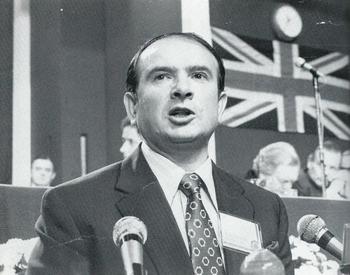
The adoption by the Parliament of Ukraine of the Declaration of State Sovereignty of Ukraine, as well as the self-determination of the Ukrainian nation, would have been impossible without the constant and persistent work of Ukraine’s friends, who lobbied for and defended the interests of their homeland before the governments of leading Western countries. One of such lobbyists was the well-known British politician of Ukrainian origin, Stefan Terlezky, about whom little is known in modern Ukrainian historiography. Thanks to his persistent work, he not only became the first ethnic Ukrainian elected to the British Parliament, but also a prominent European politician of Ukrainian descent who influenced the formation of European countries’ positions on many issues, including the recognition of Ukraine as an independent state.
Stefan Terlezky (October 29, 1927 — February 21, 2006) began his life journey in the Ivano-Frankivsk region. He was born in the village of Oleshiw, near the town of Tlumach, which today is a district center. His childhood was spent in his parents’ home near the agricultural community of Antonivka, also close to Tlumach. In 1939, Western Ukraine was annexed under the Molotov–Ribbentrop Pact, bringing major changes to Antonivka. Many of Stefan’s relatives suffered. His uncle, along with his family, was “dekulakized” after paying neighbors to help harvest crops on his estate and was subsequently exiled to Siberia. His cousins, who studied at Ivano-Frankivsk University, were also deported to Siberia as Ukrainian nationalists. These events contributed to shaping the boy’s anti-Soviet views.
After the outbreak of World War II and the occupation of the territory by German forces, 14-year-old Stefan was forced to work on military facilities—together with fellow villagers, he repaired a railway bridge over the Dniester River that had been damaged during the Red Army’s retreat. After the construction was completed, the teenager was sold at a forced labor market in Austria, where he became an unpaid worker for a farmer in the town of Voitsberg near Graz, where he remained until 1945. Thus, Terlezky was separated from his family and lived most of his life without their support—he saw his father again only 42 years later.
When Voitsberg was liberated by Soviet troops, Stefan hoped to be sent back to his homeland. However, the Soviet authorities had different plans for former forced laborers. Workers were told they would be sent to the Far East to assist in the war against Japan. At that moment, Stefan decided to radically change his fate. In Budapest, he escaped from a Soviet train heading east and returned to Voitsberg, which had come under British occupation in July 1945. He hid for some time in a forest near the Raab River. Eventually, he ended up in a displaced persons camp in Villach, Carinthia, where he found work in the kitchen of a British army base.
In 1948, Stefan was allowed to legally emigrate to Great Britain, where he began working in a coal mine in Wales. The beginning of his “British life” was quite modest—he arrived with 40 Austrian shillings in his pocket, which he exchanged in London for one British pound. However, his culinary skills helped him move forward—he later transferred to lighter work in a miners’ hostel cafeteria. He then worked in hotel management in the Welsh towns of Porthcawl and Swansea, eventually opening his own hotels in Aberystwyth and Cardiff. From then on, his life was permanently connected with Cardiff, the capital of Wales. He mastered English while studying at Cardiff High School and the Cardiff College of Food Technology and Commerce, and married a local resident, Mary.
As Terlezky himself emphasized in his memoirs, during this period he lost his last illusions about Soviet policy. In 1958, he learned that his father and sister had been arrested in the Ivano-Frankivsk region for “nationalist activities” and exiled to Siberia for six years. He had already lost his mother during World War II—she died of a heart attack. Stefan managed to maintain contact with his family and even received letters from his father in Wales, written under strict Soviet censorship, often with a touch of characteristic “camp humor”: “We have a wonderful climate here—12 months of winter, and the rest is summer.”
Stefan Terlezky’s political career began in 1968, when he became a member of the Cardiff City Council from the Conservative Party. However, his ambitions went much further. He attempted to be elected to Parliament in the 1974 general election, but unsuccessfully. From the very beginning of his political activity, Terlezky paid considerable attention to international issues. During the height of the Cold War, he insisted that Great Britain should create a strong military shield to “prevent the aggressive policies of the Soviet Union.” “Under no circumstances should we agree to Russia’s proposal to reduce our forces in Europe,” he stated in 1973. “This is exactly what Marxists and left-wing socialists want us to do. As a man who was born in slavery, I want to die a free man.”
Terlezky actively participated in public life in Cardiff—particularly as a football supporter and promoter of sports, he was invited to serve as a director of Cardiff City Football Club from 1975 to 1977. Perhaps by coincidence—or perhaps not—during this period, yellow was added to the club’s traditional blue kit.
In 1983, on his third attempt, Terlezky was elected to Parliament.
Throughout his time in Parliament, Terlezky established himself as a consistent opponent of the Soviet communist regime. For example, in a speech on January 24, 1984, he asked the Home Secretary: “What measures are being taken to prevent sailors from Soviet merchant ships from engaging in espionage activities while visiting British ports?”
In his work, Terlezky continually sought to highlight Ukraine as a distinct entity in the eyes of the British public and to encourage the British government to develop a separate policy toward Soviet Ukraine.
During parliamentary debates on April 4, 1984, Terlezky asked the British Foreign Secretary: “What status does Her Majesty’s Government assign to Ukraine?” He received a reply from Malcolm Rifkind: “We recognize the Ukrainian Soviet Socialist Republic as part of the Union of Soviet Socialist Republics.” Terlezky then asked what consequences Ukraine’s election to the UN Security Council would have for the United Kingdom. He was told that membership in the Security Council did not affect the UK’s stance and did not imply recognition of Ukraine as an independent state.
Nevertheless, such parliamentary inquiries by Terlezky can be considered one of the first attempts to raise the issue of Ukraine’s independence at a legislative level in Europe.
The beginning of perestroika in the USSR was seen by Terlezky as the first sign of hope for Ukraine’s future independence. The spring of 1986 marked an important milestone in his career and the peak of his activity, including on issues related to Anglo-Soviet relations and changes in Soviet society.
He was particularly concerned with the issue of opening a separate British diplomatic mission in Kyiv. During a hearing in the House of Commons on May 12, 1986, he asked whether urgent steps would be taken to open a British consulate in Kyiv. The Foreign Office responded that Britain had no such plans and that consular services for British citizens in Kyiv were handled by the embassy in Moscow.
Terlezky’s later speeches addressed topics such as British students studying in Kyiv, human rights in the Soviet Union, and trade relations between the UK and the USSR.
His activities sparked significant interest among the British elite in Ukraine and its people. On June 10, 1990, British Prime Minister Margaret Thatcher paid an important visit to Kyiv, becoming the first Western leader to address the Ukrainian parliament. She was later greeted by Kyiv residents with banners reading “Ukraine aspires to the European home.”
After the collapse of the Soviet Union, Terlezky became a passionate supporter of Ukraine’s independence and an advocate for its political interests in Europe. He also supported the independence movements of other republics, particularly the Baltic states, describing their forced incorporation into the USSR as “one of the greatest injustices of our time.”
In 1992, Terlezky was awarded the title of Commander of the Order of the British Empire (CBE), one of the UK’s highest honors, in recognition of his service. He earned respect from colleagues and even political opponents. As his Welsh electoral opponent Kevin Brennan noted: “Despite our political differences, I greatly respect his remarkable life journey and what he achieved both in life and as Member of Parliament for West Cardiff.”
Terlezky warmly welcomed Ukraine’s democratic transformations during the Orange Revolution. In 2005, he met with Ukrainian President Viktor Yushchenko and praised Ukraine’s achievements in freedom of speech and human rights. Stefan Terlezky passed away on February 21, 2006, at the age of 79. His personal archive was donated by his family to the Ukrainian Society in London, where it is preserved today.
As Tony Leliw wrote in his review of Terlezky’s biography: “The story of Stefan Terlezky is not just the story of one man—it is a reflection of the lives of hundreds of thousands of refugees who suffered at that time. This makes the book an ideal starting point for those in the diaspora and beyond who seek answers about this painful period of history.”
It should be noted that the emergence of Ukraine as an independent state would not have been possible without the support of British, American, French, and other politicians of that time. Political support and the ability to convey the voice of the Ukrainian people to Western elites became important factors that contributed to the adoption by the Ukrainian parliament of the Declaration of State Sovereignty of Ukraine on July 16, 1990.
O. Kozerod, Ph.D., D.Litt., member of the Royal Historical Society