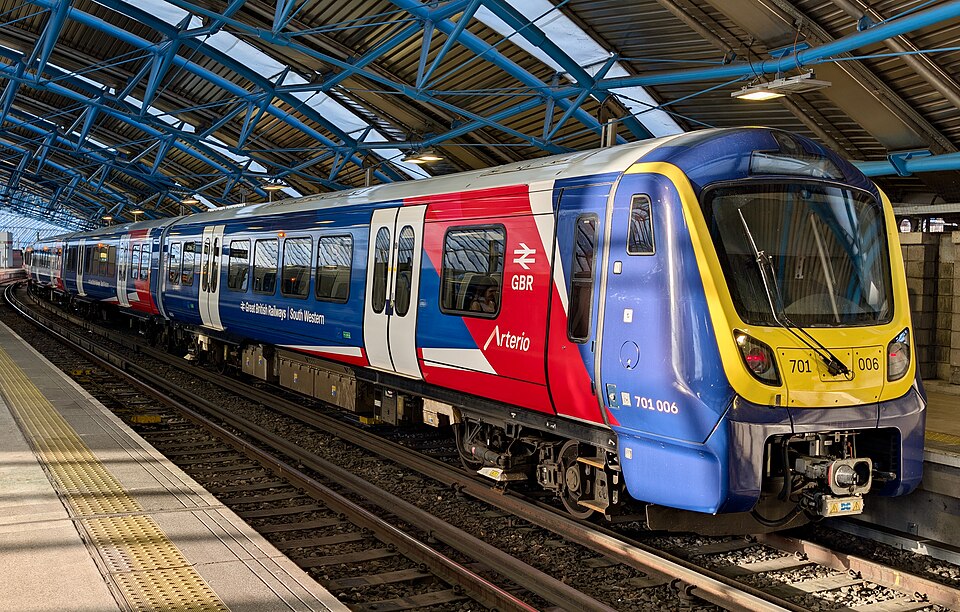
Passengers travelling into London Waterloo are seeing faster, more comfortable journeys as South Western Railway (SWR) marks one year under public ownership with the accelerated rollout
of its new Arterio fleet.
The operator has introduced 39 additional Arterio trains since renationalisation last May, taking the total number now in service to 45. The milestone was marked on 22 May when Rail Minister Peter Hendy unveiled a Great British Railways-branded Arterio train at London Waterloo station.
According to SWR, the new fleet has increased seating and standing capacity on suburban routes into Waterloo by 27%, easing pressure on some of the network’s busiest commuter services. Routes serving Windsor, Woking and Wimbledon are among those benefiting from the upgrades.
Capacity improvements have been particularly significant on several lines, including the Aldershot via Ascot route, which has seen a 55% increase, while services to Windsor have gained 42% more space. Shepperton, Dorking and Hampton Court routes have also recorded notable increases.
The Arterio trains are designed to replace older suburban stock and can carry nearly twice as many passengers. They feature onboard wifi, charging points at every seat, improved air conditioning and faster acceleration and braking systems aimed at reducing delays and improving reliability.
The government said public ownership helped remove administrative delays that had slowed the fleet’s introduction and driver training programme under the previous franchising model.
Rail Minister Peter Hendy said passengers were “seeing and feeling the difference” one year after the first operator returned to public control.
He said the faster rollout of the Arterio fleet demonstrated how nationalisation was helping to modernise the railway by “cutting red tape” and focusing on passenger needs rather than profit.
SWR and Network Rail say closer cooperation since the transfer into public ownership has helped speed up operational decisions and infrastructure planning. Lawrence Bowman, managing director for SWR and Network Rail Wessex, said the operator was approaching the point where most suburban passengers would travel on an Arterio during their daily commute.
The full fleet of 90 trains is expected to enter service by early 2027. Future additions will include real-time passenger information systems and fully accessible toilets.
Alongside the Arterio programme, SWR has announced a wider package of improvements across its network, including upgrades to diesel trains, expanded high-speed wifi coverage, signalling renewals and the recruitment of 144 new drivers this year.
The operator is also planning a full timetable overhaul later in 2026, aimed at improving reliability and making services more resilient during disruption.
The government says the wider transition to public ownership is already delivering benefits across the rail network, pointing to improved punctuality and lower cancellation rates among publicly operated train companies including c2c and Greater Anglia.
Since SWR entered public ownership, the Department for Transport has also taken control of c2c, Greater Anglia and WM Trains services, with Govia Thameslink Railway due to follow at the end of May. Chiltern Railways and Great Western Railway are expected to transfer later this year. Photo by Fortek67, Wikimedia commons.