
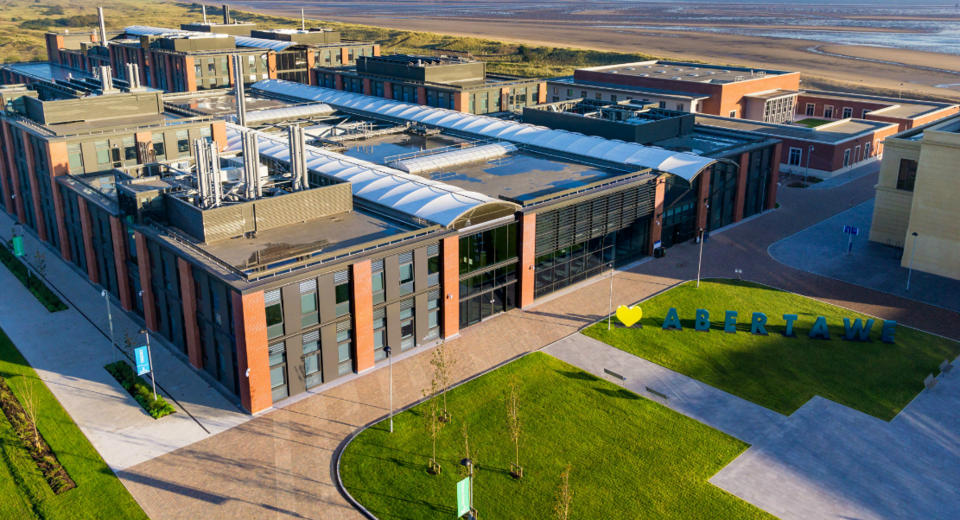
Swansea University has officially opened the UK’s first National Microgravity Research Centre (NMRC), a landmark £13 million project aimed at advancing the nation’s
space and semiconductor research capabilities. The centre, part-funded by the UK Space Agency, is poised to strengthen the UK’s position in cutting-edge space manufacturing.
The NMRC is housed within the Centre for Integrative Semiconductor Materials (CISM) at Swansea University. It serves as a hub for innovation, supporting both academic research and commercial space enterprises. Space manufacturing company Space Forge has become the centre’s first incubation client, operating from a dedicated clean room and gaining access to a full suite of semiconductor processing and characterisation tools, as well as CISM’s wider network of experts and innovators.
The facility underpins Space Forge’s hybrid manufacturing model, which combines microgravity processing in low Earth orbit with large-scale terrestrial production. Semiconductor seed wafers grown in space are returned to Earth and scaled up at CISM, creating unique opportunities for advanced material development.
UK Space Agency CEO, Dr Paul Bate, said: “The completion of the National Microgravity Research Centre is another concrete example of what our Space Clusters Infrastructure Fund is designed to achieve - tangible, lasting infrastructure that strengthens the UK’s space economy and builds sovereign capability in strategically important technologies.
Space Forge has demonstrated real ambition, from launching the first British-built in-space manufacturing satellite to now establishing a world-class terrestrial facility at Swansea University. This investment is helping to cement Wales and the wider UK as a serious player in the future of semiconductor manufacturing”.
The Space Clusters Infrastructure Fund (SCIF) has supported 13 projects since its 2023 launch, investing over £45.6 million. Matched with £43.8 million from the private sector, this has generated nearly £90 million in combined investment in UK space R&D infrastructure. Recent beneficiaries include the £20 million Westcott Space Hub in Buckinghamshire, the Airbus Launchpad in Stevenage, and Magdrive’s DEEP Lab at Harwell.
For Space Forge, the Swansea facility represents the latest milestone in a series of pioneering achievements. The company launched ForgeStar®-1, the UK’s first in-space manufacturing satellite, in June 2025, and successfully generated plasma in orbit by December 2025, demonstrating the feasibility of advanced crystal growth in space.
Joshua Western, CEO and Co-Founder of Space Forge, said: “When we secured this funding in 2023 we set out to build something that would advance microgravity materials and open doors for other space companies to do the same. Being based at CISM gives us access to world-class semiconductor infrastructure and a community of researchers and talent that will help us move faster”.
CISM itself is part of CSconnected, Europe’s first compound semiconductor cluster, established with £55 million in UK and Welsh Government funding. Space Forge’s presence at the facility further strengthens Wales’ role in the UK’s sovereign semiconductor supply chain, focusing on advanced materials like silicon carbide, gallium nitride, and gallium oxide, essential for power electronics and radiation-resistant technologies. Photo by Rhys1234567890, Wikimedia commons.
Nick Brown