Research context and relevance
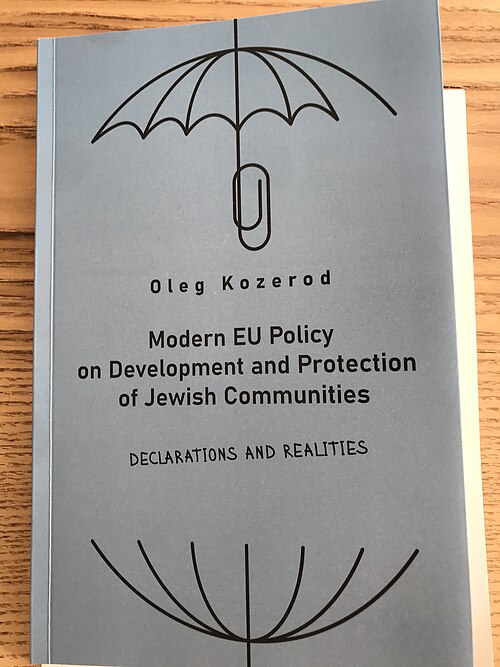
Oleg Kozerod’s monograph addresses one of the most urgent political and ethical challenges in contemporary Europe: the protection, security, and sustainable development of Jewish communities within the framework of European Union policy. Against the background of the resurgence of antisemitism, radicalization, geopolitical conflicts, and post-pandemic social polarization, the book intervenes in a field that lies at the intersection of political science, Jewish studies, human rights law, and memory studies.
The work is particularly timely in light of the EU Strategy on Combating Antisemitism and Fostering Jewish Life (2021–2030), as well as the dramatic escalation of antisemitic incidents following the events of 7 October 2023. The monograph positions itself as both an analytical and normative contribution to the debate on minority protection in Europe.
Structure and methodology
The study is methodologically interdisciplinary, combining:
- political-institutional analysis,
- historical contextualization,
- legal-normative evaluation,
- sociological observation,
- and cultural-religious analysis.
The book is structured into four main analytical blocks:
- EU policy toward the “Jewish question” (2015–2023),
- Jewish communities in Western Europe,
- Jewish communities in Eastern Europe,
- Post–7 October 2023 political developments.
This structure allows for both macro-level (EU institutions, strategy frameworks) and micro-level (national case studies, community developments) analysis. The empirical basis includes EU documents, national legislation, NGO reports, sociological surveys, and public policy statements.
Key contributions
The monograph makes several significant scholarly contributions:
- Systematic analysis of the EU Strategy (2021–2030): Kozerod offers one of the most detailed post-implementation analyses of this framework in current scholarship, highlighting both its political novelty and structural limitations.
-Comparative national case studies: The detailed examination of France, Germany, Austria, Spain, Portugal, the Netherlands, Poland, and others provides a valuable comparative perspective on how EU norms are translated into national practice.
- Identity and demographic transformation: The analysis of Jewish identity in Europe, migration trends, and generational change is empirically grounded in large-scale sociological surveys.
Religious freedom under pressure: The discussion of circumcision (Brit Milah) and ritual slaughter (Shechita) bans is one of the most important normative-legal sections of the book.
Post–7 October 2023 developments: The author is among the first to systematically document the political, security, and societal consequences of the Gaza–Israel escalation for European Jewish communities.
Critical assessment
From a scientific standpoint, the work is characterized by:
- a broad empirical foundation,
- strong document-based analysis,
- normative clarity regarding antisemitism and minority protection.
Some sections, particularly those dealing with geopolitical interpretations and pro-Palestinian activism, adopt a pronounced normative tone. While this does not undermine the analytical value, it occasionally shifts the balance from descriptive political science to advocacy-oriented interpretation. A more explicit engagement with competing theoretical perspectives on political conflict and identity politics could further strengthen the academic neutrality.
Nevertheless, the author’s clear ethical positioning corresponds to the subject matter and is consistent with traditions in human rights scholarship.
Scholarly and practical significance
Kozerod’s monograph is of high relevance for:
- political scientists (EU governance, minority policy),
- historians of contemporary Jewish life,
- legal scholars in human rights and religious freedom,
- policymakers and public administrators,
- Jewish community leaders and civil society actors.
The book not only documents policy developments but also formulates concrete normative benchmarks for evaluating the credibility of EU minority protection.
Overall evaluation
This monograph represents a substantial and timely contribution to European Jewish studies and EU policy research. It succeeds in combining empirical breadth with moral responsibility and political relevance. Despite minor theoretical imbalances, the book stands as a key reference work for understanding the current state and future prospects of Jewish life in Europe under the evolving framework of EU governance.
Kozerod O. Modern EU policy on development and protection of Jewish communities: declarations and realities. Warsaw: European World Publishing, 2023. 185 pp. ISBN: 978-83-66813-06-9
Naomi Atkin