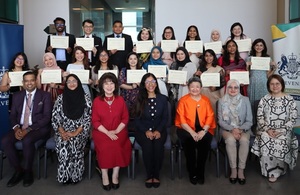
Twenty Malaysian professionals and emerging leaders are preparing to begin postgraduate studies in the United Kingdom after securing places on the prestigious Chevening scholarship
programme for the 2026–27 academic year.
The new scholars were welcomed at a pre-departure briefing and reception hosted by the British High Commission in Kuala Lumpur on 21 August, ahead of their departure for Britain in September.
The latest cohort reflects several notable changes in Malaysian participation. Five scholars come from East Malaysia, including three from Sarawak and two from Sabah, up from three recipients in the previous intake. They account for a quarter of the 2026–27 cohort, representing the highest proportion of scholars from East Malaysia in recent years.
There has also been a significant shift in the geographical choices of Malaysian scholars. Eight recipients — 40% of the new cohort — will study at universities in Scotland, compared with just three in 2025. The figures point to growing interest in leading institutions outside London and a broader geographical spread of Malaysian students across the UK.
Acting Deputy British High Commissioner to Malaysia Ruzina Hasan told the scholars that the programme was designed not only to provide access to leading British universities, but also to develop international networks and future leadership.
“Through Chevening, we invest in people with the talent, ambition and purpose to make a difference in their communities and beyond,” she said.
Hasan added that the UK was proud to support a new generation of Malaysian leaders by combining academic opportunities with cultural experiences and long-term international connections.
She described education as one of the most enduring elements of the relationship between the two countries, saying decades of academic cooperation and people-to-people links had helped make education a central pillar of UK–Malaysia relations.
The scholars selected for the new intake will study a diverse range of postgraduate subjects, reflecting challenges facing Malaysia and the wider international community. Their programmes include war and psychiatry, infection and immunity, sustainable engineering, international relations, applied theatre, cybersecurity and machine learning.
For many of the recipients, the scholarship represents an opportunity to bring specialist international expertise back to Malaysia.
Daniella Lupi Balan, from Sarawak, will study international relations at the University of Edinburgh. Her professional experience in Sarawak's development sector, combined with her background as a member of the Kayan community in Belaga, has shaped her interest in inclusive and sustainable development.
She said her experiences had demonstrated both the benefits of development and the inequalities that can emerge when local communities are not adequately represented in decision-making. She plans to use her studies in Edinburgh to contribute to Sarawak's green economy transition and strengthen international cooperation when she returns home.
Healthcare is another major area represented in the cohort. Adilah Binti Aidit, a family medicine specialist who will study infection and immunity at University College London, hopes to use her academic experience to improve infectious disease services in Malaysia.
Her work in HIV care, community outreach and national health guideline development has highlighted the continuing challenges faced by vulnerable patients, including stigma and unequal access to treatment. At UCL, she aims to deepen her expertise in infectious diseases and public health and eventually apply that knowledge to Malaysian healthcare policy and practice.
Another scholar, Dr Muhammad Farhan Nordin, will undertake an MSc in War and Psychiatry at King's College London. His interest in military and disaster psychiatry has been shaped by his experience responding to the Ranau earthquake, as well as his subsequent work as a reserve army officer and psychiatry lecturer.
He said the psychological resilience of soldiers and emergency responders was as important as physical preparedness when countries faced disasters and other crises. He intends to use his studies and the international networks developed through Chevening to contribute to research, training, guidelines and mental-health support for frontline personnel in Malaysia.
Sustainability and the energy transition are also prominent themes among the new scholars.
Prashanthini Sunderan, the second Malaysian recipient of the Chevening ASEAN Scholarship, will study engineering for sustainable development at the University of Cambridge.
With nearly two decades of experience in the energy sector, she plans to focus on the practical challenges of reducing carbon emissions while maintaining energy security and supporting economic growth.
Her studies at Cambridge will explore how technology, economics, public policy and social considerations can be combined to help industries move towards lower-carbon models. She hopes to apply that expertise to Malaysia's energy transition, particularly in sectors where decarbonisation is considered difficult.
The Chevening programme is funded and administered by the UK government's Foreign, Commonwealth & Development Office. In Malaysia, it is supported by corporate and philanthropic partners including YTL Foundation, Jeffrey Cheah Foundation, Yayasan Khazanah and CIMB Foundation, while UK universities also contribute funding.
Malaysia is currently the second-largest recipient of Chevening awards in the Association of Southeast Asian Nations, with more than 2,000 Chevening alumni now living and working in the country.
The UK government has also reiterated its commitment to welcoming international students, maintaining Britain as a major destination for postgraduate education.
Malaysians interested in applying for Chevening scholarships for the 2027–28 academic year can submit applications before the 6 October 2026 deadline. The programme offers fully funded opportunities for eligible candidates to pursue postgraduate study at universities across the UK while building professional and international networks that can continue long after graduation.