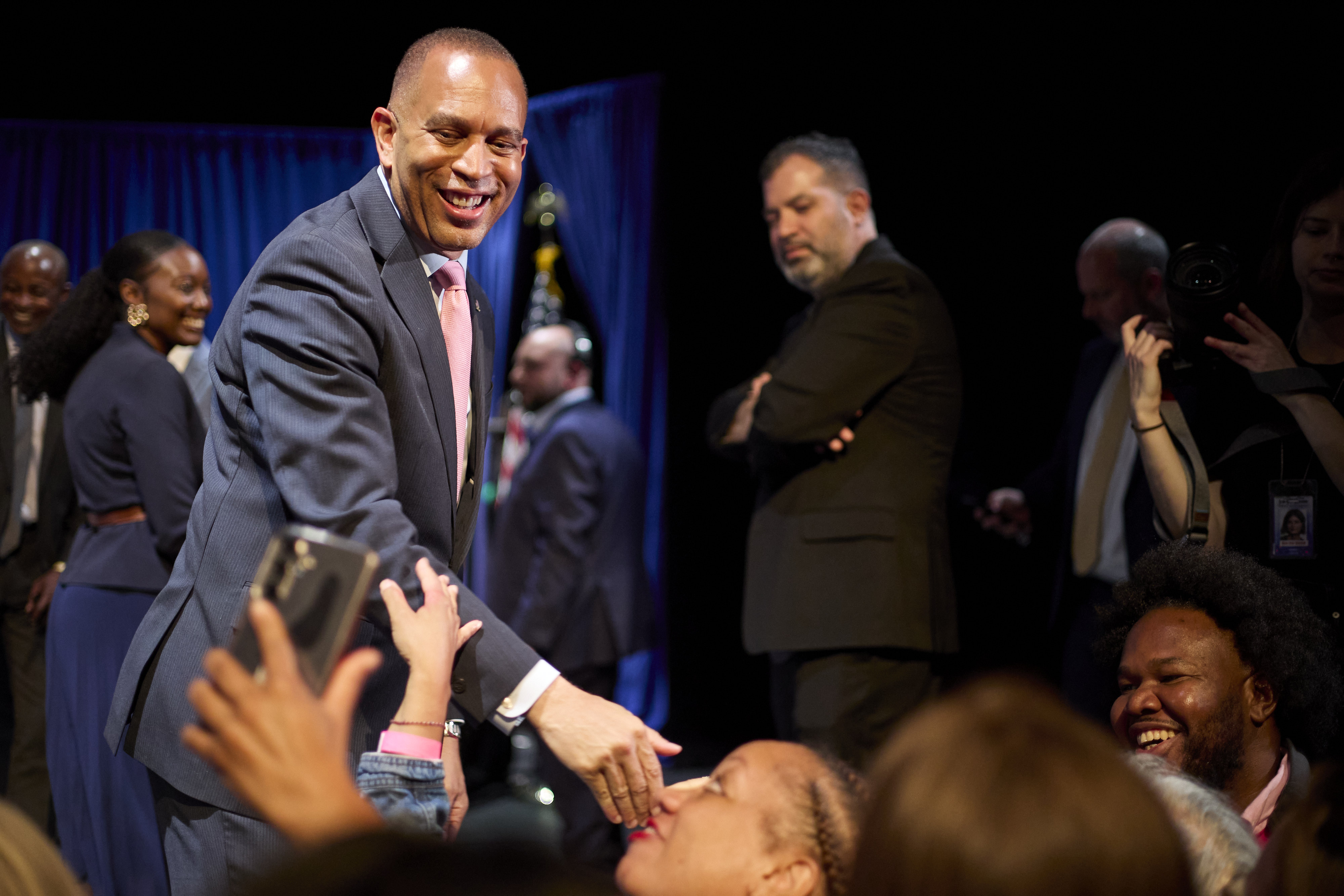
Hakeem Jeffries is on course to become the first Black Speaker of the US House of Representatives after Democrats secured a victory in the 2026 midterm elections, setting the stage for a
major political shift in Washington. His expected elevation to the chamber’s top position will bring both historic significance and a formidable political challenge: confronting President Donald Trump while maintaining unity within a party divided between moderates and progressive lawmakers.
Jeffries, who represents a congressional district in New York City, is expected to lead the Democratic majority when the newly elected Congress convenes in early January. His party’s success would end four years of Republican control of the House and give Democrats the opportunity to reshape the legislative agenda.
“The American people have spoken,” Jeffries declared in a victory address on Tuesday night, following projections that Democrats would regain control of both chambers of Congress.
“Today begins the great American comeback,” he said, describing the election result as a rejection of what he characterised as Republican extremism and corruption.
The Democratic leader has pledged to prioritise economic concerns, particularly the rising cost of living facing working families. Among his proposed legislative priorities is reversing major cuts to Medicaid, the healthcare programme serving low-income Americans and people with disabilities. The reductions were enacted into law on July 4, 2025, under the Trump administration.
Jeffries argued that voters had delivered a clear message to Washington, demanding a Congress that would focus on their everyday needs rather than partisan conflict.
A new Democratic majority prepares to challenge Trump
Beyond domestic economic policy, Jeffries has indicated that a Democratic-controlled House would intensify scrutiny of the Trump administration’s activities, particularly its relationships with major corporations and wealthy political donors.
Democrats have signalled that congressional investigations could examine business interests connected to Trump’s campaigns and projects. However, Jeffries has so far avoided committing to a third attempt to impeach the president.
California Representative Robert Garcia, who is expected to take over as chairman of the House Oversight Committee, offered a more confrontational message following the election.
“Lawyer up,” Garcia said in a statement on election night, signalling the prospect of aggressive investigations into the administration.
The precise size of the Democratic majority remains uncertain, as votes continue to be counted across the country. The final balance of power will determine how much legislative freedom Jeffries has and how effectively he can advance the party’s priorities.
The House speaker occupies one of the most influential positions in American government. The speaker oversees the 435-member chamber, determines which bills receive consideration and plays a central role in shaping the legislative agenda. The office also places its holder second in the presidential line of succession, after Vice President JD Vance.
Democratic lawmakers are expected to meet later this month to select their nominee for the speakership. Jeffries is widely regarded as the overwhelming favourite, with Democratic aides indicating that no serious challenger has emerged.
The full House will elect its next speaker when the new Congress begins in January. Republicans are expected to nominate their own candidate, although the party’s loss of its majority makes a successful bid highly unlikely.
Balancing progressive demands and moderate priorities
Despite his strong position within the Democratic Party, Jeffries faces a potentially difficult task in securing the support of every member of his caucus.
Several progressive lawmakers have expressed reservations about his leadership and are demanding stronger commitments on issues ranging from healthcare to housing and foreign policy.
Among them is New York Representative-elect Darializa Avila Chevalier, who declined to endorse Jeffries during a September 30 interview with Vanity Fair.
Instead, she outlined a series of policy conditions for the next speaker, including voting rights reforms, increased investment in public housing, restrictions on offensive weapons transfers to Israel and the introduction of universal healthcare.
These demands highlight the ideological divisions Jeffries will need to navigate as he seeks to consolidate Democratic support.
His political position could prove particularly complicated on healthcare and the Middle East. Pro-Israel organisations rank among his major campaign contributors, while Jeffries has been cautious about proposals for a “Medicare for All” system.
The universal healthcare initiative has faced resistance from moderate Democrats, who argue that its financial implications could make it politically and economically difficult to implement.
Michele Swers, a professor of American government at Georgetown University, said Jeffries would have to negotiate carefully with the progressive wing of his party.
“The question is what he has to give them to get them on board,” she said.
However, moving too far towards the left could create a different problem, potentially alienating moderate Democrats whose support will be essential to maintaining a functioning majority.
Affordability at the centre of the agenda
At 56, Jeffries has built a reputation as a consensus-oriented leader who seeks to unite competing factions within the Democratic caucus.
His approach differs from the more centralised leadership style associated with former House Speaker Nancy Pelosi, although Jeffries has demonstrated a willingness to use sharp rhetoric when seeking to rally his colleagues against Republican opponents.
The election result places him at the centre of a new political confrontation in Washington. With Democrats preparing to take control of the House, Jeffries will be expected to translate electoral success into tangible policy outcomes while holding together a diverse coalition of lawmakers.
For the incoming speaker, the immediate challenge will be to demonstrate that Democrats can respond to voters’ economic concerns, scrutinise the Trump administration and maintain party discipline.
His ability to balance those competing priorities could determine not only the effectiveness of the next Congress, but also the political direction of the Democratic Party ahead of the next presidential election. Photo by Peglet00, Wikimedia commons.