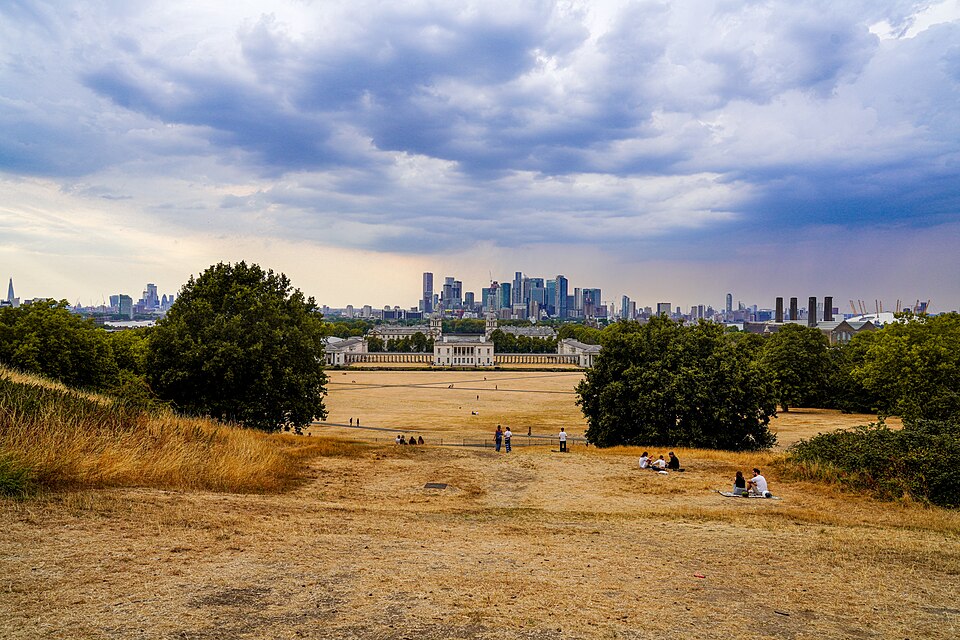
Almost three-quarters of England has now been placed in drought after the country recorded its driest July in more than a century, with officials warning that water resources are
deteriorating rapidly and another spell of hot, dry weather could deepen the crisis.
The East Midlands, Lincolnshire and Northamptonshire, Kent and East Sussex, and Solent and the South Downs were moved into drought status on Monday following an emergency meeting of the National Drought Group.
The latest measures mean 71.3 per cent of England is now officially in drought, affecting around 45 million people. More than 27 million people are already living in areas where temporary restrictions on water use are in force.
The North East and Yorkshire have also entered a period of prolonged dry weather — the stage immediately before drought. No part of England is now classified as being in normal water-resource conditions.
The Environment Agency said the country is experiencing what it describes as a “flash drought”, driven by exceptionally low rainfall combined with high temperatures.
The deterioration follows an extraordinary July. England recorded its driest July in 190 years, while some parts of south-east England received barely 1 per cent of their normal rainfall. In parts of Hampshire, the Isle of Wight and West Sussex, there has been no rain for 59 days.
August has so far offered little relief, with only about 5 per cent of expected rainfall recorded. Forecasts suggest that another heatwave could push temperatures into the mid-30s Celsius in parts of England this week.
Tony Grayling, strategic drought lead at the Environment Agency and chair of the National Drought Group, said the situation would not improve without substantial and sustained rainfall.
“Drought conditions are worsening and will continue to do so until we see significant and sustained rainfall,” he said.
Grayling said the prolonged heat and lack of rain were already taking a serious toll on agriculture and the natural environment, urging households to reduce unnecessary water use.
“Every drop we can save is a drop more for your local farmers, local wildlife and local rivers,” he said.
Rivers and reservoirs falling
The pressure on England’s water system is becoming increasingly visible.
Reservoir storage has fallen to 69 per cent, around 11.6 per cent below the level normally expected at this point in the year. Storage dropped by 16 per cent during July alone — the largest July decline recorded in at least three decades.
River flows are also deteriorating. Only 14 per cent of monitored rivers are currently at normal levels, while 22 per cent are classified as exceptionally low. The Avon, Wye, Ely Ouse and Exe are among those affected.
Water temperatures are rising alongside falling river levels, creating dangerous conditions for fish and other aquatic life. Temperatures have reached 28C in the River Misbourne in Buckinghamshire, while the Hampshire Avon and River Trent have reached 27C.
Warmer water contains less dissolved oxygen, increasing the risk of fish deaths and forcing authorities to carry out emergency rescues.
The Environment Agency has already recorded 134 incidents linked to drought and dry weather this year, approaching the levels seen during the major droughts of 2022 and 2025.
There have also been 26 navigation closures and 19 restrictions across the Canal & River Trust network because of water shortages, with further closures possible if rainfall does not return.
Natural England has reported 245 wildfires on Sites of Special Scientific Interest this year, while wetlands and sensitive peatlands are drying out.
Farmers face mounting losses
Agriculture is among the sectors feeling the effects most sharply.
Farmers have reported some of their earliest harvests in two decades, alongside reduced yields. Livestock producers are already using winter forage because grass growth has stalled, raising concerns about milk production and the availability of feed.
In East Anglia, restrictions on agricultural water abstraction are increasing. More than 1,500 irrigation restrictions are now in place, while hundreds of abstractors are being required to cut the amount of water they take from rivers by half.
In Norfolk, 14 abstractors in the Wensum catchment have been forced to stop taking water because river flows have fallen too low.
Paul Tompkins, deputy president of the National Farmers’ Union, warned that the absence of meaningful rainfall in the coming weeks would make an already difficult situation worse.
Farmers, he said, were facing early harvests, poor yields and growing difficulties in maintaining crops and livestock.
The NFU is calling for a more responsive water-licensing system, greater investment in reservoirs and irrigation infrastructure, and additional support to help agriculture adapt to increasingly volatile weather.
“Water plays a crucial role in food security and the resilience of our nation,” Tompkins said.
Water restrictions reach millions
Eight water companies have introduced Temporary Use Bans, commonly known as hosepipe bans, affecting more than 27 million customers.
The companies are Affinity Water, Anglian Water, Cambridge Water, Essex & Suffolk Water, Southern Water, South East Water, Thames Water and South West Water.
Early evidence suggests the restrictions are working: some companies have recorded reductions in public water demand of up to 9 per cent.
The government, however, is putting pressure on water companies to address another persistent problem — leakage.
Water Minister Emma Hardy said companies must take every available measure to reduce leaks, particularly as dry soils can cause pipes to move and become more vulnerable to failure.
She also said ministers were considering additional measures to help farmers, including making it easier to construct on-farm irrigation reservoirs.
Longer-term plans include nine new reservoirs and water-transfer schemes, alongside measures intended to accelerate the construction of large-scale water infrastructure.
Southern Water has applied for two Drought Orders. One would allow normal abstraction from the River Test despite low flows, while the other would impose additional restrictions on non-essential water use. Both applications are being considered by Defra.
A drought becoming increasingly familiar
The current crisis is particularly striking because it is not an isolated event.
England has experienced three droughts in just five years — in 2022, 2025 and 2026 — raising fresh questions about whether the country's water infrastructure is equipped for a changing climate.
The Met Office said July 2026 was an exceptional month in the UK's climate record, with both England and Wales recording their driest and sunniest July on record alongside periods of unusually high temperatures.
Sarah Davies, the Met Office's head of environment and energy, said the weather had placed significant additional pressure on water resources.
Forecasts for the remainder of August and into September currently point towards further periods of dry weather, interspersed with unsettled spells. Although some areas could receive useful rainfall, there is no strong indication of the prolonged, widespread rain needed to reverse the drought.
That leaves England facing a difficult balance: maintaining water supplies for households and agriculture while protecting rivers, wetlands and wildlife.
Pressure on wildlife intensifies
The ecological consequences are already becoming increasingly apparent.
Fish rescues have been carried out across the country, including 38 in the West Midlands alone, where Atlantic salmon and brown trout have been among the species affected.
Wildlife groups are also reporting problems for breeding birds, amphibians and white-clawed crayfish, a species that has yet to fully recover from previous droughts.
Mark Owen, head of fisheries at the Angling Trust, said rising temperatures and falling river levels were creating increasingly dangerous conditions for freshwater species.
Anglers, he said, were often among the first to identify fish in distress and could play an important role in alerting authorities.
The Environment Agency is releasing water from strategic reservoirs and groundwater sources to maintain river flows, support navigation and protect the environment. In Lincolnshire, the Trent Witham Ancholme River Transfer Scheme can move the equivalent of 60 Olympic-sized swimming pools of water each day when required.
But such measures provide only temporary relief.
The fundamental problem remains the lack of rainfall.
Another heatwave threatens
England has already recorded 34 days this year when temperatures reached at least 30C somewhere in the country, including 13 consecutive days during July.
The combination of heat and drought creates a vicious cycle: dry conditions reduce available supplies while higher temperatures increase demand for water.
A high-pressure system is now raising the risk of another period of hot and dry weather, with the UK Health Security Agency maintaining heat alerts.
Waterwise chief executive Nicci Russell said the drought should be treated as a warning of a changing climate rather than a temporary anomaly.
The immediate message from officials is straightforward: use less water wherever possible.
Turning off taps while brushing teeth, repairing leaking toilets, shortening showers and avoiding unnecessary hosepipe use can all help conserve supplies.
But with reservoirs falling, rivers running exceptionally low and farmers already reporting serious losses, the scale of the challenge goes well beyond household water use.
England now needs sustained rainfall — and there is little sign of it arriving soon. Photo by Alisdare Hickson, Wikimedia commons.