UK house prices recorded a stronger-than-expected rise in March, offering a brief boost to a housing market increasingly under pressure from rising borrowing costs and global uncertainty.
Figures released Tuesday by mortgage lender Nationwide showed that house prices climbed by 0.9% month-on-month — the fastest increase since December 2024. The jump sharply exceeded economists’ expectations of a 0.1% decline and marked a notable acceleration from February’s modest 0.3% rise.
On an annual basis, prices were up 2.2%, the strongest growth since October and a clear improvement from February’s 1.0% increase.
According to Robert Gardner, the data suggests the housing market had begun to regain momentum after a sluggish start to the year. However, that recovery may prove short-lived.
Rising geopolitical tensions, particularly linked to the Iran war, have driven up global energy prices and, in turn, increased borrowing costs. This is now feeding through to mortgage rates, raising concerns about affordability for prospective buyers.
Separate data from the Bank of England showed mortgage approvals picked up more than expected in February, indicating underlying resilience. Yet other indicators point to growing caution, with buyer demand beginning to soften as financial pressures mount.
UK Finance Minister Rachel Reeves has acknowledged the uncertainty, noting it is too early to fully assess the economic impact of the conflict. She also signaled that targeted support for households could be considered if conditions worsen.
Economists are increasingly revising their outlook. Ashley Webb warned that higher mortgage rates and weak economic growth are likely to limit house price gains this year. His firm has downgraded its forecast from a 3.5% increase to closer to 1% growth — or even stagnation.
Financial markets currently expect a significant chance that the Bank of England will raise interest rates to around 4% in the coming months, with further increases possible into 2026. However, many economists believe the central bank may hold rates steady if economic growth continues to falter.
UK real estate market: bigger picture
The UK housing market is now at a turning point, shaped by three key forces:
- Mortgage Affordability Crunch
Mortgage rates remain well above the ultra-low levels seen during the pandemic era. Even small increases in interest rates significantly impact monthly payments, reducing buyer purchasing power and cooling demand.
- Supply Constraints vs. Weak Demand
While demand is softening, supply remains tight — particularly in high-demand regions like London and the South East. This imbalance is preventing sharp price declines, even as activity slows.
- Construction Slowdown
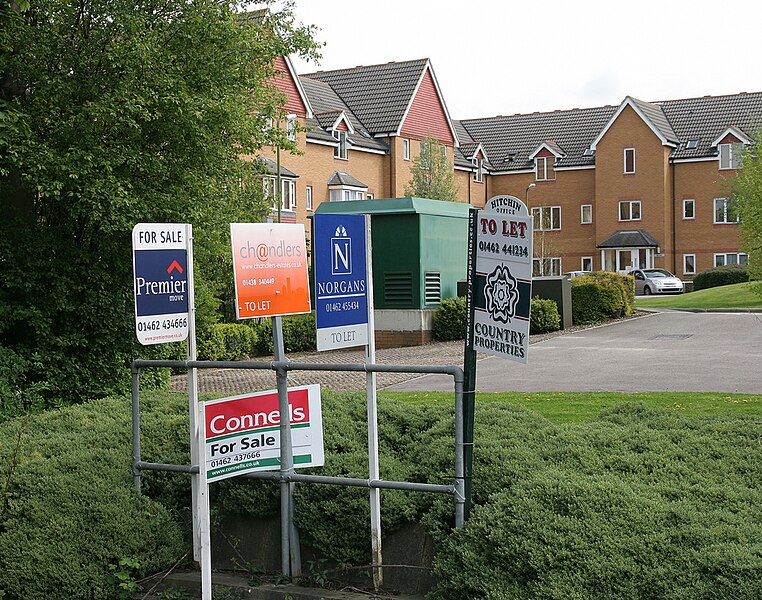
Data from S&P Global highlights a prolonged contraction in the construction sector, with housebuilding activity declining sharply. This poses a challenge for Prime Minister Keir Starmer and his plans to accelerate housing development. Photo by I See Modern Britain, Wikimedia commons.