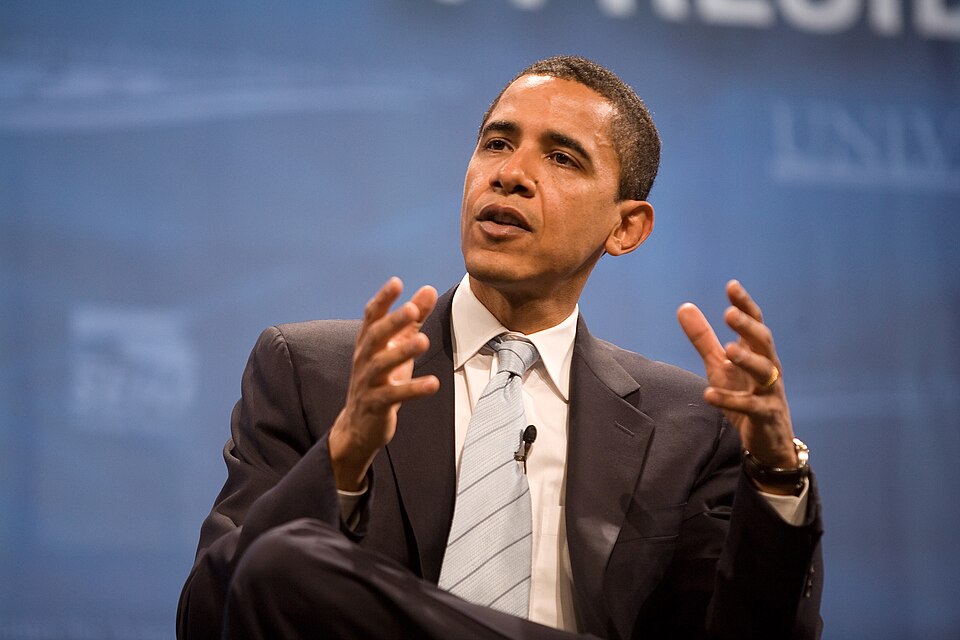
Former US President Barack Obama has launched a sharp assault on Donald Trump’s administration, accusing the Republican president of corruption, criticising his handling of the conflict
with Iran and mocking the lavish redesign of the White House as he campaigns to boost Democratic prospects ahead of the November 3 midterm elections.
Speaking at rallies in Cleveland, Ohio, and Detroit, Michigan, Obama urged voters to use the elections to restore accountability in Washington and limit what he described as damaging decisions by the current administration.
With just ten days remaining before Americans head to the polls, the former president sought to turn the contest into a referendum on Trump’s leadership. Control of Congress is at stake, with the balance of power finely poised.
Addressing supporters in Michigan, Obama campaigned for Democratic Senate candidate Abdul El-Sayed, who is challenging Republican Mike Rogers, a former member of the House of Representatives. He described the election as an opportunity to introduce a political check on the president’s authority.
Obama called on voters to activate a political “circuit breaker” that could curb what he characterised as excesses and mismanagement under Trump.
“We got to flip that circuit breaker, bring some accountability to this government,” Obama told the crowd.
The former president, who served from 2009 to 2017, remains an influential figure among Democratic voters. His involvement in the campaign reflects the party’s efforts to energise its supporters and strengthen its position in competitive congressional races.
Obama focused much of his criticism on allegations that Trump and his political allies have blurred the boundaries between public office and private financial interests. He accused the administration of exploiting political power for personal benefit and argued that Republicans had failed to hold the president accountable.
“We have never seen a president excel in straight-up grifting, on your dime, like this,” Obama said, adding that Trump appeared unusually focused on using his position to secure favours.
He also argued that the Republican Party had increasingly come to represent corruption, administrative incompetence or a retreat from effective government.
The White House had not immediately responded to a request for comment.
Obama’s accusations come amid public concerns about the relationship between the president’s business interests and his policy decisions. An August Reuters/Ipsos poll found that 63% of Americans believed Trump and his family had improperly profited from cryptocurrency since his return to the White House the previous year. The same survey found that 69% thought his decisions as president were influenced by his private business dealings.
Foreign policy was another major target of Obama’s speech. He challenged the administration’s portrayal of its campaign against Iran as a success, arguing that the conflict had instead strengthened Tehran’s strategic position.
Obama pointed to Iran’s ability to threaten commercial shipping through the Strait of Hormuz, a critical passage for international oil supplies. Such threats, he argued, had increased uncertainty for energy exporters and given Tehran greater influence over global markets.
“Iran now has veto power over the Strait of Hormuz, where oil goes through to get to the world,” he said.
The former president also ridiculed what he portrayed as misplaced priorities within the administration, taking aim at Defence Secretary Pete Hegseth over his public emphasis on the physical appearance and testosterone levels of American military personnel.
Obama’s criticism extended to the White House’s decorative changes, which he described as excessive and lacking in taste. In a sarcastic comparison, he likened the renovated surroundings to a combination of Saddam Hussein’s opulence and an American restaurant chain.
The remarks formed part of a broader effort to portray Trump’s presidency as focused on personal image and spectacle rather than the issues affecting ordinary Americans.
For Democrats, Obama’s appearances offer an opportunity to mobilise voters at a decisive moment in the campaign. His popularity among the party’s supporters makes him a prominent campaign surrogate as candidates seek to turn dissatisfaction with the administration into votes.
The November 3 elections will determine the composition of Congress and shape the political environment for the remainder of Trump’s term. A shift in control could give Democrats greater leverage over legislation and oversight of the administration, while a Republican victory would strengthen the president’s ability to advance his agenda.
Obama’s intervention underscores how the midterms have become a wider contest over Trump’s leadership, economic and foreign policy decisions, and the limits of presidential power. Photo by Center for American Progress Action Fund from Washington, DC, Wikimedia commons.