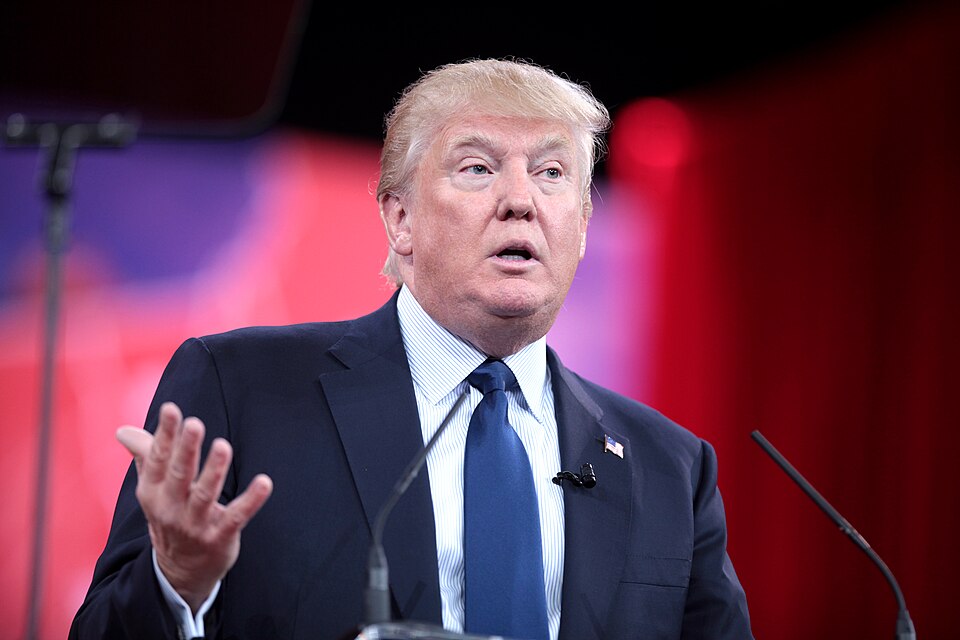
US President Donald Trump has arrived in Manila for a series of high-level diplomatic meetings aimed at reinforcing American influence in the Indo-Pacific, ahead of a closely watched visit
to China that is expected to put relations between Washington and Beijing back in the international spotlight.
The Asian tour comes at a particularly sensitive moment for the US administration. Washington is facing growing economic and strategic competition with China, while disagreements over technology exports, artificial intelligence and trade restrictions are threatening to undermine a fragile truce in the two countries' trade dispute. The trip also follows a difficult period in US domestic politics, including Republican losses in the midterm elections and renewed controversy surrounding allegations of espionage.
Trump's first major engagement in Manila will be a meeting of the Quadrilateral Security Dialogue, better known as the Quad, bringing together the leaders of the United States, Japan, Australia and India. The gathering is particularly significant because it will be the first meeting of the four countries' leaders in two years and Trump's first participation in the format.
The Quad has become an important element of Washington's Indo-Pacific strategy, providing a framework for cooperation on maritime security, economic resilience, emerging technologies and regional stability. Although its members insist that the initiative is not directed against any particular country, Beijing has repeatedly viewed the grouping with suspicion, regarding it as an attempt to limit China's growing influence.
The Manila discussions are expected to cover critical minerals, artificial intelligence, restrictions on technology exports, maritime security and the diversification of strategic supply chains. Undersea communications infrastructure and cooperation on disaster response are also likely to feature on the agenda.
The timing of the meeting is politically important. By demonstrating solidarity with its Asian partners before travelling to China, the Trump administration is seeking to underline that its engagement with Beijing will take place alongside continued cooperation with regional allies.
Following the Manila meetings, Trump is scheduled to travel to China to attend the Asia-Pacific Economic Cooperation (APEC) forum in Shenzhen, hosted by Chinese President Xi Jinping. The visit is expected to be one of the most closely watched diplomatic events of the year, particularly given the economic and geopolitical tensions between the world's two largest economies.
The programme is also expected to include a high-profile trilateral meeting involving Trump, Xi Jinping and Russian President Vladimir Putin. Such a gathering would bring together three of the world's most influential political leaders at a time when international security, trade and relations between major powers remain deeply unsettled.
Trade and technology are likely to dominate the discussions between Washington and Beijing. US restrictions on China's access to advanced artificial intelligence chips have added another complication to efforts to maintain the existing trade understanding. Both countries have strong incentives to avoid a renewed escalation, given the consequences for global supply chains, investment and economic growth.
The Chinese leadership, meanwhile, is keen to present Beijing as a defender of international trade and economic cooperation. Speaking at the ASEAN summit, Chinese Premier Li Qiang highlighted the expanding economic relationship between China and Southeast Asia, arguing that countries should resist external pressure and strengthen cooperation in the face of global trade restrictions.
China remains ASEAN's largest trading partner and an important source of investment. Nevertheless, governments across the region are seeking to maintain close economic relations with Beijing while preserving their security and commercial partnerships with the United States.
The strategic importance of the Quad was also emphasised by former US Deputy Secretary of State Kurt Campbell, who argued that the meeting could send an important message before Trump's engagement with the Chinese and Russian leaders. He particularly stressed the importance of the US-Japan relationship as a foundation of American policy in Asia.
Japanese Prime Minister Sanae Takaichi has meanwhile pledged a more active Japanese role in regional affairs. Speaking during the ASEAN meetings, she called for stronger economic and energy resilience, closer cooperation on critical minerals and more robust supply chains in response to growing geopolitical uncertainty and the rapid development of artificial intelligence.
Trump's Manila visit also has a bilateral economic dimension. He is expected to sign a joint statement with Thai Prime Minister Anutin Charnvirakul concerning progress towards a reciprocal trade agreement. The United States is Thailand's largest export market, accounting for approximately 24% of its shipments this year.
Before departing for China, Trump is also scheduled to meet Philippine President Ferdinand Marcos Jr, reaffirming Washington's relationship with a key regional defence partner.
The visit to Asia therefore represents more than a sequence of diplomatic engagements. It is an attempt by the Trump administration to balance competition with China against the need to preserve economic stability, reassure traditional allies and maintain American influence across the Indo-Pacific. The outcome of the discussions in Manila and Shenzhen could have significant implications for the future of regional security, international trade and relations between Washington, Beijing and Moscow.
The China leg is particularly consequential because the White House has confirmed that Trump will hold bilateral talks with Xi Jinping before joining an unprecedented three-way meeting with Putin. The trilateral discussions, scheduled for November 19 in Shenzhen, are expected to focus on nuclear arms reduction and the war in Iran. US officials have cautioned that Washington does not anticipate a concrete agreement emerging from the encounter. The conflict in Ukraine is reportedly not on the planned agenda.
The Chinese visit will also bring together senior American and Chinese business representatives at the APEC summit, highlighting the importance of commercial relations alongside political and security negotiations. Executives from major companies, including Boeing, Visa, Mastercard and Google, are expected to participate, while China's delegation includes representatives of leading technology, banking and manufacturing groups. Photo by Gage Skidmore from Peoria, AZ, United States of America, Wikimedia commons.