Jamaica has stepped up its campaign for slavery reparations by formally asking King Charles to obtain legal advice on whether Britain could be required to compensate the
country for the historic enslavement of Africans.
The move brings a highly sensitive question about Britain’s colonial past directly into the orbit of the Crown and Westminster, despite the UK government’s firm insistence that it will not pay reparations.
Jamaica’s Culture Minister Olivia Grange said she was encouraged by the engagement of Buckingham Palace as a Jamaican delegation submitted a petition asking the Judicial Committee of the Privy Council to consider three legal questions relating to the transatlantic slave trade.
The committee, the final court of appeal for several Commonwealth countries and British overseas territories, is being asked to examine whether the transportation and enslavement of Africans in Jamaica was lawful and whether Britain has a legal obligation to provide a reparatory remedy.
"We're not pre-empting the process, but we are encouraged," Grange told Reuters shortly before the petition was filed.
The intervention puts the King in an increasingly complicated constitutional and political position. Charles remains Jamaica's head of state, although the Caribbean country has been moving towards replacing the monarchy with a republic.
At the same time, the Palace has sought to distinguish the King's personal views from the question of government policy.
A Buckingham Palace spokesperson said Charles remained personally committed to increasing understanding of slavery and to finding ways of addressing "historic wrongs" for communities today.
The King has previously acknowledged the legacy of slavery. Speaking to Commonwealth leaders in 2022, he expressed deep sorrow over the suffering caused by the slave trade and slavery.
But there is no indication from the Palace that Charles supports Jamaica's demand for financial compensation.
Westminster says no to reparations
The British Government has taken a considerably harder line.
A spokesperson for Prime Minister Andy Burnham said the UK "does not and will not pay reparations", while describing the transatlantic slave trade as "abhorrent".
That position is likely to remain a major obstacle to Jamaica's campaign.
Supporters of reparations argue that the economic and social consequences of slavery did not disappear when the institution was abolished and that former colonial powers have a responsibility to help address its continuing impact.
Jamaica says the legacy remains visible in its economic development and social inequalities.
"There's so much that has impacted negatively on Jamaica as a result of the enslavement of our ancestors," Grange said. "We feel it is important that going forward there is some support that would help us to build back stronger."
The Jamaican initiative has received backing from the Caribbean Community and Ghanaian President John Dramani Mahama, giving the campaign broader regional and international support.
It also comes shortly after a UN committee said states had legal obligations to consider reparations and other measures addressing the enduring consequences of the transatlantic slave trade.
A battle moving into British politics
The reparations debate has increasingly become politically charged in Britain.
Reform UK leader Nigel Farage has previously proposed restricting visas for nationals of countries seeking reparations, including Jamaica — a position that illustrates how sharply divided the British political debate has become.
Critics of reparations argue that modern governments and institutions should not be held legally responsible for actions committed centuries ago.
Jamaica, however, believes the international debate is moving in its direction.
"There's a global trend where there is more support for reparatory justice," Grange said. "There will always be some negative responses, but we stay focused."
The legal petition could now add a new dimension to a debate that has largely been political and historical. By seeking a judicial examination, Jamaica is attempting to move the argument from questions of morality and diplomacy towards the question of legal responsibility.
For the British Government, that creates an awkward challenge: how to maintain its categorical rejection of reparations while the issue is increasingly being framed not simply as a historical grievance, but as a potential question of law.
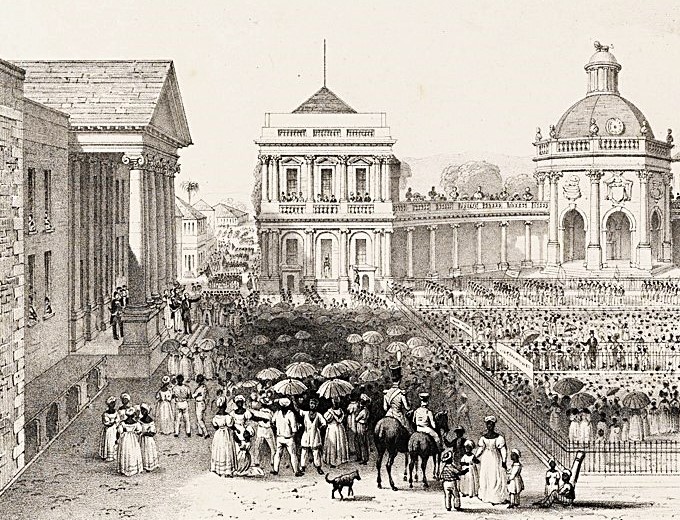
And for the King, Jamaica's action places the monarchy at the centre of an unresolved debate about Britain's imperial past — at precisely the moment when some Commonwealth countries are reconsidering their constitutional ties to the Crown. Photo by Thomas Ashburton Picken, Wikimedia commons.