A quarter of a century after the attacks that reshaped American foreign policy, voters now see home-grown extremism as a greater terrorist threat than violence organised from abroad,
a new Reuters/Ipsos poll suggests.
Twenty-five years after September 11 transformed America's understanding of national security, the country's perception of terrorism has undergone a striking reversal.
The threat that once came overwhelmingly from abroad is now increasingly viewed as a danger from within.
A new Reuters/Ipsos poll found that 33% of Americans regard domestic terrorism as the biggest threat to the safety of ordinary people, compared with 20% who identify foreign terrorism. A further 42% say random acts of violence, including mass shootings, represent the greatest danger.
The figures underline how profoundly the American security debate has changed since the attacks of September 11, 2001.
In 2013, Reuters/Ipsos polling showed a very different picture. Only 21% of Americans considered domestic terrorism the greatest threat, while 28% pointed to foreign terrorism. More than half — 51% — were primarily concerned about random acts of violence.
The shift is particularly striking because the September 11 attacks themselves remain deeply embedded in the American public consciousness.
The threat is no longer simply overseas
The attacks on New York and Washington by al Qaeda militants launched two decades of American military intervention and fundamentally altered the country's approach to terrorism.
Afghanistan became the centre of the U.S. response, followed by the invasion of Iraq and a prolonged campaign against jihadist organisations across the Middle East and beyond.
But the nature of the threat confronting Americans has changed.
The United States has experienced a succession of attacks motivated by domestic radicalisation, racial hatred, religious extremism and political violence. Mass shootings have become a recurring feature of American life, while Black, Latino, Jewish and other communities have repeatedly been targeted.
The political dimension has also become increasingly difficult to ignore.
Trump himself survived an assassination attempt during his 2024 presidential campaign, when a gunman wounded him in the ear. In 2025, conservative activist Charlie Kirk was shot dead while addressing university students in Utah.
The result is a growing perception that the country's most immediate extremist threat may not be an organisation operating thousands of miles away, but individuals or networks radicalised inside the United States.
Asked specifically about ideology-driven attacks, 61% of Americans said domestic extremists posed the greater threat, compared with 34% who chose extremists based abroad.
That is a significant change in the country's post-9/11 security mindset.
The wars that followed are losing public support
The poll also reveals a broader reassessment of the legacy of the "war on terror".
Americans remain deeply conscious of September 11. Six in 10 say they still think about the attacks periodically, while a similar proportion would support military action if the United States suffered another major terrorist attack.
But that does not mean Americans believe the wars that followed were justified.
Only 21% said the war in Afghanistan was worth its cost, compared with 48% who said it was not.
The verdict on Iraq is similarly stark: 51% believe the war was not worth the cost, while just 21% disagree.
For a country that spent trillions of dollars and more than two decades fighting wars launched in the aftermath of September 11, the figures point to a profound public reassessment.
They also help explain the political appeal of Trump's long-standing promise to avoid America's so-called "forever wars".
Trump's Iran war faces the same question
There is an obvious political complication.
Trump has since launched a war with Iran, a conflict that has proved considerably harder to resolve than initially anticipated.
The Reuters/Ipsos poll suggests that Americans are far from convinced.
Only 25% believe the Iran conflict has been worth the cost, while 54% say it has not.
The figures suggest that the public's appetite for military action may be conditional: Americans remain willing to demand a forceful response to a direct attack, but increasingly question whether open-ended wars deliver meaningful security.
That distinction could prove politically important as Washington debates the future of American power overseas.
Twenty-five years on, the security state remains
Yet there is one area where the post-9/11 consensus remains remarkably strong: security.
Around six in 10 Americans believe the government's response to the September 11 attacks has been at least somewhat effective in preventing another major attack on U.S. soil.
Support is particularly high among Republicans, with around eight in 10 expressing confidence in the government's efforts.
The public also continues to support one of the most visible legacies of September 11: tougher airport security.
A bipartisan majority — 71% of Democrats and 75% of Republicans — believe the enhanced security measures introduced after the attacks have been worth the disruption caused to travellers.
There is similarly little enthusiasm for reducing the federal government's role in airport security. Only 23% support replacing the existing federal system with an alternative model considered by the Trump administration.
A different America from 2001
The findings offer a revealing snapshot of an America that has changed dramatically since September 11.
In 2001, the defining security question was how to protect the country from an international terrorist network capable of planning attacks on an unprecedented scale.
A quarter-century later, the anxiety is increasingly domestic.
Americans are looking at political extremism, mass shootings, radicalisation and targeted violence — threats that are harder to deter with military power and far more difficult to separate from the country's increasingly polarised political culture.
The paradox of the post-9/11 era is therefore becoming clearer.
The United States built a vast international security architecture to prevent another attack from abroad. Twenty-five years later, many Americans believe the more immediate danger is coming from inside the country itself.
The wars of the post-9/11 era may be losing their hold on the public imagination. But the security state they created — from airport screening to counterterrorism policies — remains firmly embedded in American life.
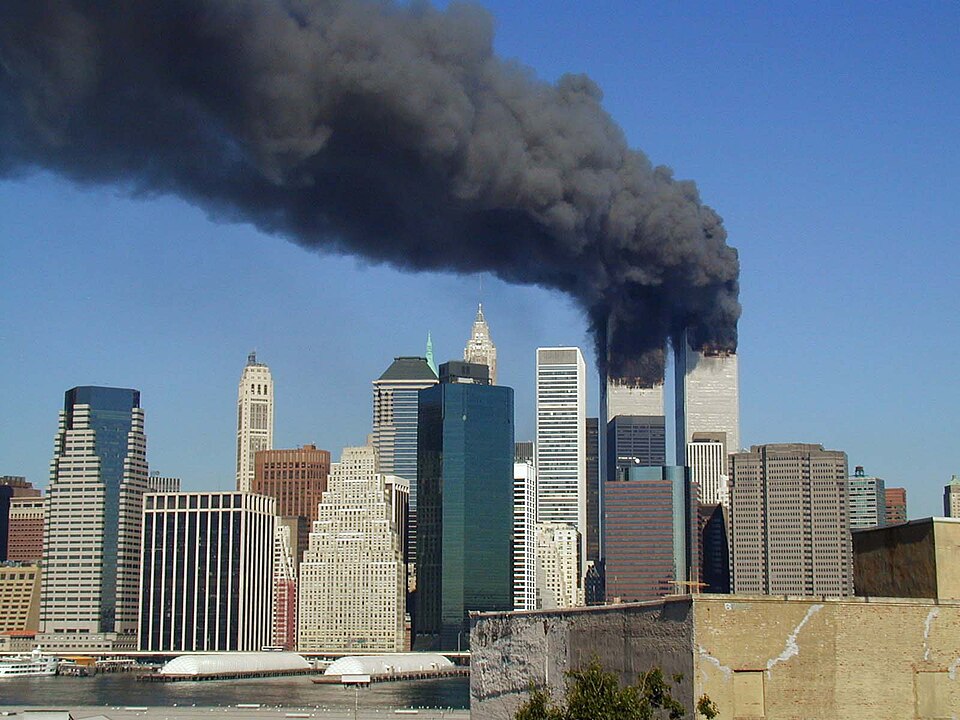
What has changed is the direction in which Americans are looking for the next threat. Photo by Michael Foran, Wikimedia commons.