The United Kingdom and Albania have strengthened their joint fight against organised crime with a landmark agreement allowing recovered criminal assets to be shared between
the two countries.
Described as the first arrangement of its kind in the Western Balkans, the agreement establishes a practical framework for returning a share of criminal proceeds to both jurisdictions and demonstrates a growing commitment to targeting criminal finances across borders.
The arrangement follows a concluded prosecution in England and Wales involving a conspiracy to supply cannabis to organised crime groups. Investigators and prosecutors in the UK worked closely with Albanian authorities to trace assets connected to the criminal activity and recover property in Albania.
Under the agreement, the recovered proceeds will be divided equally between the United Kingdom and Albania. The funds can subsequently be directed towards initiatives that deliver wider social benefits, turning assets generated through criminal activity into resources that can serve communities.
A new model for cross-border asset recovery
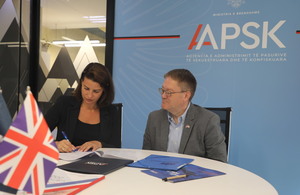
The agreement was formally initiated during a ceremony in Tirana on 13 July 2026, attended by His Majesty’s Ambassador to Albania, Nicholas Abbott, and Risena Xhaja, Chief Administrator of Albania’s Agency for the Management of Seized and Confiscated Property (AAPSK).
Following further work by the authorities in both countries, the arrangement was formally completed and signed in the United Kingdom on 6 August.
The process brought together several key British and Albanian institutions, including the UK Home Office, the National Crime Agency (NCA), the Crown Prosecution Service (CPS) and AAPSK. Their cooperation was aimed at ensuring that the financial gains associated with organised crime could be identified, confiscated and ultimately put to constructive use.
The initial arrangement covers approximately £54,000 in recovered real estate assets, which will be shared equally between the UK Government and AAPSK.
The agreement is intended to establish a precedent for future cooperation, particularly as criminal organisations increasingly operate across national borders and move illicit money through complex international financial networks.
Targeting the money behind organised crime
The UK Government has made the seizure and recovery of criminal proceeds a central element of its strategy against serious organised crime. By targeting the financial infrastructure of criminal groups, law enforcement agencies seek not only to prosecute individuals but also to undermine the business models that allow organised crime networks to operate and expand.
The UK and Albania have consequently expanded cooperation in areas including financial investigations, money laundering, cryptocurrency-related crime and the identification of assets obtained through criminal activity.
British authorities have supported Albania with specialist software and training designed to strengthen its ability to investigate financial crime. The UK also chaired a Berlin Process event on illicit finance in 2025, bringing regional attention to the importance of recovering assets linked to organised crime across the Western Balkans.
Britain is also supporting Albania's ongoing review of its anti-money laundering legislation, reflecting a broader effort to strengthen the country's financial crime enforcement framework.
Albania faces growing pressure over illicit assets
The scale of asset seizures in Albania illustrates the importance of international cooperation.
During the first quarter of 2025 alone, Albanian authorities reported that the value of seized and confiscated assets exceeded €58 million. More than 1,000 properties were among the assets seized or confiscated.
The figures highlight concerns over the use of the real estate market to conceal or launder proceeds generated through criminal activity. Property can provide criminal networks with a relatively stable way to store illicit wealth while making the origins of funds more difficult to trace.
AAPSK has also substantially increased the revenue generated from seized and confiscated assets over the past two years, signalling greater capacity to manage and monetise property recovered through criminal investigations.
A shared commitment to making crime pay less
Organised crime networks increasingly exploit international borders, using cash, informal money-transfer mechanisms, property transactions and cryptocurrencies to move and conceal their profits.
For the UK and Albania, closer cooperation on asset recovery represents an effort to close some of those gaps.
The new arrangement sends a broader message that criminal proceeds can be pursued even when they are moved abroad. It also creates a mechanism through which recovered assets can ultimately be redirected towards legitimate public and social purposes.
The two countries are expected to continue developing cooperation on financial crime and asset recovery as part of their wider partnership on tackling serious organised crime.
Key facts
The agreement is the first asset-sharing arrangement of its kind in the Western Balkans.
The arrangement was initiated at a ceremony in Tirana on 13 July 2026.
It was formally completed and signed in the UK on 6 August 2026.
The initial case involves approximately £54,000 in recovered real estate assets.
The proceeds will be divided equally between the UK Government and Albania's AAPSK.
Albanian authorities recorded more than €58 million in seized and confiscated assets in the first quarter of 2025.
More than 1,000 real estate properties were included among those seizures.
UK and Albanian agencies involved include the Home Office, National Crime Agency, Crown Prosecution Service and AAPSK.