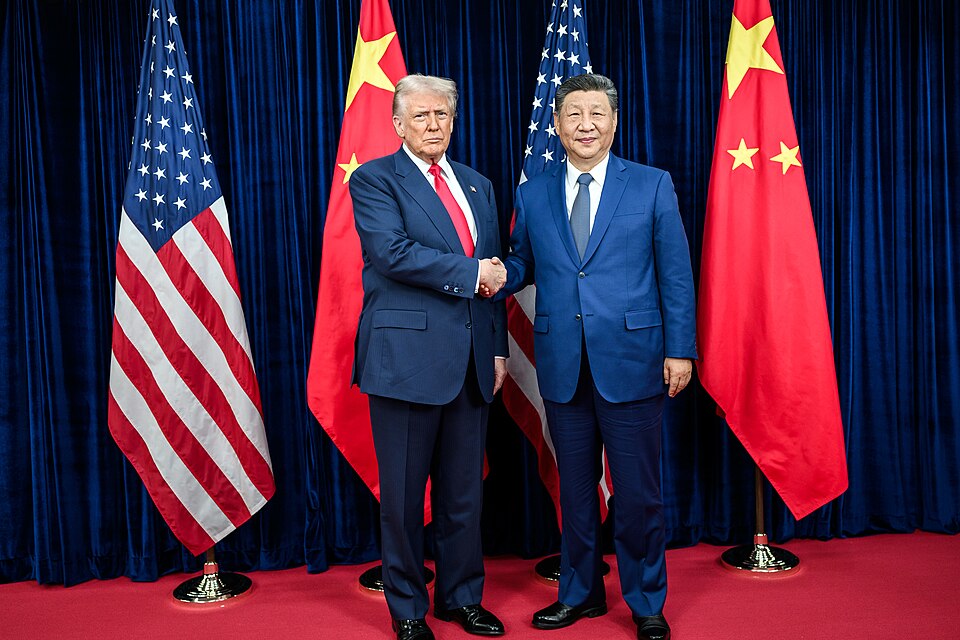
U.S. President Donald Trump arrived in Beijing on Wednesday for a closely watched summit with Chinese President Xi Jinping, bringing with him a delegation of top American executives
including Nvidia CEO Jensen Huang and Tesla chief Elon Musk as Washington seeks fresh economic wins and a steadier relationship with China.
The two-day visit marks the first trip by a sitting U.S. president to China in nearly a decade and comes at a politically sensitive moment for Trump, who is balancing tensions abroad, economic uncertainty at home and mounting pressure ahead of the U.S. midterm elections.
Before departing for Beijing, Trump said he intended to press Xi to give American companies broader access to the Chinese market.
“I will be asking President Xi ... to ‘open up’ China so that these brilliant people can work their magic,” Trump wrote on Truth Social, referring to the business leaders accompanying him.
Among the most closely watched figures on the trip is Huang, whose company Nvidia has faced hurdles securing approval to sell its advanced H200 artificial intelligence chips in China. A source familiar with the matter said Trump personally invited Huang to join the delegation at the last minute, with the executive later seen boarding Air Force One during a stop in Alaska.
Chinese officials struck a measured tone ahead of the summit. Foreign Ministry spokesperson Guo Jiakun said Beijing was prepared to “expand cooperation, manage differences and inject more stability and certainty into the turbulent world.”
\While Trump traveled to Beijing, U.S. Treasury Secretary Scott Bessent concluded several hours of preparatory trade talks with Chinese Vice Premier He Lifeng at South Korea’s Incheon airport. China’s state-run Xinhua news agency described the discussions as “candid, in-depth and constructive,” though few details were released.
Trade is expected to dominate the summit agenda as both governments attempt to preserve a fragile truce reached last year. Under that agreement, Trump suspended steep tariffs on Chinese imports, while Beijing eased threats to restrict exports of rare earth materials critical to industries ranging from electric vehicles to defense manufacturing.
Washington is expected to push for increased Chinese purchases of Boeing aircraft, agricultural products and U.S. energy exports in an effort to narrow the long-running trade imbalance between the two countries. Beijing, meanwhile, is seeking relief from U.S. restrictions on advanced semiconductor and chipmaking technology exports.
Beyond trade, the talks are expected to cover several contentious geopolitical issues, including the conflict involving Iran and U.S. arms sales to Taiwan.
Trump is widely expected to urge China to encourage Tehran toward negotiations with Washington, although he has publicly downplayed the need for Beijing’s involvement. China, meanwhile, reiterated its opposition to American military support for Taiwan, where a proposed $14 billion U.S. arms package remains under review.
The visit will include a formal welcome ceremony at the Great Hall of the People, a tour of Beijing’s historic Temple of Heaven and a state banquet hosted by Xi.
Despite Trump’s repeated praise for his personal relationship with the Chinese leader, analysts say Washington may enter the talks from a weaker position. Legal challenges have constrained Trump’s tariff authority, while the economic fallout from the Iran conflict has fueled inflation concerns at home.
“The Trump administration needs this meeting more than China does,” said Liu Qian, founder of Beijing-based geopolitical consultancy Wusawa Advisory. “It needs to show American voters that deals are signed and economic gains are being made.”
Among ordinary Chinese residents, reactions to Trump’s visit appeared mixed — balancing skepticism with cautious optimism that the summit could stabilize trade ties and ease tensions between the world’s two largest economies. Photo by The White House, Wikimedia commons.