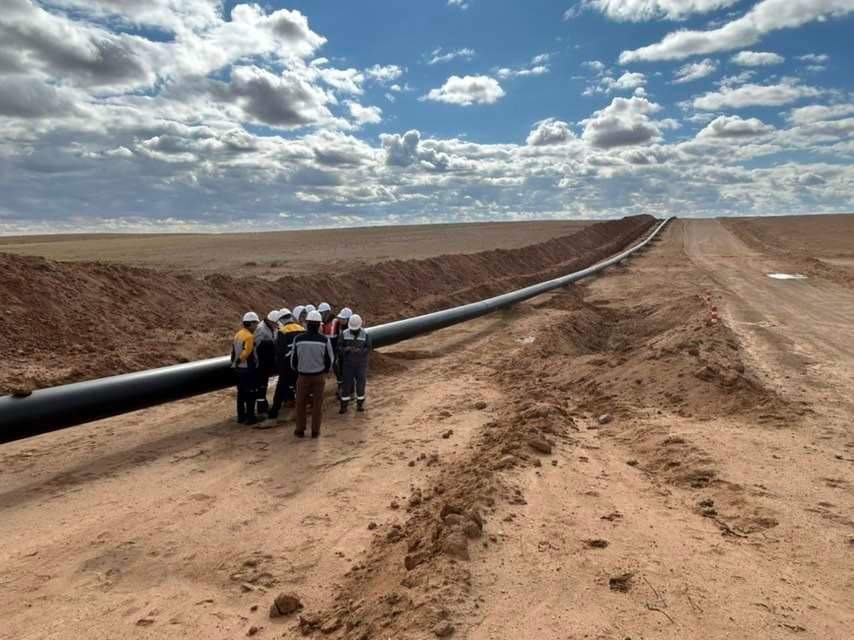
Russia will halt the transit of Kazakh crude oil to Germany through the Druzhba pipeline starting May 1, Deputy Prime Minister Alexander Novak announced on Wednesday, a decision that is
expected to strain fuel supplies to one of Germany’s key refineries near Berlin.
The move will directly affect the PCK Schwedt refinery, which plays a critical role in supplying fuel to the German capital and currently relies on Kazakh oil for roughly 17% of its intake. The disruption comes at a sensitive moment for Germany’s energy system, already facing uncertainty due to geopolitical tensions affecting global oil flows.
Novak attributed the decision to “technical possibilities” but did not provide further clarification. He added that volumes previously routed through the pipeline would be redirected to alternative logistics channels.
Industry sources had earlier indicated that Russia was preparing to end Kazakh oil deliveries via Druzhba, a major pipeline network that carries crude from Russia into Central and Eastern Europe. Last year alone, Kazakhstan shipped about 2.146 million metric tons of crude through the route to Germany—equivalent to roughly 43,000 barrels per day—marking a 44% increase compared with 2024. In the first quarter of 2026, shipments totaled 730,000 tons.
The Druzhba system supplies Germany via its northern branch, separate from the southern line that serves Hungary and Slovakia. That southern section is expected to resume operations after repairs following earlier disruptions.
The Schwedt refinery has been under German trusteeship since 2022, after Berlin effectively removed control from Russian energy company Rosneft following the invasion of Ukraine. Despite this, Rosneft remains the majority shareholder, alongside minority stakes held by Shell and Eni.
Reacting to the announcement, German officials emphasized that contingency supply routes are available. The economy ministry said alternative imports via ports such as Gdansk or Rostock could help compensate for the shortfall and insisted that national fuel security remains stable.
However, officials also acknowledged the possibility of regional price fluctuations as supply chains adjust. Germany’s Federal Network Agency said it is coordinating closely with operators to manage the transition.
Russian officials, meanwhile, downplayed the impact. Novak suggested Germany would not be significantly affected, pointing out that Berlin had already distanced itself from Russian crude imports.
As supply routes are reconfigured, attention is turning to how quickly Germany can stabilize flows to Schwedt, a refinery that remains central to fuel distribution in the country’s northeast. Photo by Enkhgerele, Wikimedia commons.