
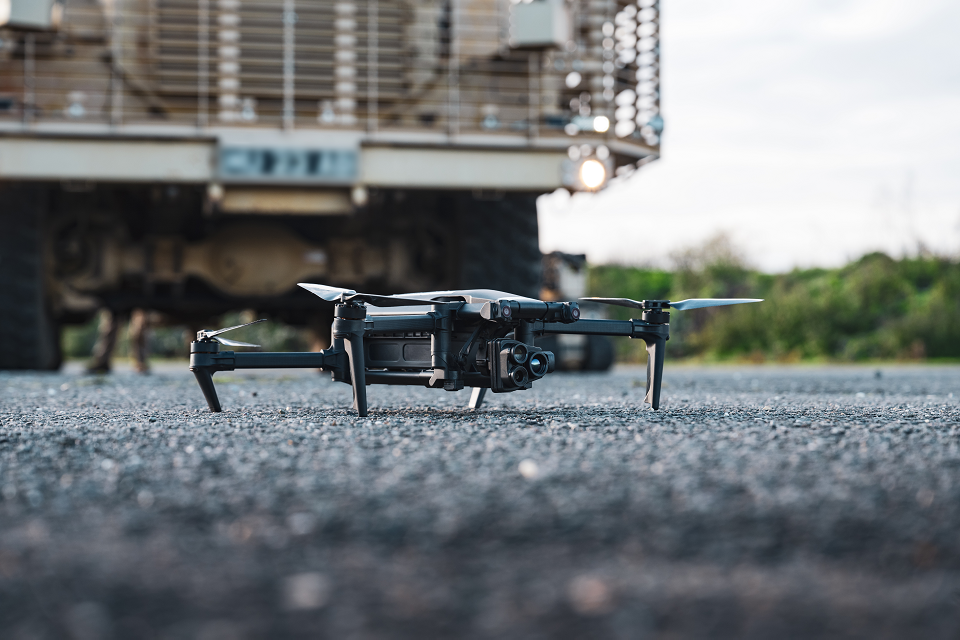
The UK is accelerating its push into battlefield technology, as a major trial led by the Defence Science and Technology Laboratory (Dstl) has shown how artificial intelligence and drones can
dramatically speed up bomb detection and disposal operations.
Working on behalf of the British Army, the trial enabled explosive ordnance disposal (EOD) teams to locate threats more quickly while significantly reducing risk to personnel.
AI and drones transforming bomb disposal
The exercise, conducted with the 33 Engineer Regiment at its Essex base, unfolded over several weeks. Engineers deployed dozens of replica mines and unexploded ordnance across varied terrain to simulate real battlefield conditions.
Small uncrewed aerial systems—commonly known as drones—played a central role. Equipped with advanced sensors, they scanned the environment and transmitted real-time data back to operators. AI-powered tools then analyzed the information, identifying and classifying potential threats with impressive speed.
One of the most significant breakthroughs was the ability to rapidly retrain AI models. This means systems can quickly adapt to new types of explosives or unfamiliar environments—an essential capability in modern warfare, where threats evolve constantly.
Lessons from modern conflicts
The urgency behind such innovation has been reinforced by the war in Ukraine, where drones and improvised explosive devices are reshaping combat at an unprecedented pace. British defence planners are closely studying these developments as they modernize their own capabilities.
Government boosts investment in autonomy
The trial aligns with the UK’s broader defence strategy, which prioritizes cutting-edge technologies such as AI, robotics and autonomous systems. Under the Strategic Defence Review, government investment in autonomous platforms is set to double from £2 billion to £4 billion during this parliament.
Luke Pollard described the trial as a clear example of innovation at “wartime pace,” highlighting the goal of removing soldiers from danger while increasing operational effectiveness.
Dstl experts echoed this sentiment, emphasizing the need for constant adaptation as explosive threats become more sophisticated. By combining scientific expertise with industry partnerships, the agency is developing tools designed to give British forces a decisive edge.
The future of battlefield technology
According to British Army capability lead Mark Fetters, the modern battlefield is increasingly saturated with explosive hazards. The integration of AI and drones could allow EOD teams to work faster and at a safer distance.
As sensor technology continues to evolve—becoming smaller, lighter and more energy-efficient—these capabilities are expected to expand further. Future systems may be deployed on even smaller drones, improving flexibility and reach in complex environments.
Drones in the British Army: a growing force
Drones are already becoming a cornerstone of British Army operations. Beyond bomb detection, they are used for:
- Surveillance and reconnaissance, providing real-time battlefield awareness
- Target acquisition, supporting precision strikes
- Logistics support, including delivery of critical supplies
- Training and simulation, helping soldiers prepare for modern combat scenarios
The Army is increasingly investing in swarming drone technology and autonomous systems, where multiple drones operate together with minimal human input. These advancements aim to enhance speed, coordination and resilience in high-intensity conflicts.
What comes next
Following the success of the trial, further testing is planned this year to refine the technology and prepare it for frontline deployment. The ultimate goal is to equip soldiers directly with these advanced tools.
The initiative forms part of a wider transformation of UK defence, driven by data, connectivity, automation and lessons learned from recent conflicts. The British Army has set an ambitious target: achieving a tenfold increase in combat effectiveness over the next decade.
If these trials are any indication, AI-powered drones will play a central role in reaching that goal—making operations faster, smarter and significantly safer for those on the front line.



























