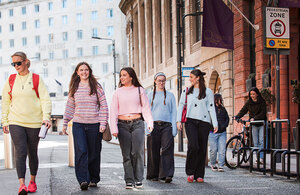
A sweeping national effort to redesign streets and improve public safety has been unveiled, after new research revealed that the vast majority of women feel unsafe walking alone after dark.
According to fresh polling by YouGov, nearly 9 in 10 women (88%) say they have felt unsafe at night, with 71% admitting they actively change their routes during darker months to avoid risk. The findings highlight deep-rooted concerns around personal safety in public spaces, particularly after sunset.
In response, Active Travel England (ATE) has announced that new government guidance will be issued to councils across the country in 2026. The initiative aims to help local authorities rethink how streets are designed, with a focus on making them safer and more inclusive for women and girls.
The plans form part of a broader government ambition to cut violence against women and girls in half within the next decade.
Safety concerns driving change
The survey identified several key factors contributing to feelings of insecurity, including poor street lighting, neglected walkways, antisocial behaviour, and limited visibility. Many respondents said that addressing these issues would significantly improve their confidence in walking locally.
These concerns were echoed during a recent visit to Liverpool, where Local Transport Minister Lilian Greenwood joined women and girls on an evening walk to better understand their experiences firsthand.
What the new guidance will include
The upcoming guidance will encourage councils to view urban planning through a gender-sensitive lens. Key recommendations are expected to include:
- Improved street lighting and visibility
- Safer, well-used walking routes monitored by CCTV
- Redesign of isolated or poorly maintained areas
- Increased community oversight and engagement
Training sessions for local authorities are also set to roll out in spring 2026.
Local success stories across the UK
Several regions have already piloted initiatives aimed at improving safety:
- In Nottinghamshire, a Safer Streets programme introduced 27 new CCTV cameras, upgraded 200 streetlights, and provided taxi drivers with training to tackle misogynistic behaviour.
- Milton Keynes has created designated safe routes to transport hubs and trained night-time economy staff to intervene in unsafe situations.
- Merseyside Police launched “Halo Points” in Liverpool—well-lit safety hubs directly linked to emergency services.
- In the North East, Mayor Kim McGuinness has committed £7.1 million to upgrade bus stops with better lighting and infrastructure.
- Cities like Leicester and Manchester have removed underpasses in favor of street-level crossings to improve visibility and safety.
Learning from global innovations
The UK is also looking abroad for inspiration. In Amsterdam, city planners are evaluating how public spaces function at night, particularly for young women. Meanwhile, Vigo has introduced flexible night bus stops, allowing passengers to request safer drop-off points closer to home.
Funding and long-term goals
Councils will be able to tap into ATE’s £626 million funding programme to implement these safety measures, supporting broader efforts outlined by the Department for Transport. These include enhanced CCTV at transport hubs, mandatory safety training for bus drivers, and strengthened policing strategies.
The initiative marks a significant step toward reshaping public spaces, with the goal of ensuring that women and girls can move freely and safely—day or night.
Local Transport Minister, Lilian Greenwood said:
“No one should worry about getting to their destination safely after dark, and these stats show just how much work there is to be done.
This programme is turning conversations into real change by working directly with the councils who design our streets to ensure women and girls in our communities feel safe to walk, wheel and cycle whenever they want to”.
Minister for Safeguarding and Violence Against Women and Girls, Jess Phillips, said:
“Violence against women and girls is a national emergency, and this government will halve it in a decade. Women and girls deserve to feel safe simply going about their lives, whether that is walking down the street, travelling, or using public spaces after dark.
I welcome this work to design streets that make women feel safer, shifting responsibility away from women and onto the spaces and behaviours that put them at risk”.
National Active Travel Commissioner, Chris Boardman said:
“That almost 9 out of 10 women say they feel unsafe walking after dark is an appalling finding we should be ashamed of. For too long, we have designed streets that don’t work for women and girls. We want to help councils remove the barriers that are stopping women and girls from choosing to walk and wheel - whether that’s by providing better lighting, surface crossings over underpasses, CCTV or simply by listening to and acting on lived experiences.
It’s a terrible thing that women and girls don’t feel they have the same freedoms to simply walk in their neighbourhood as men and boys. Everyone should feel safe getting around, and our job is to help make that happen”.
North East Mayor Kim McGuinness said:
“There needs to be a radical change in how we design and think about public spaces and public transport with funding to match, and that has been a priority for me from day one as Mayor. In the North East we’re already backing that with action, listening to women’s lived experiences and investing millions in better lit bus stops and stations, safer waiting areas and public spaces that feel welcoming, not intimidating. Women should not have to plan their journeys around fear and spaces they need to avoid. Safety must be built into how our streets and transport networks are designed, and this guidance is an important first step”.
Chief Executive of Living Streets, Catherine Woodhead said:
“Like many women and girls, I have felt fearful when moving through public spaces my whole life, due to experience. The safety of women and girls on our streets must not be ignored in our community and transport planning and policy. When it is, it leads to women and girls missing out on everything from education and exercise, to leisure and accessing work. Living Streets wants neighbourhoods where every woman and girl can walk or wheel wherever they want, whenever they want – free from harassment, fear and exclusion. Achieving this requires not only behaviour change among those who perpetrate harassment but also creating streets that actively prioritise the needs of women and girls”.