
Media

As Iraqi forces struggle to pin back the Islamic State group on the ground, Baghdad is taking its war against the jihadists to the airwaves with a television comedy series.
The usually elusive Abu Bakr al-Baghdadi features prominently in the show, whose promoters argue that ridiculing the jihadist supremo can help dent his aura of almost supernatural villainy.
The fear factor -- fed by online videos of mass executions, beheadings and abductions -- has been a key aspect of IS strategy, often handing it victory before the battle had even started.
The goal of the show is "to remove this phobia that has taken root in a lot of people's minds", chief supervisor Thaer Jiyad told AFP on the set between two scenes.
But if the show is Baghdad's new weapon in the war against IS, then its very first shots were a friendly fire blunder that sparked controversy even as the series premiered on Saturday.
The trailer that Iraqiya state TV had been showing several times a day for weeks plays on a belief widely held in Iraq that IS was created by the CIA, Israel and Gulf monarchies to sow chaos.
With the United States now leading an aerial bombing campaign which also involves several Gulf countries against IS in Iraq and Syria, the Iraqi Media Network production company had to order a last-minute reshoot.
The first version of the trailer, which is still widely available on the Internet, opens with a cartoon-like devil character brandishing a fork leading a column of jihadist fighters through the desert.
He is met with open arms by an ostensibly American character in full cowboy attire who leads him into a tent for an arranged marriage.
- 'State of Superstition' -
The bride is a Jewish princess -- a large star of David hangs around her neck to make that clear -- who is escorted to her nuptial nest by a woman whose sunglasses and bright green pantsuit are an unmistakeable reference to Qatar's first lady Sheikha Mozah.
She and the cowboy were dropped from the new version of the opening clip for the series, whose title loosely translates as "State of Superstition" and is a play on the Arabic word for caliphate.
The Joker of Batman fame, Dracula and a dwarf are among the random mix of characters in the background, all dancing to the series' catchy theme song, a parody of a known IS anthem.
The next scene shows the result of the union between the Jewish bride and the devil.
"The egg hatched, a little IS-ling emerged," the song goes.
The Baghdadi figure that grows out of the shell then leads a choir of officers from Saddam Hussein's ex-ruling Baath party into reciting his programme of blood-letting for Iraq with the refrain: "O beheader, where are you?"
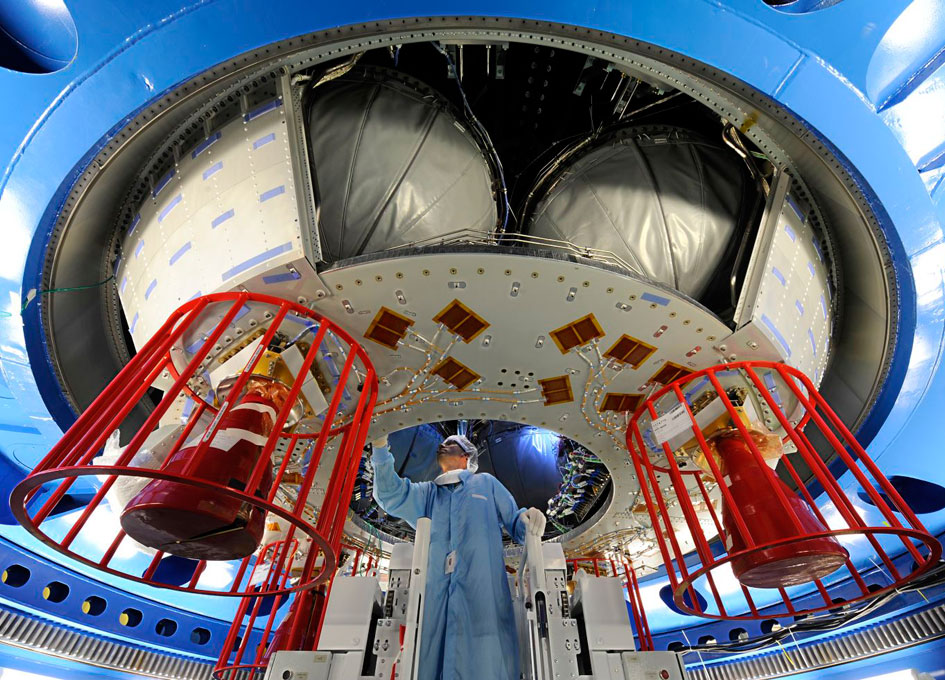
An Ariane 5 ES heavy rocket lifted off from South America bearing Europe's fifth and final robot supply ship for the International Space Station (ISS), mission control said.
The rocket rose from the launch pad at the European Space Agency's base in Kourou, French Guiana at 8:47 pm (2347 GMT) with a payload of more than 20 tonnes, the biggest in ESA's history, it said.
After being placed in orbit, the Automated Transfer Vehicle (ATV) is scheduled to navigate its way to the ISS by starlight and dock with it on August 12 at a height of about 400 kilometres (250 miles) above the Earth.
Named after Georges Lemaitre, the Belgian astrophysicist who proposed the "Big Bang" theory of how the Universe came into being, the ATV carries nearly 6.6 tonnes of fuel, water, oxygen, food, clothes and scientific experiments for the six ISS crew.
The 10-metre (33-feet) pressurised capsule will provide additional living space and use its onboard engines to boost the altitude of the ISS, which loses height each day through drag from lingering atmospheric molecules.
At the end of its six-month mission, filled with garbage and human waste, the spacecraft will undock and burn up in a controlled re-entry over the South Pacific.
It is the last in a series of ATVs that the 20-nation agency contracted to build and launch as its contribution to the US-led ISS project.
The six-year programme cost 4.2 billion euros ($5.6 billion), but ESA says the ships have been a testbench for technology that will live on in NASA's Orion, a planned capsule-based successor to the space shuttle which was phased out in 2011.

Timberwolf the koala was lucky to be alive Monday after surviving a terrifying 88-kilometre (54.5-mile) ride down a busy Australian freeway clinging to the bottom of a car.
The four-year-old male, who survived with nothing more than a torn nail, was struck by the vehicle near Maryborough in Queensland state on Friday.
The Australia Zoo wildlife hospital said it latched onto the bottom of the car as it sped away, with the family inside not knowing they had a marsupial on board.
It was only when they stopped in Gympie after a high-speed freeway drive that they noticed it, and called the hospital for help.
The maximum speed on the freeway is 110 kilometres per hour.
Australia Zoo vet Claude Lacasse said it was amazing the koala, named Timberwolf by the rescuers who brought him in, was in such great health.
"It is absolutely amazing that he has such minor injuries and he survived," Lacasse said.
"It is a truly remarkable story, he is a very lucky koala."

A sun-powered plane made a successful test flight on Monday, clearing a vital hurdle towards its goal of a round-the-world trip next year, its pilot and mission chiefs said.
Solar Impulse 2 carried out a flight lasting two hours and 15 minutes, half an hour longer than scheduled, German test pilot Markus Scherdel said.
"Everything worked as expected," Scherdel told a press conference at an air base in Payerne, central Switzerland.
"Of course, we have to do more testing, but it's a good start and I'm looking forward to flying the airplane the next time."
Built from carbon fibre, the 2.3-tonne plane has four 17.5-horsepower electrical motors powered by 17,248 solar cells studding its fuselage and 72-metre (234-feet) wingspan -- as long as that of an Airbus A380.
It is the successor of Solar Impulse, a record-breaking craft that in 2010 notched up a 26-hour flight, proving its ability to store enough power in lithium batteries during the day to keep flying at night.
The forerunner was put through its paces in Europe, crossed the Mediterranean to reach Morocco and traversed the United States last year without using a drop of fossil fuel.
The goal with Solar Impulse 2 is to fly non-stop for more than 120 hours -- five days and five nights -- enabling it to cross the Pacific and Atlantic legs of its global mission.

Trust in the Internet took a major blow as alarm spread that software commonly used to encrypt and secure online transactions could wind up giving away the store.
Computer security specialists, website masters, and fans of online privacy were worriedly abuzz with word of a freshly-discovered flaw in online data-scrambling software that hackers can turn to their advantage.
A bug dubbed "Heartbleed" in OpenSSL encryption software lets attackers illicitly retrieve passwords and other bits of information from working memory on computer servers, according to cyber-defense specialists at Fox-IT.
"Expect everybody who runs an https web server to be scrambling today," the Tor Project said in a warning posted at its website.
"If you need strong anonymity or privacy on the Internet, you might want to stay away from the Internet entirely for the next few days while things settle," it said.
OpenSSL is used to protect passwords, credit card numbers and other data coursing through the Internet.
-Crown jewels at risk -
Information considered at risk includes source codes, passwords, and "keys" that could be used to impersonate websites or unlock encrypted data.
"These are the crown jewels, the encryption keys themselves," said a website devoted to details of the vulnerability.
"Leaked secret keys allows the attacker to decrypt any past and future traffic to the protected services and to impersonate the service at will."
The flaw in OpenSSL essentially allows a hacker to read the memory of a machine working the software, but no more than 64 kilobytes of data at a time, according to security specialists.
Nor can hackers control which bits of memory are tapped, leaving to chance what they get their hands on.
However, hackers could repeatedly grab packets of memory to ramp up the odds of stealing valuable data.
"There is no limit on the number of attacks that can be performed," Fox-IT said in a blog post that listed steps business IT handlers can take to thwart incursions.
Security researchers reported being able to dig out Yahoo password information by taking advantage of the bug. Yahoo released a statement Tuesday saying it had fixed the problem at its main online properties.
Fox-IT estimated that the vulnerability has existed for about two years, since the version of OpenSSL at issue was released.
OpenSSL is used by more than half of websites, but not all versions have the vulnerability, according to heartbleed.com.
The group behind open-source OpenSSL put out a security alert urging users to upgrade to an improved version of the software and gave credit for finding the bug to Neel Mehta of Google Security.

Leading scientists and officials completed a fresh climate report Sunday expected to lay bare the grim impact of climate change, with warnings that global food shortages could spark violence in vulnerable areas.
Part of a massive overview by the United Nations' Intergovernmental Panel on Climate Change (IPCC) set for release on Monday, the report is likely to shape international policy on climate for years to come, and will announce that the impact of global warming is already being felt.
Some 500 scientists and government officials have been gathered since Tuesday in Yokohama, south of Tokyo, to hammer out its wording.
It will serve as the second of three volumes into climate change's causes, consequences and possible solutions by the expert panel.
The work comes six months after the first volume in the long-awaited Fifth Assessment Report declared scientists were more certain than ever that humans caused global warming.

Zebras have stripes to deter the tsetse and other blood-sucking flies, according to a fresh bid to settle a debate that has raged among biologists for over 140 years.
Since the 1870s, in a dispute sparked by the founders of evolutionary theory Charles Darwin and Alfred Russel Wallace, scientists have squabbled over how the zebra got its trademark look.
Are its stripes for camouflage, protecting the zebra with a "motion dazzle confusion effect" against hyenas, lions and other predators in the savannah?
Do the stripes radiate heat to keep the zebra cool?
Or do they have a social role -- for group identity, perhaps, or mating?
But a new study, published in the journal Nature Communications on Tuesday, says the strongest likelihood is that the stripes discourage parasitic flies.
The finding was intriguingly thrown up by lab experiments in 2012 that showed how blood-feeding flies shun stripey surfaces and prefer instead to land on uniform colours.
Researchers led by Tim Caro of the University of California at Davis, say there is no black-and-white answer to the Great Stripe Riddle -- but the insect theory is by far the best bet.
"A solution to the riddle of zebra stripes, discussed by Wallace and Darwin, is at hand," they write.
The team found a strong geographical overlap between zebras and the two groups of biting flies, Tabanus and Glossina, that feed on equid species, which explains why zebras would need a shield against this pest.
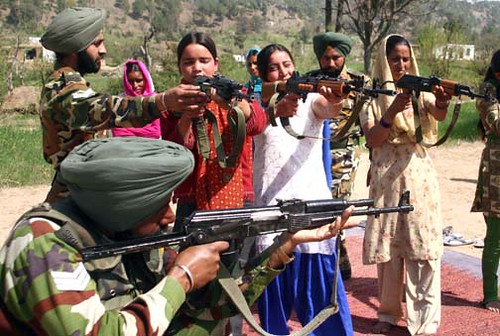
India remains the biggest buyer of arms in the world, importing nearly three times as many weapons as its nearest competitors China and Pakistan over the last five years, a Swedish think tank said.
The total volume of arms sales was up 14 percent in 2009-13 compared to the previous five years, according to the Stockholm International Peace Research Institute (SIPRI).
Indian imports of major weapons rose by 111 percent in the last five years compared to 2004–08. Its share of total global arms imports increased from 7 to 14 percent, SIPRI said.
India replaced China as the world's biggest arms buyer in 2010. With its domestic defence industry struggling to manufacture high-tech arms, India is in the midst of a defence spending binge as it struggles to keep up with better-equipped Chinese forces and a range of military challenges in its volatile neighbourhood.
The main supplier of arms to India in 2009-13 was Russia, accounting for 75 percent of all imports -- reflecting India's need to upgrade and modernise weapons systems dating back to their close relationship during the Cold War.

Toyota said Monday it has suspended production at its two Indian auto assembly plants in response to threats against management and "deliberate" assembly-line stoppages, as efforts to hammer out a labour deal failed.
The world's biggest automaker said the move will see the lock-out of about 6,400 employees at the factories in southern India.
Company and union officials had been trying to sign a new contract for the past 10 months, with the local government helping mediate negotiations.
"In the meantime, under the instigation of the union, certain sections of the employees have resorted to deliberate stoppages of the production line, abuse and threatening of supervisors thereby continuously disrupting business for the past 25 days," Toyota said in a statement.
"All these unlawful activities have been detailed in the lock-out notice. With this background, the company is left with no other option but to declare a lock-out of the premises to ensure the safety of its workers and management personnel," it added.
A Tokyo-based company spokesman said Toyota hoped to restart production quickly, but could not give a timeline for any re-opening of the plants, which make a range of models including the flagship Camry sedan, the Corolla and the Prius hybrid.

In 1984, with only $25,000 in Chinese government funding and a dusty 20-square-metre bungalow as their headquarters, a small group of scientists in Beijing founded a firm called New Technology Developer Inc.
Thirty years later, the tech company -- which went on to become Legend and later, Lenovo -- is the world's biggest personal computer maker, and has just completed two major deals with IBM and Google that analysts say will help it to diversify away from the sagging PC market and boost its expansion overseas.
Lenovo's $2.3 billion purchase of IBM's low-end server business and its $2.91 billion acquisition of Motorola from Google are evidence of the Chinese tech giant's "global ambitions", said Jean-Francois Dufour at DCA Chine-Analyse.
"Just as iPhones and iPads have overtaken Macs in commercial importance for Apple, smartphones and tablets are expected to replace PCs in part for Lenovo," said Dufour, who called the firm "the pioneer of Chinese companies' global offensive".
The back-to-back deals are all the more significant because of their timing, coming just as US President Barack Obama noted in his annual State of the Union address on Tuesday that "for the first time in over a decade, business leaders around the world have declared that China is no longer the world's number one place to invest; America is".
With Chinese investment in the US doubling to $14 billion in 2013, a larger and larger share of that capital is coming from America's rival across the Pacific -- a fact unmentioned by Obama in his speech.
From its humble beginnings, Lenovo has charted an impressive course in the personal computer market. Under its earlier name, Legend, it secured the biggest share in China's domestic market in 1996 and in the Asia-Pacific region three years later.
Its 2003 decision to change the name of its PC brand from Legend to Lenovo in a bid to boost its sales abroad marked the beginning of its ascent to global preeminence.
That move was followed by a successful 2004 bid to serve as the exclusive computing technology provider for the 2006 Turin Winter Olympics and the 2008 Beijing Games, making it the first Chinese firm to become a major Olympic sponsor.
But it was Lenovo's 2005 acquisition of IBM's PC division for $1.75 billion that cemented its rise, setting it on track to unseat Hewlett-Packard as the world's top PC vendor last year.
Lenovo now has PC products in more than 160 countries and has worked to build its global brand by recruiting celebrities such as basketball star Kobe Bryant and Hollywood actor Ashton Kutcher, who the company named a "product engineer" for its new Yoga Tablet device.
With its Motorola purchase, Lenovo hopes to replicate its PC market success in the smartphone universe. The deal "will immediately make Lenovo a strong global competitor in smartphones", Lenovo chairman and chief executive officer Yang Yuanqing said.
As it did after the 2005 IBM deal, however, it faces tough odds.
Category
Sport
Rybakina pulls out of Wuhan Open as foot injury forces break from tennis
 Rybakina pulls out of Wuhan Open as foot injury forces break from tennis
Manchester United turns Old Trafford turf into a piece of club history for fans
 Manchester United turns Old Trafford turf into a piece of club history for fans
Former police chief among officers investigated over Maccabi Tel Aviv fans ban
 Former police chief among officers investigated over Maccabi Tel Aviv fans ban
Nick Kyrgios suspended after cocaine test as Australian tennis star admits ‘huge mistake’
 Nick Kyrgios suspended after cocaine test as Australian tennis star admits ‘huge mistake’
Fraud arrest follows security disruption at Birmingham European Athletics Championships
 Fraud arrest follows security disruption at Birmingham European Athletics Championships
Asher-Smith matches European medal record as Hunt completes golden treble
 Asher-Smith matches European medal record as Hunt completes golden treble
OG Anunoby brings NBA champion’s backing to Mayor’s £2m plan to transform London basketball courts
 OG Anunoby brings NBA champion’s backing to Mayor’s £2m plan to transform London basketball courts
London launches bid to bring 2029 World Athletics Championships back to the capital
 London launches bid to bring 2029 World Athletics Championships back to the capital
Serbia and Sweden withdraw support for Infantino's FIFA re-election
 Serbia and Sweden withdraw support for Infantino's FIFA re-election
Wales withdraws support for Infantino’s FIFA re-election bid
 Wales withdraws support for Infantino’s FIFA re-election bid
Education
-
 Nearly half of workers and students miss days due to flu-like illness, UK study finds
Almost half of people in employment or education who experienced flu-like symptoms missed work or school, highlighting the significant impact seasonal respiratory illnesses can have onRead More...
Nearly half of workers and students miss days due to flu-like illness, UK study finds
Almost half of people in employment or education who experienced flu-like symptoms missed work or school, highlighting the significant impact seasonal respiratory illnesses can have onRead More... -
 Oxford holds global university crown for record 11th consecutive year
The University of Oxford has retained its position as the world’s highest-ranked university for an unprecedented 11th consecutive year, according to the Times Higher Education (THE)Read More...
Oxford holds global university crown for record 11th consecutive year
The University of Oxford has retained its position as the world’s highest-ranked university for an unprecedented 11th consecutive year, according to the Times Higher Education (THE)Read More... -
 Jewish students face rising antisemitism on UK campuses, report finds
Antisemitic incidents at universities across Britain have risen sharply since the Hamas-led attacks on Israel in October 2023, according to a new report from the Community Security TrustRead More...
Jewish students face rising antisemitism on UK campuses, report finds
Antisemitic incidents at universities across Britain have risen sharply since the Hamas-led attacks on Israel in October 2023, according to a new report from the Community Security TrustRead More... -
 UK schools to receive new support to confront misogyny and harmful online influences
Schools across England are set to receive a new package of guidance and resources designed to help teachers tackle misogyny, promote respectful relationships and address harmfulRead More...
UK schools to receive new support to confront misogyny and harmful online influences
Schools across England are set to receive a new package of guidance and resources designed to help teachers tackle misogyny, promote respectful relationships and address harmfulRead More... -
 England to recruit 1,000 youth workers in biggest youth services expansion for a generation
The government is to fund the recruitment and training of 1,000 new youth workers across England as part of a major expansion of services aimed at helping young people who are at riskRead More...
England to recruit 1,000 youth workers in biggest youth services expansion for a generation
The government is to fund the recruitment and training of 1,000 new youth workers across England as part of a major expansion of services aimed at helping young people who are at riskRead More... -
 London schools see sharp fall in exclusions as Inclusion Charter strengthens safety and belonging
New evidence suggests that efforts to improve inclusion and prevent violence are contributing to safer and more supportive school environments across London, with suspension andRead More...
London schools see sharp fall in exclusions as Inclusion Charter strengthens safety and belonging
New evidence suggests that efforts to improve inclusion and prevent violence are contributing to safer and more supportive school environments across London, with suspension andRead More... -
 £22.5m programme to expand enrichment opportunities for children in more than 400 schools
Hundreds of thousands of young people in disadvantaged communities across England are set to gain greater access to sport, music, arts, debating, volunteering and outdoor activitiesRead More...
£22.5m programme to expand enrichment opportunities for children in more than 400 schools
Hundreds of thousands of young people in disadvantaged communities across England are set to gain greater access to sport, music, arts, debating, volunteering and outdoor activitiesRead More... -
 Jewish studies in Europe at a crossroads: an interview with Oleg Kozerod
Interview with Oleh Kozerod, Researcher at the Kuras Institute of Political and Ethnic Studies of the National Academy of Sciences of UkraineRead More...
Jewish studies in Europe at a crossroads: an interview with Oleg Kozerod
Interview with Oleh Kozerod, Researcher at the Kuras Institute of Political and Ethnic Studies of the National Academy of Sciences of UkraineRead More... -
 England’s education overhaul puts local leaders at the centre of jobs and skills reform
Government brings mayors, employers, schools and colleges together to reshape technical education and connect young people with regional job opportunitiesRead More...
England’s education overhaul puts local leaders at the centre of jobs and skills reform
Government brings mayors, employers, schools and colleges together to reshape technical education and connect young people with regional job opportunitiesRead More... -
 London’s school run transformed as car journeys fall and active travel soars
A decade of policies introduced under Mayor Sadiq Khan has significantly changed how children travel to school, with new Transport for London figures showing a sharp fall in schoolRead More...
London’s school run transformed as car journeys fall and active travel soars
A decade of policies introduced under Mayor Sadiq Khan has significantly changed how children travel to school, with new Transport for London figures showing a sharp fall in schoolRead More...

World News
-
 Argentina takes Falklands oil dispute to International Tribunal, seeking halt to UK-backed drilling
Argentina has escalated its long-running sovereignty dispute with the United Kingdom by asking the International Tribunal for the Law of the Sea (ITLOS) to order provisional measuresRead More...
Argentina takes Falklands oil dispute to International Tribunal, seeking halt to UK-backed drilling
Argentina has escalated its long-running sovereignty dispute with the United Kingdom by asking the International Tribunal for the Law of the Sea (ITLOS) to order provisional measuresRead More... -
 UK calls for energy ceasefire in Ukraine as Russia intensifies attacks on power infrastructure
Foreign Secretary urges European allies to unite behind Zelenskyy and strengthen defences against Russian hybrid threatsRead More...
UK calls for energy ceasefire in Ukraine as Russia intensifies attacks on power infrastructure
Foreign Secretary urges European allies to unite behind Zelenskyy and strengthen defences against Russian hybrid threatsRead More... -
 ASEAN looks to European experience to accelerate regional electricity grid
Senior energy officials from Southeast Asia have examined European cross-border electricity infrastructure during a study visit to France, the United Kingdom and Brussels, seekingRead More...
ASEAN looks to European experience to accelerate regional electricity grid
Senior energy officials from Southeast Asia have examined European cross-border electricity infrastructure during a study visit to France, the United Kingdom and Brussels, seekingRead More... -
 UK backs Solomon Islands cocoa industry with new processing equipment
The United Kingdom is supporting the growth of the Solomon Islands’ cocoa industry by providing new processing equipment to a local social enterprise, aiming to boost production, expandRead More...
UK backs Solomon Islands cocoa industry with new processing equipment
The United Kingdom is supporting the growth of the Solomon Islands’ cocoa industry by providing new processing equipment to a local social enterprise, aiming to boost production, expandRead More... -
 Burnham says Russia interfered in 2016 Brexit referendum
British Prime Minister Andy Burnham has said Russia interfered in the 2016 referendum on the United Kingdom’s membership of the European Union, becoming the first UK primeRead More...
Burnham says Russia interfered in 2016 Brexit referendum
British Prime Minister Andy Burnham has said Russia interfered in the 2016 referendum on the United Kingdom’s membership of the European Union, becoming the first UK primeRead More...

Culture
-
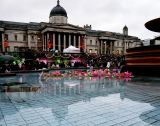 London to celebrate Diwali with free festival of music, dance and culture in Trafalgar Square
Trafalgar Square will become the centre of London’s Diwali celebrations on Sunday, 25 October, as the capital prepares to welcome thousands of residents and visitors for a free festivalRead More...
London to celebrate Diwali with free festival of music, dance and culture in Trafalgar Square
Trafalgar Square will become the centre of London’s Diwali celebrations on Sunday, 25 October, as the capital prepares to welcome thousands of residents and visitors for a free festivalRead More... -
 England’s national museums to keep free admission for all visitors
Government rules out charges for international tourists as museums receive further investmentRead More...
England’s national museums to keep free admission for all visitors
Government rules out charges for international tourists as museums receive further investmentRead More... -
 UK museums given three months to keep rare Renaissance bronze in Britain
British museums and galleries have been given a limited window to secure a rare Renaissance sculpture valued at more than £4.6 million, after the Government temporarily halted itsRead More...
UK museums given three months to keep rare Renaissance bronze in Britain
British museums and galleries have been given a limited window to secure a rare Renaissance sculpture valued at more than £4.6 million, after the Government temporarily halted itsRead More... -
 Oasis set to return in 2027 with massive 38-date global tour
Oasis are extending their long-awaited comeback with an ambitious 38-date tour scheduled for 2027, taking the iconic Britpop group across the UK, Ireland, continental Europe and theRead More...
Oasis set to return in 2027 with massive 38-date global tour
Oasis are extending their long-awaited comeback with an ambitious 38-date tour scheduled for 2027, taking the iconic Britpop group across the UK, Ireland, continental Europe and theRead More... -
 UK moves to keep Stanley Spencer’s landmark resurrection painting
The British government has stepped in to prevent a major early work by Stanley Spencer from leaving the country, giving museums and galleries a limited window to secure the paintingRead More...
UK moves to keep Stanley Spencer’s landmark resurrection painting
The British government has stepped in to prevent a major early work by Stanley Spencer from leaving the country, giving museums and galleries a limited window to secure the paintingRead More... -
 London’s record summer of live music delivers £3.4bn boost
London has enjoyed a record-breaking summer of live music, with millions of fans attending concerts across the capital as some of the world’s biggest artists took to its stadiums, arenasRead More...
London’s record summer of live music delivers £3.4bn boost
London has enjoyed a record-breaking summer of live music, with millions of fans attending concerts across the capital as some of the world’s biggest artists took to its stadiums, arenasRead More... -
 Government blocks export of rare Anglo-Saxon artefact in bid to keep national treasure in UK
The UK government has imposed a temporary export ban on an exceptionally rare Anglo-Saxon metal mount, giving museums and galleries time to raise funds to keep the historicRead More...
Government blocks export of rare Anglo-Saxon artefact in bid to keep national treasure in UK
The UK government has imposed a temporary export ban on an exceptionally rare Anglo-Saxon metal mount, giving museums and galleries time to raise funds to keep the historicRead More... -
 Jan van Eyck’s portraits to unite in landmark National Gallery exhibition
An unprecedented gathering of works by one of the Northern Renaissance’s greatest masters will bring Jan van Eyck’s portraiture into focus at the National Gallery this winter, with all 10 ofRead More...
Jan van Eyck’s portraits to unite in landmark National Gallery exhibition
An unprecedented gathering of works by one of the Northern Renaissance’s greatest masters will bring Jan van Eyck’s portraiture into focus at the National Gallery this winter, with all 10 ofRead More... -
 Europol sounds alarm over more violent museum heists across Europe
Museum robberies are taking a more dangerous turn across Europe, with organised criminal groups increasingly using heavy tools, explosives and other forms of force to steal valuableRead More...
Europol sounds alarm over more violent museum heists across Europe
Museum robberies are taking a more dangerous turn across Europe, with organised criminal groups increasingly using heavy tools, explosives and other forms of force to steal valuableRead More... -
 London marks UNESCO day with call for action, memory and justice on the legacy of the transatlantic slave trade
City Hall brings together community leaders, artists, young Londoners and historians to honour those affected by the transatlantic slave trade and celebrate the strength of African andRead More...
London marks UNESCO day with call for action, memory and justice on the legacy of the transatlantic slave trade
City Hall brings together community leaders, artists, young Londoners and historians to honour those affected by the transatlantic slave trade and celebrate the strength of African andRead More... -
 Honiara welcomes a global showcase of wildlife photography
Some of the world’s most striking wildlife photographs have arrived in the Solomon Islands, as the British High Commission and the Solomon Islands National Art Gallery open anRead More...
Honiara welcomes a global showcase of wildlife photography
Some of the world’s most striking wildlife photographs have arrived in the Solomon Islands, as the British High Commission and the Solomon Islands National Art Gallery open anRead More... -
 Britain’s festival season stages a cautious comeback as fans pay for more
Britain’s battered music festival industry is showing tentative signs of recovery, with several major events selling out faster than expected as organisers reshape their offer aroundRead More...
Britain’s festival season stages a cautious comeback as fans pay for more
Britain’s battered music festival industry is showing tentative signs of recovery, with several major events selling out faster than expected as organisers reshape their offer aroundRead More... -
 British Week in Paraguay marks a decade with nine days of culture, food and music
Asunción is preparing for the 10th edition of British Week, a nine-day programme showcasing British culture and connections across Paraguay.Read More...
British Week in Paraguay marks a decade with nine days of culture, food and music
Asunción is preparing for the 10th edition of British Week, a nine-day programme showcasing British culture and connections across Paraguay.Read More...

British Queen celebrates
Most Read
- Teen held after US woman killed in London stabbings
- Heave-ho Harry! Prince prepares to join the walking wounded in ice trek to North Pole
- Football: Farhad Moshiri adamant Everton deal above board
- "Master of English Style". Interview with Designer Lydia Dart
- Letter to the Financial Times from Lord Mayor Alderman Michael Bear