Bank of England Chief Economist Huw Pill has expressed doubts about financial markets’ expectations of four interest rate increases over the next 12 months, warning that the scale and
pace of monetary tightening will depend on how persistently the war involving Iran fuels inflation in the United Kingdom.
Speaking at an event organised by Citi in Bangkok on Wednesday, on the sidelines of the International Monetary Fund’s semi-annual meetings, Pill questioned whether investors were justified in anticipating a series of consecutive rate rises.
He argued that, although the UK economy faces growing inflationary risks, it remains uncertain whether the Bank of England will need to raise borrowing costs as aggressively as markets currently anticipate.
“Is it obvious that we will need to move, follow market pricing to four 25 basis-point hikes and so forth? So there, I would be a little bit more sceptical,” Pill said.
The comments highlight the challenge facing the Bank of England as policymakers attempt to balance the threat of renewed inflation against the potential consequences of higher interest rates for households, businesses and economic activity.
Iran conflict complicates the inflation outlook
The economic consequences of the conflict in the Gulf have become a central concern for the Monetary Policy Committee (MPC), which sets the UK’s benchmark interest rate. Disruptions to energy markets and higher costs for businesses could push up prices and make inflation more difficult to bring under control.
At the same time, policymakers remain divided over how quickly the central bank should respond.
At its September meeting, Pill and two other MPC members voted to increase interest rates by 0.25 percentage points. The majority, including Governor Andrew Bailey, supported leaving rates unchanged while waiting for clearer evidence of the conflict’s impact on inflation.
However, the gap between the two camps appears to be narrowing as the conflict continues and the risk of longer-lasting price pressures becomes more apparent.
Pill acknowledged that the inflationary implications for Britain were increasingly clear, particularly if the initial economic shock were to trigger a broader and more persistent rise in prices.
“It's clearer that the implications of that are inflationary for the UK in a more persistent way, and I think it's clearer that there is a risk of some self-sustaining momentum taking hold,” he said.
Such a scenario would complicate the Bank’s efforts to return inflation to its 2% target. Higher energy and transport costs can feed into the prices of goods and services, while businesses may pass increased operating expenses on to consumers. If workers subsequently seek higher wages to compensate for rising living costs, inflationary pressures could become more entrenched.
Governor Bailey has also warned that the duration of the conflict will be critical in determining its economic consequences. On Tuesday, he reiterated that the impact on broader inflation had so far been relatively limited, but cautioned that the risks would increase the longer the situation continued.
Markets anticipate a series of rate rises
Financial markets have moved towards a more aggressive outlook for UK monetary policy, with investors treating a quarter-point increase at the Bank of England’s November meeting as almost certain.
Market pricing also points to three further increases by September 2027, taking the anticipated total to four rises over approximately a year.
Pill’s remarks suggest that investors should not automatically assume this trajectory will be followed. While the central bank may need to tighten monetary policy if inflation proves persistent, the eventual decision will depend on incoming economic data and the strength of underlying price pressures.
Interest rate increases generally make mortgages, business loans and other forms of borrowing more expensive. They can also restrain consumer spending and investment, helping to reduce demand and ease inflation over time. However, raising rates too aggressively could put additional pressure on households and companies already facing higher costs.
The Bank therefore faces a difficult decision: act firmly enough to prevent inflation from becoming entrenched without unnecessarily weakening economic growth.
Wage growth remains a key concern
Developments in the UK labour market offer some grounds for optimism. Pill pointed to the slowdown in wage increases as a positive sign for the inflation outlook, since more moderate pay growth can reduce pressure on businesses to raise prices.
Nevertheless, he cautioned that wage growth remained, at best, near the upper end of the pace considered consistent with the Bank’s 2% inflation objective.
This leaves policymakers with limited room for complacency. If wage pressures ease further and the effects of the conflict on domestic prices remain contained, the case for repeated rate increases could weaken. Conversely, sustained energy-cost increases combined with persistent wage and service-sector inflation could strengthen the argument for tighter monetary policy.
The coming months will therefore be crucial in determining whether the Bank of England follows the path currently anticipated by investors or adopts a more measured approach.
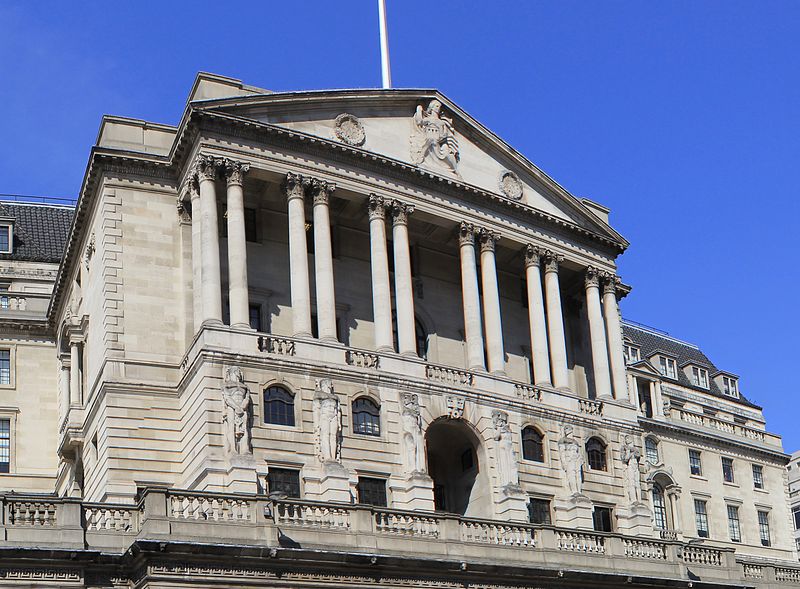
For borrowers and businesses, Pill’s intervention offers a reminder that market expectations are not a guarantee of future decisions. Although the possibility of higher borrowing costs has increased, the number and timing of any rate rises remain dependent on how the inflation outlook develops. Photo by Katie Chan, Wikimedia commons.