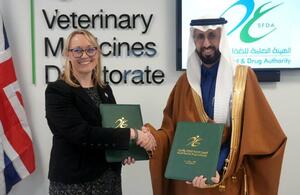
The United Kingdom and Saudi Arabia are expanding cooperation in public health, scientific research and regulatory standards, following a new agreement between their veterinary
medicines authorities. The partnership is part of a much broader bilateral programme covering trade, investment, education, healthcare, defence, clean energy and technological innovation.
Saudi Arabia and the United Kingdom have taken another step towards strengthening their long-standing relationship by signing a Memorandum of Understanding (MoU) on the regulation of veterinary medicines. The agreement between the Saudi Food and Drug Authority (SFDA) and the UK's Veterinary Medicines Directorate (VMD) aims to improve regulatory cooperation, facilitate scientific exchanges and reinforce safeguards for animal and human health.
The document was signed in London on 19 November 2026, on the sidelines of the DIA–MHRA Global Summit, entitled Global Collaboration for Safer and Smarter Health Innovation. The agreement was signed by Dr Hisham S. Aljadhey, Chief Executive Officer of the SFDA, and Abigail Seager, Chief Executive of the VMD.
The initiative reflects growing recognition that animal health and public health are closely interconnected, particularly as international trade in livestock, food products and veterinary pharmaceuticals continues to expand.
Under the agreement, the two authorities will establish a framework for exchanging regulatory information, scientific assessments and technical expertise. This will include sharing information about the availability of veterinary medicines, their approval requirements and the procedures used to evaluate their safety, quality and effectiveness.
The partnership will also encourage professional exchanges between specialists, training programmes and cooperation between regulatory experts and consultants from both countries.
An important area of collaboration will be the development of consistent approaches to laboratory testing, regulatory inspections and monitoring of veterinary products after they enter the market. The authorities also intend to exchange experience in supervising manufacturers, assessing market compliance and strengthening surveillance systems.
Particular attention will be paid to antimicrobial resistance (AMR), which occurs when microorganisms develop resistance to medicines used to treat infections. The excessive or inappropriate use of antibiotics in animals is recognised as one of the factors contributing to this global public health challenge.
Dr Aljadhey described the agreement as a strategic partnership that would improve technical capabilities, information exchange and the adoption of internationally recognised regulatory standards.
Abigail Seager said that cooperation between veterinary medicines regulators was essential to protecting both animal and human health. She highlighted the opportunity to share scientific knowledge and develop more effective responses to common challenges, including antimicrobial resistance.
The agreement is expected to benefit both countries by improving regulatory transparency, supporting the availability of safe veterinary medicines and facilitating cooperation between their scientific and regulatory institutions.
A broader strategic partnership beyond veterinary medicine
The new agreement should be viewed in the context of the wider strategic relationship between the two countries. Cooperation between London and Riyadh has developed considerably in recent years, extending well beyond traditional diplomatic and commercial relations.
The central institutional framework is the UK–Saudi Strategic Partnership Council, established in March 2018. It is designed to coordinate cooperation across two principal areas: economic and social development, and political and security affairs.
The economic and social pillar brings together initiatives in trade, investment, financial services, education, healthcare, energy, industry, environmental protection, culture, sport and tourism.
One of the most visible examples of this cooperation is the GREAT FUTURES campaign, launched in Riyadh in May 2024. The initiative provides a platform for British and Saudi businesses, government institutions and investors to develop joint projects, establish commercial partnerships and identify opportunities in emerging industries.
Its programme covers 13 economic sectors and has included business events, investment discussions and agreements designed to encourage companies from both countries to expand their operations in each other's markets.
At the September 2025 meeting of the Strategic Partnership Council in London, the two governments announced a new strategic partnership intended to align the UK's modern Industrial Strategy with Saudi Arabia's Vision 2030 economic transformation programme. Five priority areas were identified, including financial connectivity, education and innovation, healthcare, energy and industrial development, and cultural cooperation.
Trade and investment: ambitions for the next decade
Economic relations remain one of the strongest foundations of the bilateral partnership. Both governments have been working to increase commercial exchanges, attract investment and improve access to each other's markets.
In September 2025, the two countries reported that bilateral trade had exceeded £16 billion in 2024 and reaffirmed their ambition to increase it to £30 billion by 2030.
An important development came in May 2026, when the United Kingdom and the Gulf Cooperation Council (GCC), which includes Saudi Arabia, concluded negotiations on a free trade agreement. The agreement is intended to strengthen commercial relations between Britain and the six Gulf states by improving market access and creating new opportunities for exporters and investors.
Financial cooperation is also expanding. In October 2025, Saudi Arabia's Public Investment Fund (PIF) and UK Export Finance signed an agreement to facilitate up to £4–5 billion in financial support for British companies seeking contracts connected with PIF and its portfolio companies.
The arrangement is particularly significant for British suppliers of engineering, construction, infrastructure and professional services, which could benefit from Saudi Arabia's major development projects.
Education, healthcare and development of professional skills
Education and scientific innovation have become another important dimension of bilateral cooperation.
The two countries are encouraging partnerships between universities, educational institutions and research organisations. British educational providers have been expanding their presence in Saudi Arabia, while cooperation in technical and vocational education is intended to prepare young people for employment in new economic sectors.
A particularly important initiative is the Saudi–UK Future Skills Initiative, launched in April 2025 under the Strategic Partnership Council. It seeks to develop professional capabilities in 13 promising sectors, including financial services, energy, healthcare, transport, technology, tourism and advanced manufacturing.
The programme is designed to connect educational institutions with employers and ensure that professional training responds to the changing requirements of the labour market.
Healthcare cooperation also includes the exchange of expertise, medical training, digital healthcare development and investment in medical infrastructure. The establishment of a British nursing college in Saudi Arabia represents one practical example of this expanding relationship.
In science and innovation, the two countries are also working to encourage joint research projects and strengthen cooperation between their scientific institutions. Their priorities include artificial intelligence, emerging technologies, healthcare innovation and solutions to global challenges such as water and food security.
Energy transition and environmental protection
Energy security and the development of cleaner technologies are also central to the UK–Saudi relationship.
Both countries recognise the importance of combining their industrial capabilities and scientific expertise to support the transition towards more sustainable energy systems.
Their cooperation covers several areas:
Hydrogen technologies: developing green and clean hydrogen production and exploring commercial opportunities.
Carbon capture: sharing expertise in carbon capture, utilisation and storage (CCUS).
Renewable energy: encouraging investment and technological cooperation in clean energy.
Critical minerals: developing partnerships to improve access to resources essential for advanced manufacturing and energy technologies.
Environmental protection: supporting joint projects involving marine conservation, meteorology and climate change.
The two governments have also identified opportunities for cooperation in advanced manufacturing, mining, petrochemicals and space-related industries.
Culture, tourism and sports
Cultural diplomacy and people-to-people contacts are increasingly important elements of the partnership.
Under the bilateral cultural cooperation framework, the countries are encouraging collaboration between museums, cultural institutions, creative industries and organisations involved in preserving historical heritage.
Tourism has also benefited from improved travel arrangements, including electronic visitor visa facilities. According to the countries' September 2025 joint statement, more than 750,000 people travelled between the two kingdoms in 2024.
Sports cooperation includes professional training, academic research, the development of sports infrastructure and initiatives supporting women's participation in sport. The two countries have also explored cooperation in esports, including partnerships between their national esports organisations.
Defence and regional security
Defence and security remain another significant component of the relationship. The Strategic Partnership Council's political and security pillar provides a framework for consultations on regional stability, international security and defence cooperation.
The two countries maintain established military and security links, while continuing dialogue on developments in the Middle East and wider international security challenges. Their cooperation also includes efforts to strengthen institutional capabilities and address emerging security threats.
A partnership with growing international significance
The latest veterinary medicines agreement demonstrates how the UK–Saudi relationship is expanding into specialised areas of scientific and regulatory cooperation.
Although the agreement focuses on a relatively specific sector, its potential implications extend to food safety, international trade, pharmaceutical regulation and the fight against antimicrobial resistance.
For Britain, closer cooperation with Saudi Arabia offers opportunities for its scientific institutions, pharmaceutical companies, educational providers and technology businesses to participate in the Kingdom's economic diversification.
For Saudi Arabia, British expertise can support the development of regulatory institutions, healthcare infrastructure, research capabilities and modern industrial sectors.
The combination of Saudi Arabia's Vision 2030 programme and the UK's ambitions to strengthen international trade, investment and technological partnerships provides a substantial foundation for further cooperation.
The veterinary medicines agreement is therefore another example of how the two countries are translating their broader strategic ambitions into practical cooperation, with potential benefits for businesses, researchers, regulators and the wider public.