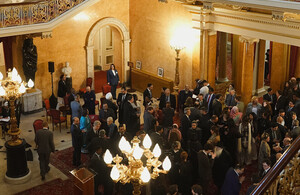
More than 180 guests from across the United Kingdom gathered at Lancaster House in London for a major community iftar hosted by government ministers, celebrating the contributions of
British Muslims to national life and encouraging stronger ties between faith communities.
The Ramadan event, held on 4 March, was jointly organised by the UK’s Ministry of Housing, Communities and Local Government and the Foreign, Commonwealth and Development Office. Community leaders, diplomats, parliamentarians, youth representatives and cultural figures attended the evening, which combined speeches, exhibitions and a shared meal to break the fast.
The reception aimed to recognise the economic, cultural, social and civic contributions made by Muslim communities throughout Britain. It also highlighted the government’s ongoing commitment to engaging with faith groups, diaspora communities and international partners.
The event was hosted by Communities Secretary Steve Reed, Minister for Faith, Devolution and Communities Miatta Fahnbulleh, and Foreign Office ministers Hamish Falconer and Seema Malhotra. During the evening, ministers acknowledged the concerns felt by many communities amid the ongoing tensions in the Middle East.
Speaking to guests, Reed praised the role British Muslims play in shaping modern Britain.
“Today, the United Kingdom is home to one of the most diverse Muslim communities in the world, and British Muslims continue to play a huge role in shaping so much of our shared national life,” he said.
“Nights like tonight really matter. They give us a moment to pause, to come together, and to think about the things that shape our lives. The values of Ramadan speak to all of us, no matter who we are or what we believe.”
Fahnbulleh emphasised the importance of building community cohesion through relationships at a grassroots level.
“Events like this matter because building cohesion happens on the ground, in our communities, through the relationships we build with faith leaders and organisations,” she said.
“That is exactly what this event is about — coming together, listening, and reaffirming that British Muslims are an integral and valued part of this country. Ramadan has become part of the fabric of life in Britain.”
Middle East Minister Falconer also highlighted the significance of Ramadan as a time of reflection and unity.
“Ramadan is a time for reflection and reminds us of the shared values that unite us all,” he said, acknowledging that recent events in the Middle East had been particularly difficult for many during the holy month.
“Last night’s Iftar reception stands as an important symbol of hope and peace during troubling times, and an opportunity to bring communities together.”
Among the speakers was Sajda Shah, who received an MBE in December 2025 for her work in community development. She stressed the importance of leadership and trust in strengthening communities.
“Tonight we were reminded that committed leadership, trust, and strong relationships are our greatest assets,” she said.
“That is the work ahead — and it is work we must pursue with purpose, resolve and drive.”
Alongside the iftar, guests viewed several exhibitions highlighting the historic contributions of Muslims to Britain.
One display featured “Great Faith” by British war artist Arabella Dorman, a portrait series honouring 80 Muslim servicemen and women — from veterans of the World Wars to those serving in the armed forces today.
Another exhibition, “Pioneers” by the Muslims in Rail network, showcased the role Muslim workers played in rebuilding Britain’s railway system in the decades following the Second World War.
The National Archives also presented an original exhibit on Noor Inayat Khan, the British spy who served during the Second World War and became the first female wireless operator sent to Nazi-occupied France to support the resistance.
The evening concluded with guests sharing the traditional iftar meal, reflecting the spirit of Ramadan — unity, reflection and community — while celebrating the enduring contributions of British Muslims to the country’s social fabric.