France’s government is preparing for another wave of demonstrations as the Yellow Vests movement plans a major march through Paris on Saturday, putting pressure on Prime Minister
Sébastien Lecornu to prevent a repeat of the violent unrest that swept several French cities last weekend.
The planned protest comes amid growing public frustration over the cost of living, deteriorating public services and the government’s handling of the crisis. The violence on 17 October, which included riots and looting in several urban centres, has raised serious questions about the authorities’ ability to maintain public order.
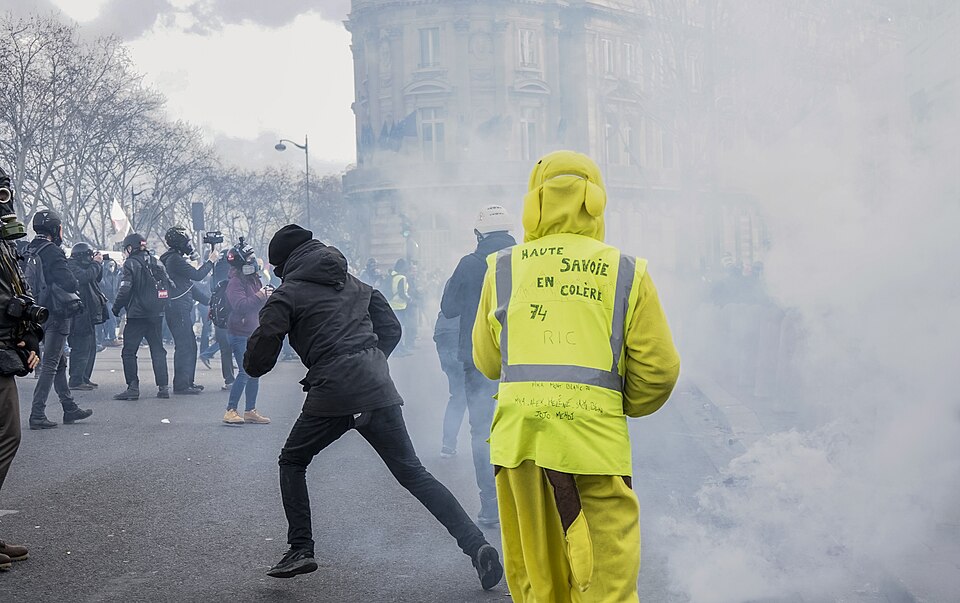
A representative of the grassroots Yellow Vests movement, known in French as Gilets Jaunes, has submitted plans for a march through central Paris, including districts recently affected by vandalism and looting. The movement, which emerged in 2018 in response to rising fuel prices and broader economic grievances, is seeking to regain momentum amid renewed discontent over living standards.
Student organisations are also planning demonstrations on Saturday, demanding increased investment in education and improved conditions in schools and universities. The simultaneous mobilisation of different groups presents an additional challenge for the authorities as they attempt to contain tensions without restricting the right to protest.
Government steps up security as markets react
The unrest last weekend escalated rapidly in Paris, Marseille, Lyon and Limoges, where police struggled to bring disturbances under control. The government has since acknowledged weaknesses in its initial response and promised a substantially strengthened security operation ahead of the forthcoming demonstrations.
Additional police officers are expected to be deployed, alongside military personnel, as ministers seek to prevent further destruction and confrontations. President Emmanuel Macron is also due to meet intelligence officials on Thursday to assess the security situation before the planned protests.
The crisis is already having repercussions beyond the streets. French government borrowing costs have risen sharply, with yields on benchmark 10-year bonds reaching 5% this week, their highest level since July 2002.
Financial analysts warn that prolonged instability could undermine efforts to restore the country’s strained public finances. France is already facing considerable budgetary pressures, and the prospect of further unrest could make it more difficult for the government to implement politically sensitive fiscal measures.
The authorities must therefore contend with two interconnected challenges: restoring confidence in public security and convincing investors that the country remains capable of addressing its financial difficulties.
Unions call for a political response
Lecornu met union representatives on Wednesday in an effort to ease tensions and find ways to prevent further violence. In a letter sent ahead of the discussions, the prime minister stressed the importance of protecting what he described as the essential freedom to demonstrate, arguing that peaceful protest must not be conflated with acts of violence.
France’s major trade unions have separately announced a nationwide mobilisation for 5 November, adding to the pressure on the government to address the underlying causes of public anger.
Sophie Binet, head of the CGT trade union, argued that the crisis required political solutions rather than a predominantly security-driven response. Speaking to RTL radio, she said the anger expressed by demonstrators was substantial and legitimate, and indicated that she would urge the prime minister to respond to those grievances.
Meanwhile, a second consecutive night of local curfews passed without major incidents in areas affected by the violence, providing a temporary reprieve for the authorities as preparations for Saturday’s demonstrations continued.
Political tensions intensify ahead of elections
The unrest has intensified criticism of the government at a sensitive moment, with France preparing for presidential elections next year. Opinion polls have shown strong support for both far-right and hard-left political forces, increasing the potential electoral consequences of the crisis.
Marine Le Pen, the prominent far-right leader, accused the government of losing control of the situation during an interview with Franceinfo radio. Her criticism reflects the political risks facing the administration as it struggles to demonstrate that it can restore order.
The hard-left France Unbowed (LFI), which government ministers have accused of contributing to the unrest, has also opposed plans to deploy military personnel on the streets of Paris. In a statement, the party’s parliamentary group argued that protesters should not be treated as internal enemies and warned against turning the confrontation into a conflict between the state and its citizens.
The competing responses illustrate the difficult balance facing the government. A tougher security posture could reassure residents and businesses concerned about violence, but it also risks provoking criticism from those who believe the authorities are failing to address the economic and social grievances driving the protests.
Wider European concerns over living standards
France’s difficulties are unfolding against a broader backdrop of public discontent elsewhere in Europe. Recent unrest in Italy and Albania has reinforced concerns that dissatisfaction with living standards, combined with pressure on public finances, could contribute to further political instability across the continent.
Italy has already responded to its own disturbances by approving a package of security measures, including a new offence relating to violent participation in demonstrations and tougher penalties for rioters.
For the French government, Saturday’s march will be a crucial test of whether its reinforced security preparations can prevent another outbreak of violence while allowing peaceful demonstrations to proceed.
The longer-term challenge, however, is political rather than purely operational. Unless the authorities can demonstrate progress on the cost of living, public services and wider economic concerns, renewed protests could continue to undermine confidence in the government in the months leading up to the presidential election. Photo by Norbu Gyachung, Wikimedia commons.