A bipartisan group of U.S. lawmakers visiting Taipei on Monday delivered a clear message: Taiwan must move quickly to approve President Lai Ching-te’s stalled $40 billion defence budget or
risk weakening its ability to deter growing pressure from China.
The delegation, led by Republican Senator John Curtis, met with President Lai amid heightened tensions across the Taiwan Strait. Their visit comes as Beijing intensifies military drills and political pressure aimed at forcing the self-governed island to accept Chinese sovereignty—a claim Taiwan firmly rejects.
“Washington is watching closely,” Curtis said after the meeting at the presidential office. “If the United States is investing in Taiwan’s security, we expect Taiwan to demonstrate the same commitment. This is a shared effort.”
Despite lacking formal diplomatic ties, the United States remains Taiwan’s most important international partner—supplying weapons, providing strategic support, and backing the island diplomatically on the global stage.
However, Lai’s proposed defence spending boost has stalled in Taiwan’s opposition-controlled parliament, where lawmakers continue to debate the scale and urgency of the package. The delay comes even as Taiwan has already secured approval to proceed with roughly $9 billion in U.S. arms purchases under existing agreements.
Democratic Senator Jeanne Shaheen, part of the visiting group, voiced concern over Beijing’s escalating actions. “China’s increasing military activity around Taiwan raises the risk of miscalculation,” she said, pointing to recent large-scale war games conducted near the island.
Those exercises followed Washington’s approval of an $11 billion arms sale to Taiwan late last year. U.S. officials are now preparing an additional package reportedly worth up to $14 billion—further underscoring the deepening security relationship.
Growing U.S.–Taiwan security cooperation
Beyond arms sales, U.S.–Taiwan cooperation has expanded significantly in recent years. Washington has stepped up military training support, intelligence sharing, and joint planning efforts aimed at strengthening Taiwan’s asymmetric defence capabilities—strategies designed to make any potential invasion by China costly and difficult.
Under legislation like the Taiwan Relations Act, the U.S. is committed to helping Taiwan maintain a sufficient self-defence capacity. More recently, initiatives such as the Taiwan Enhanced Resilience Act and increased congressional visits have signaled stronger political backing.
The U.S. has also encouraged Taiwan to adopt a “porcupine strategy”—focusing on mobile missile systems, drones, cyber defence, and coastal defence weapons rather than traditional large-scale platforms. This approach aligns closely with American military thinking on how smaller forces can counter larger adversaries.
At the same time, cooperation has broadened beyond defence. The U.S. and Taiwan have deepened ties in trade, semiconductor supply chains, and technology security—areas seen as critical to both economic resilience and national security. Taiwan, home to global chip giant TSMC, plays a pivotal role in the global tech ecosystem, making stability in the region a strategic priority for Washington.
A critical moment
For Taiwan, the stalled defence budget now sits at the intersection of domestic politics and international expectations. While opposition lawmakers have raised concerns over spending levels and oversight, U.S. officials argue that delays could send the wrong signal at a time of rising regional risk.
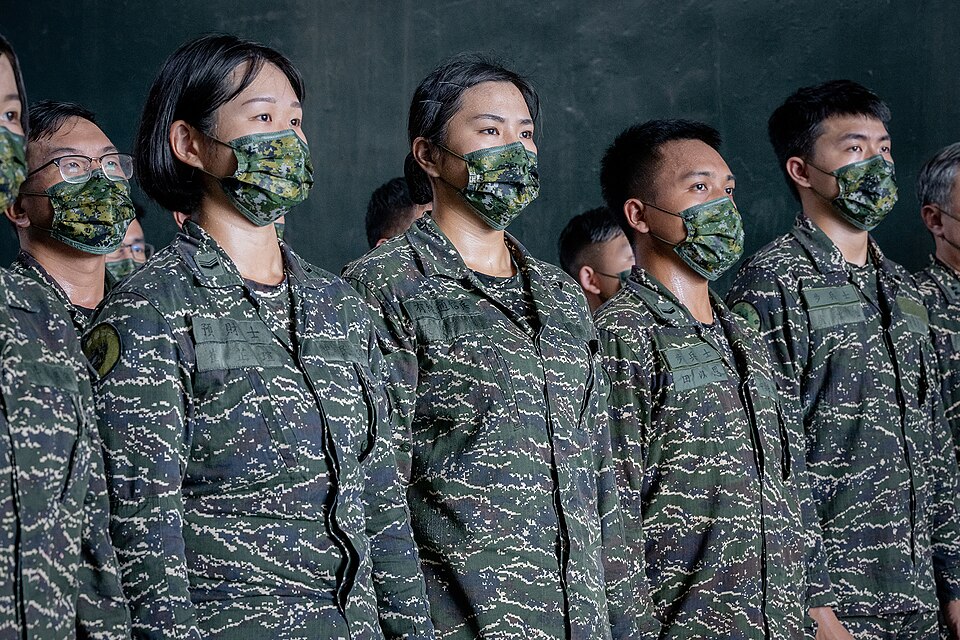
With China showing no signs of easing pressure, and U.S. support continuing to grow, the coming weeks could prove decisive in shaping Taiwan’s defence posture—and the broader balance of power in the Indo-Pacific. Photo by 總統府, Wikimedia commons.