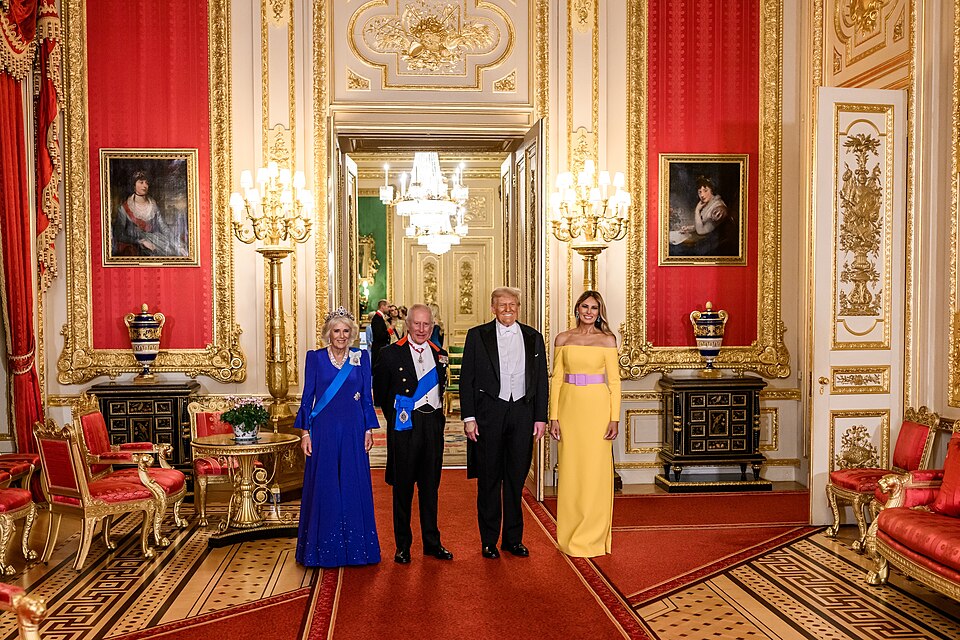
King Charles III is set to travel to the United States in late April for a high-profile state visit, Buckingham Palace confirmed on Tuesday, in what is widely seen as a diplomatic effort to stabilize
increasingly strained relations between London and Washington.
The monarch, accompanied by Queen Camilla, will undertake the visit as part of commemorations marking the 250th anniversary of American independence—an event that underscores both the historical rupture and enduring partnership between the two nations. Following their U.S. engagements, the royal couple will also travel to Bermuda.
According to Buckingham Palace, the visit will “celebrate the historic connections and the modern bilateral relationship between the United Kingdom and the United States,” emphasizing shared values, cultural ties, and strategic cooperation. The trip is being carried out on the advice of the British government.
This marks the first state visit by a British monarch to the U.S. since 2007, when Queen Elizabeth II made her fourth and final official trip during her reign.
U.S. President Donald Trump announced that the visit will begin on April 27, with a formal state banquet scheduled at the White House the following evening. In a post on Truth Social, Trump expressed enthusiasm about the visit, describing it as “terrific” and praising the king.
Diplomatic strains over Iran conflict
Despite the ceremonial tone, the visit comes at a time of heightened political tension. Relations between the U.S. administration and British Prime Minister Keir Starmer have deteriorated over disagreements the Iran conflict. Starmer’s initial reluctance to support U.S. military operations—and his refusal to allow American forces to launch early strikes from British bases—drew sharp criticism from Washington.
Although the UK has since permitted limited defensive operations, Trump has publicly rebuked Starmer, questioning his leadership and accusing Britain of undermining the long-standing alliance. His remarks have included pointed criticism of Britain’s military contributions and warnings about reduced U.S. support.
Further friction has emerged over geopolitical issues such as the Chagos Islands, where the UK’s proposed sovereignty transfer to Mauritius—affecting a key joint U.S.-UK military base—has drawn opposition from Washington.
The ‘special relationship’ under pressure
The United Kingdom and the United States have long described their alliance as a “special relationship,” built on deep military cooperation, intelligence sharing, trade, and common democratic values. From NATO collaboration to joint operations in global conflicts, the partnership has historically been one of the closest in international politics.
However, this relationship has periodically faced strain, particularly when political leadership or strategic priorities diverge. The current tensions highlight how disagreements over foreign policy—especially in volatile regions like the Middle East—can test even the strongest alliances.
At the same time, economic ties remain robust. The U.S. is one of the UK’s largest trading partners, and both countries continue to cooperate closely on security, technology, and climate initiatives, even when political rhetoric becomes heated.
Royal diplomacy and soft power
Amid these challenges, the British government appears to be leaning on the monarchy’s soft power to ease tensions. King Charles, who has received praise from Trump in the past, is seen as a unifying figure capable of reinforcing goodwill between the two nations.
The king previously hosted Trump for a second state visit to the UK last September, an unprecedented gesture that included a ceremonial carriage procession and banquet at Windsor Castle. During that visit, Trump described the UK–US bond as “unbreakable.”
Prime Minister Starmer is expected to hope that the king can once again help stabilize relations, particularly as both countries navigate complex global issues such as the war in Ukraine and potential trade disputes.
However, the visit is not without its sensitivities. Trump remains an unpopular figure among many Britons, and his views on issues like climate change sharply contrast with the king’s long-standing environmental advocacy.
A delicate balancing act
For King Charles, the upcoming visit represents a delicate diplomatic balancing act—one that requires honoring the longstanding alliance while navigating political divisions. As the UK and U.S. mark centuries of shared history, the success of this visit may depend not only on ceremony, but on its ability to quietly rebuild trust at a critical moment.
With further royal engagement expected later this year, including a potential visit by Prince William during the summer, the monarchy may continue to play a subtle yet significant role in shaping the future of transatlantic relations. Photo by Executive Office of the President of the United States, Wikimedia commons.