
UK news

Police stepped up their investigation Monday into the bombing of a packed London Underground train during rush hour after officers made a second arrest in their probe.
The bomb went off on Friday's morning in a crowded carriage and although the device is thought to have malfunctioned, it still wounded 30 people. Britain downgraded on Sunday the nation's terrorism threat from its highest level following the arrest.
It was the country's fifth terror attack in six months, a series that has claimed 35 lives.
Police said earlier Sunday that a 21-year-old man, who has not been identified, was detained late Saturday in Hounslow, on the western rim of the capital.
"The Joint Terrorist Analysis Centre, which reviews the threat level that the UK is under, have decided to lower that level from critical to severe," interior minister Amber Rudd said in a televised statement.
Five years on from the 2012 Olympics, the area of London where they were held has a new train station, a luxury shopping centre and vast green spaces.
A swathe of post-industrial land in Stratford, east London, was given a new life but for local residents, the reality is a lot less perfect.
Penny Bernstock, an expert in housing and regeneration at the University of East London, said there were now "two worlds that co-exist" -- the old, poor, Stratford and a new, wealthy one.
But Hugh Robertson, Britain's sports minister at the time of the Games, told AFP the legacy of 2012 is clear: "The area around Stratford has been completely transformed."
The aim for the London Legacy Development Corporation (LLDC) going into the Games was to regenerate the area -- once deprived and blighted by high unemployment -- by ensuring the infrastructure would have a life after the Olympics.
According to the LLDC, it's job done after billions of pounds were poured into the area.
The 2012 organisers were determined they would leave none of the white elephants that have littered host cities of past Olympics.
The Olympic stadium has been leased to Premier League football club West Ham for the next 99 years -- and hosted the World Athletics Championships in August.
The futuristic Aquatics Centre designed by the late award-winning architect Zaha Hadid was scaled down after the Games and is now a popular facility for locals that can still host international events.

The Olympic Village, where athletes stayed during the competition, has been turned into thousands of flats.
"This is heaven! Look around you; look at this garden," Richard, a 29-year-old local resident, told AFP before making his way into the Olympic Park for his daily jog.
The LLDC plans for 10,000 new homes to be built in the area by 2030.
London seems to have avoided the fate endured by Athens -- where the Games are synonymous with financial ruin -- and Rio, where just over a year since the Olympics took place, the feelgood factor has vanished amid scandal and rotting venues.
In the Greek capital, little of the infrastructure has been reused, while in Rio, the Olympic Park is closed, the swimming pool has been drained and the Village, which was meant to be transformed into high-end housing, is still awaiting residents.
- 'Affordable for whom?' -
Many Stratford locals though feel they have not benefited from the huge sums spent on the Olympics.

Britons left stranded on Caribbean islands devastated by Hurricane Irma said Britain's response had been faulty, but Foreign Secretary Boris Johnson on Monday called the criticism "completely unjustified".
British billionaire Richard Branson meanwhile revealed the scale of the destruction by posting images on his blog of destroyed buildings on his private island in the British Virgin Islands.
Geoffrey Scott Baker, whose daughter Amy Brown is on the nearby Dutch-French Caribbean territory of St Martin, told BBC radio: "Nothing is happening."
"It seems that everybody can airlift their citizens out except for the UK who are doing absolutely nothing on the ground," Baker said after US citizens were evacuated from the island over the weekend.
Ian Smart told The Daily Telegraph that his son Jos with his girlfriend Julia Taylor were trapped on the same island, where "lawlessness is getting worse".

This is the shocking moment a woman was pushed in front of a bus after she collided with a jogger on a west London street.
Dramatic CCTV of the incident shows a man running along Putney Bridge before appearing to push the 33-year-old pedestrian into the road.
A bus heading straight towards the woman is forced to swerve into the adjacent lane, only narrowly avoiding hitting her.
The Metropolitan Police said the bus stopped and passengers tended to the woman – who received minor injuries – following the incident on Friday, May 5 at about 7.40am.
Officers said the jogger ran the other way across the bridge around 15 minutes later and the victim attempted to speak to him, but “he did not acknowledge her”.
Investigating officer Sergeant Mat Knowles said: “The victim was put in extreme danger when she was knocked into the road.

A 17-year-old girl who allegedly married an Islamic State group fighter via Skype appeared in a London court Wednesday (July 26) over plans to carry out a terror attack in Britain.
The teenager wed the jihadist over the messaging service in September 2016, the court heard.
She had already been arrested on a terrorism charge in August after authorities thwarted her plan to join the ISIS member in Syria, but was released on bail.
Between December and April, the duo allegedly conspired to carry out a terror attack in Britain and the girl planned to receive hand grenades and a firearm.

Most European equities sank Monday on poor data, airline sector turbulence and the strong euro, which neared a two-year peak against the dollar.
In afternoon trading London's FTSE 100 index was down 0.9 percent, with airline stocks facing headwinds after low-cost Irish carrier Ryanair posted soaring first-quarter profits but hinted at a price war in the sector.
Sentiment about eurozone stocks was hit as a survey showed that private sector business activity slowed in July for the second month running.
IHS Markit said its July Composite Purchasing Managers Index (PMI) came in at 55.8 points, the lowest reading in six months. A reading above 50 indicates economic expansion.
"The FTSE has suffered a rude awakening to the new week," said IG analyst Joshua Mahony.

US financial firms and no-frills airline easyJet have begun activating Brexit contingency plans and fears are growing that the trickle could turn into a flood as most major businesses in Britain are preparing similar arrangements.
Britain's easyJet, Europe's second biggest carrier by passenger numbers, set up a Vienna-based division on Thursday that will allow it to fly across the European Union regardless of the final outcome of talks on the UK exit from the bloc.
The announcement came after a source told AFP that New York investment bank Morgan Stanley had picked Frankfurt as its temporary hub in the EU and would be adding 200 jobs at its offices there.
US asset manager Northern Trust meanwhile has chosen Luxembourg for its base, and US bank giant Citigroup says it will move some operations from London to Frankfurt and expects "over time" to increase its presence in other EU cities.

Survivors of last month's deadly tower block inferno in London packed a tense meeting Wednesday and heckled the new leader of the local authority that has been attacked for its handling of the disaster.
Under tight security prompted by previous confrontations with the angry residents, at least 70 people who lost their homes in the devastating blaze crowded into the Kensington and Chelsea town hall.
The councillors' election at the meeting of Elizabeth Campbell as their new chief was met by boos and shouts of "shame on you", with the heckling a sign of survivors' continued anger at the authorities' handling of the Grenfell Tower disaster.
"I am deeply sorry for the grief and trauma that you are suffering. I am truly sorry that we did not do more to help you when you needed it the most," said Campbell, who at times could not be heard over shouts for her to resign.
Campbell took over after her predecessor Nicholas Paget-Brown who resigned following criticism at his response to the inferno, which spread ferociously through the 24-storey west London block and killed at least 80 people.

Distressed over a rise in acid attacks, some 200 delivery drivers protested in front of the British parliament on Tuesday, demanding the government takes action.
"Most of the time we get attacked or our bikes are stolen. I don't feel safe doing my work. Yesterday I felt threatened because some boys wanted to attack me," Musa, a young UberEATS driver toldAFP.
The protest was organised after five people, including delivery driver Jabed Hussain, were attacked with acid in the space of just 90 minutes on the night of July 13.

London's economy is wobbling from the early effects of Brexit judging from the capital's faltering housing market, fewer European Union citizens seeking work and weaker job creation, according to a report from the Centre for London think tank.
Despite the unemployment rate holding at its lowest in more than 25 years at 5.5 per cent, job creation has slowed and the number of foreign workers seeking payroll tax registrations has dropped by 15 per cent compared with a year earlier.
"While no-one knows how Brexit will play out, this new analysis suggests that London's economy is beginning to wobble," think tank director Ben Rogers said on Tuesday.
Category
Sport
Rybakina pulls out of Wuhan Open as foot injury forces break from tennis
 Rybakina pulls out of Wuhan Open as foot injury forces break from tennis
Manchester United turns Old Trafford turf into a piece of club history for fans
 Manchester United turns Old Trafford turf into a piece of club history for fans
Former police chief among officers investigated over Maccabi Tel Aviv fans ban
 Former police chief among officers investigated over Maccabi Tel Aviv fans ban
Nick Kyrgios suspended after cocaine test as Australian tennis star admits ‘huge mistake’
 Nick Kyrgios suspended after cocaine test as Australian tennis star admits ‘huge mistake’
Fraud arrest follows security disruption at Birmingham European Athletics Championships
 Fraud arrest follows security disruption at Birmingham European Athletics Championships
Asher-Smith matches European medal record as Hunt completes golden treble
 Asher-Smith matches European medal record as Hunt completes golden treble
OG Anunoby brings NBA champion’s backing to Mayor’s £2m plan to transform London basketball courts
 OG Anunoby brings NBA champion’s backing to Mayor’s £2m plan to transform London basketball courts
London launches bid to bring 2029 World Athletics Championships back to the capital
 London launches bid to bring 2029 World Athletics Championships back to the capital
Serbia and Sweden withdraw support for Infantino's FIFA re-election
 Serbia and Sweden withdraw support for Infantino's FIFA re-election
Wales withdraws support for Infantino’s FIFA re-election bid
 Wales withdraws support for Infantino’s FIFA re-election bid
Education
-
 Oxford holds global university crown for record 11th consecutive year
The University of Oxford has retained its position as the world’s highest-ranked university for an unprecedented 11th consecutive year, according to the Times Higher Education (THE)Read More...
Oxford holds global university crown for record 11th consecutive year
The University of Oxford has retained its position as the world’s highest-ranked university for an unprecedented 11th consecutive year, according to the Times Higher Education (THE)Read More... -
 Jewish students face rising antisemitism on UK campuses, report finds
Antisemitic incidents at universities across Britain have risen sharply since the Hamas-led attacks on Israel in October 2023, according to a new report from the Community Security TrustRead More...
Jewish students face rising antisemitism on UK campuses, report finds
Antisemitic incidents at universities across Britain have risen sharply since the Hamas-led attacks on Israel in October 2023, according to a new report from the Community Security TrustRead More... -
 UK schools to receive new support to confront misogyny and harmful online influences
Schools across England are set to receive a new package of guidance and resources designed to help teachers tackle misogyny, promote respectful relationships and address harmfulRead More...
UK schools to receive new support to confront misogyny and harmful online influences
Schools across England are set to receive a new package of guidance and resources designed to help teachers tackle misogyny, promote respectful relationships and address harmfulRead More... -
 England to recruit 1,000 youth workers in biggest youth services expansion for a generation
The government is to fund the recruitment and training of 1,000 new youth workers across England as part of a major expansion of services aimed at helping young people who are at riskRead More...
England to recruit 1,000 youth workers in biggest youth services expansion for a generation
The government is to fund the recruitment and training of 1,000 new youth workers across England as part of a major expansion of services aimed at helping young people who are at riskRead More... -
 London schools see sharp fall in exclusions as Inclusion Charter strengthens safety and belonging
New evidence suggests that efforts to improve inclusion and prevent violence are contributing to safer and more supportive school environments across London, with suspension andRead More...
London schools see sharp fall in exclusions as Inclusion Charter strengthens safety and belonging
New evidence suggests that efforts to improve inclusion and prevent violence are contributing to safer and more supportive school environments across London, with suspension andRead More... -
 £22.5m programme to expand enrichment opportunities for children in more than 400 schools
Hundreds of thousands of young people in disadvantaged communities across England are set to gain greater access to sport, music, arts, debating, volunteering and outdoor activitiesRead More...
£22.5m programme to expand enrichment opportunities for children in more than 400 schools
Hundreds of thousands of young people in disadvantaged communities across England are set to gain greater access to sport, music, arts, debating, volunteering and outdoor activitiesRead More... -
 Jewish studies in Europe at a crossroads: an interview with Oleg Kozerod
Interview with Oleh Kozerod, Researcher at the Kuras Institute of Political and Ethnic Studies of the National Academy of Sciences of UkraineRead More...
Jewish studies in Europe at a crossroads: an interview with Oleg Kozerod
Interview with Oleh Kozerod, Researcher at the Kuras Institute of Political and Ethnic Studies of the National Academy of Sciences of UkraineRead More... -
 England’s education overhaul puts local leaders at the centre of jobs and skills reform
Government brings mayors, employers, schools and colleges together to reshape technical education and connect young people with regional job opportunitiesRead More...
England’s education overhaul puts local leaders at the centre of jobs and skills reform
Government brings mayors, employers, schools and colleges together to reshape technical education and connect young people with regional job opportunitiesRead More... -
 London’s school run transformed as car journeys fall and active travel soars
A decade of policies introduced under Mayor Sadiq Khan has significantly changed how children travel to school, with new Transport for London figures showing a sharp fall in schoolRead More...
London’s school run transformed as car journeys fall and active travel soars
A decade of policies introduced under Mayor Sadiq Khan has significantly changed how children travel to school, with new Transport for London figures showing a sharp fall in schoolRead More... -
 UK families to save thousands as free school meals and breakfast clubs expand
Millions of children will gain access to free school meals this term as the government rolls out a wider package aimed at cutting the cost of sending children to school.Read More...
UK families to save thousands as free school meals and breakfast clubs expand
Millions of children will gain access to free school meals this term as the government rolls out a wider package aimed at cutting the cost of sending children to school.Read More...
Culture
-
 England’s national museums to keep free admission for all visitors
Government rules out charges for international tourists as museums receive further investmentRead More...
England’s national museums to keep free admission for all visitors
Government rules out charges for international tourists as museums receive further investmentRead More... -
 UK museums given three months to keep rare Renaissance bronze in Britain
British museums and galleries have been given a limited window to secure a rare Renaissance sculpture valued at more than £4.6 million, after the Government temporarily halted itsRead More...
UK museums given three months to keep rare Renaissance bronze in Britain
British museums and galleries have been given a limited window to secure a rare Renaissance sculpture valued at more than £4.6 million, after the Government temporarily halted itsRead More... -
 Oasis set to return in 2027 with massive 38-date global tour
Oasis are extending their long-awaited comeback with an ambitious 38-date tour scheduled for 2027, taking the iconic Britpop group across the UK, Ireland, continental Europe and theRead More...
Oasis set to return in 2027 with massive 38-date global tour
Oasis are extending their long-awaited comeback with an ambitious 38-date tour scheduled for 2027, taking the iconic Britpop group across the UK, Ireland, continental Europe and theRead More... -
 UK moves to keep Stanley Spencer’s landmark resurrection painting
The British government has stepped in to prevent a major early work by Stanley Spencer from leaving the country, giving museums and galleries a limited window to secure the paintingRead More...
UK moves to keep Stanley Spencer’s landmark resurrection painting
The British government has stepped in to prevent a major early work by Stanley Spencer from leaving the country, giving museums and galleries a limited window to secure the paintingRead More... -
 London’s record summer of live music delivers £3.4bn boost
London has enjoyed a record-breaking summer of live music, with millions of fans attending concerts across the capital as some of the world’s biggest artists took to its stadiums, arenasRead More...
London’s record summer of live music delivers £3.4bn boost
London has enjoyed a record-breaking summer of live music, with millions of fans attending concerts across the capital as some of the world’s biggest artists took to its stadiums, arenasRead More... -
 Government blocks export of rare Anglo-Saxon artefact in bid to keep national treasure in UK
The UK government has imposed a temporary export ban on an exceptionally rare Anglo-Saxon metal mount, giving museums and galleries time to raise funds to keep the historicRead More...
Government blocks export of rare Anglo-Saxon artefact in bid to keep national treasure in UK
The UK government has imposed a temporary export ban on an exceptionally rare Anglo-Saxon metal mount, giving museums and galleries time to raise funds to keep the historicRead More... -
 Jan van Eyck’s portraits to unite in landmark National Gallery exhibition
An unprecedented gathering of works by one of the Northern Renaissance’s greatest masters will bring Jan van Eyck’s portraiture into focus at the National Gallery this winter, with all 10 ofRead More...
Jan van Eyck’s portraits to unite in landmark National Gallery exhibition
An unprecedented gathering of works by one of the Northern Renaissance’s greatest masters will bring Jan van Eyck’s portraiture into focus at the National Gallery this winter, with all 10 ofRead More... -
 Europol sounds alarm over more violent museum heists across Europe
Museum robberies are taking a more dangerous turn across Europe, with organised criminal groups increasingly using heavy tools, explosives and other forms of force to steal valuableRead More...
Europol sounds alarm over more violent museum heists across Europe
Museum robberies are taking a more dangerous turn across Europe, with organised criminal groups increasingly using heavy tools, explosives and other forms of force to steal valuableRead More... -
 London marks UNESCO day with call for action, memory and justice on the legacy of the transatlantic slave trade
City Hall brings together community leaders, artists, young Londoners and historians to honour those affected by the transatlantic slave trade and celebrate the strength of African andRead More...
London marks UNESCO day with call for action, memory and justice on the legacy of the transatlantic slave trade
City Hall brings together community leaders, artists, young Londoners and historians to honour those affected by the transatlantic slave trade and celebrate the strength of African andRead More... -
 Honiara welcomes a global showcase of wildlife photography
Some of the world’s most striking wildlife photographs have arrived in the Solomon Islands, as the British High Commission and the Solomon Islands National Art Gallery open anRead More...
Honiara welcomes a global showcase of wildlife photography
Some of the world’s most striking wildlife photographs have arrived in the Solomon Islands, as the British High Commission and the Solomon Islands National Art Gallery open anRead More... -
 Britain’s festival season stages a cautious comeback as fans pay for more
Britain’s battered music festival industry is showing tentative signs of recovery, with several major events selling out faster than expected as organisers reshape their offer aroundRead More...
Britain’s festival season stages a cautious comeback as fans pay for more
Britain’s battered music festival industry is showing tentative signs of recovery, with several major events selling out faster than expected as organisers reshape their offer aroundRead More... -
 British Week in Paraguay marks a decade with nine days of culture, food and music
Asunción is preparing for the 10th edition of British Week, a nine-day programme showcasing British culture and connections across Paraguay.Read More...
British Week in Paraguay marks a decade with nine days of culture, food and music
Asunción is preparing for the 10th edition of British Week, a nine-day programme showcasing British culture and connections across Paraguay.Read More... -
 Stefan Zweig’s London refuge marked with blue plaque 90 years after Austrian writer fled Hitler
A London address that once offered refuge to one of Austria’s most celebrated writers has been formally marked in honour of Stefan Zweig, the Jewish novelist and essayist who fled theRead More...
Stefan Zweig’s London refuge marked with blue plaque 90 years after Austrian writer fled Hitler
A London address that once offered refuge to one of Austria’s most celebrated writers has been formally marked in honour of Stefan Zweig, the Jewish novelist and essayist who fled theRead More...
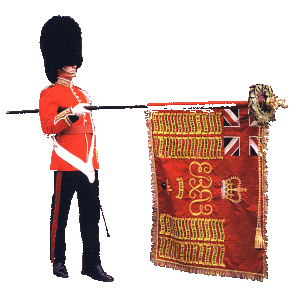
British Queen celebrates
Most Read
- Teen held after US woman killed in London stabbings
- Heave-ho Harry! Prince prepares to join the walking wounded in ice trek to North Pole
- Football: Farhad Moshiri adamant Everton deal above board
- "Master of English Style". Interview with Designer Lydia Dart
- Letter to the Financial Times from Lord Mayor Alderman Michael Bear