Reform UK leader Nigel Farage has regained his parliamentary seat in Clacton, defeating a colourful challenge from comedian Jonathan Harvey’s alter ego Count Binface — but the scale of
the protest vote has raised fresh questions about the momentum behind his party.
Farage secured 62.8% of the vote in Friday’s by-election, comfortably retaining the Essex constituency after deliberately resigning his seat last month to seek what he described as a renewed mandate.
But the result was far less emphatic than some opinion polling had suggested. Count Binface, a perennial figure of British electoral satire, captured 26.7% of the vote, turning what was expected to be a straightforward Farage victory into an unusual political contest. Turnout was 44%.
The result also exposed the risks of Farage’s decision to force the by-election. He had portrayed the contest as a battle between ordinary voters and what he called an establishment determined to undermine him over questions surrounding his financial affairs.
Instead, with Labour and Conservative candidates absent after the main parties dismissed the election as a self-serving exercise, the campaign became dominated by Count Binface’s irreverent challenge.
His manifesto included proposals to limit the price of ice cream cones and conscript people who use speakerphones on public transport — policies designed less to win power than to ridicule the political spectacle surrounding Farage.
Farage himself stayed away from the count in Clacton, saying police had warned him of an alleged campaign to disrupt the proceedings. He also cancelled a victory speech scheduled for later in the evening.
“I am damned if I am going to stand on a stage, having won a resounding victory ... and be demeaned and humiliated by nobodies,” Farage told supporters at a party before the result was announced.
The decision to resign his seat and immediately fight a by-election was intended to strengthen Farage’s political position while putting the controversy over his finances behind him.
Instead, the issue remains alive.
Parliamentary authorities reinstated an investigation into Farage’s financial declarations shortly after the result was announced. The inquiry concerns whether he should have declared a £5 million gift from a Thailand-based billionaire cryptocurrency investor before the 2024 general election.
Farage has acknowledged receiving the money but insists that he did not break parliamentary rules.
Under the rules governing MPs, relevant donations received in the year before a general election must be declared within a month of taking office. If the investigation ultimately finds that Farage breached those requirements, he could face suspension and potentially another contest for the Clacton seat.
Such an outcome would be considerably more serious if Labour and the Conservatives chose to participate in a future election.
The by-election has also provided a snapshot of the changing political landscape confronting Reform UK.
Farage’s party enjoyed a sustained period of strong national polling, but its support has recently begun to soften amid scrutiny of its finances and competition on the right.
Labour has benefited from a boost since Andy Burnham became prime minister last month, while Reform faces pressure from both the Conservatives and the anti-immigration Restore Britain party.
National polling now puts Labour ahead of Reform, with the governing party on 28% compared with Reform’s 25%.
Laura Richards-Gray, a politics lecturer at Birkbeck University of London, said the absence of mainstream opponents had ultimately weakened Farage’s attempt to frame the contest as a national confrontation with the establishment.
“This has backfired, particularly nationally, as Farage lost control of the narrative,” she said.
Farage nevertheless secured the immediate objective: his return to Parliament is confirmed.
But the unexpectedly strong performance by Count Binface, combined with the revival of the parliamentary investigation into his finances and signs that Reform’s national support is losing momentum, means the by-election may prove less of a triumph than its headline result suggests.
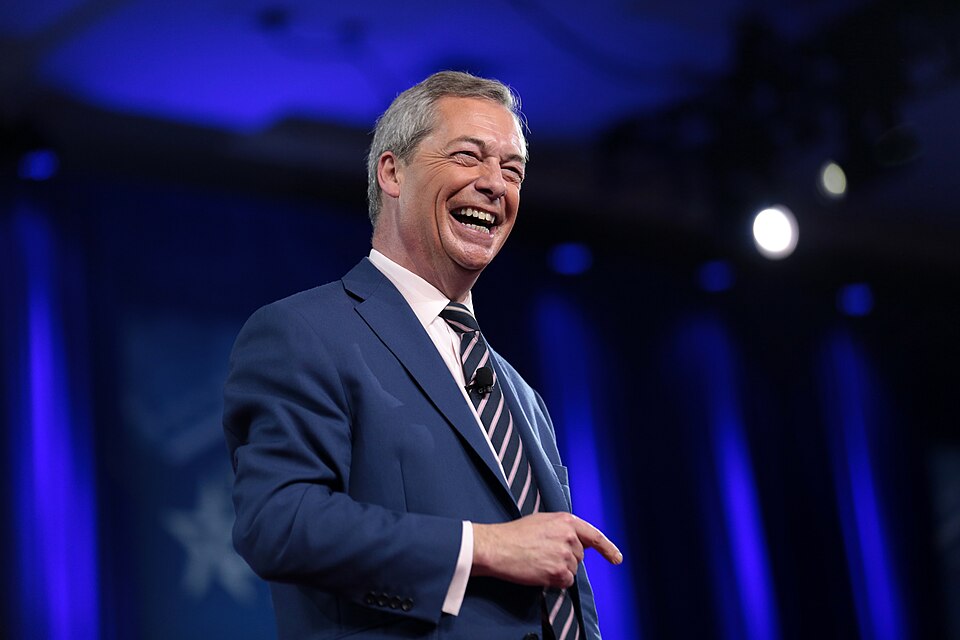
For Farage, the fight to retain Clacton may be over. The larger battle over Reform’s political direction — and his own future at Westminster — is not. Photo by Gage Skidmore from Peoria, AZ, United States of America, Wikimedia commons.