Major coastal defence works are now under way along the Sussex coastline, as the Environment Agency launches its annual spring programme to reduce flood risk for thousands of homes and
businesses.
The project, centred on the Pevensey Bay and Eastbourne frontage, forms part of a wider, multi-year strategy to strengthen resilience against rising sea levels and increasingly severe storms. This spring, engineers have begun relocating around 5,000 cubic metres of shingle — roughly equivalent to 50 double-decker buses — from Eastbourne to Pevensey Bay.
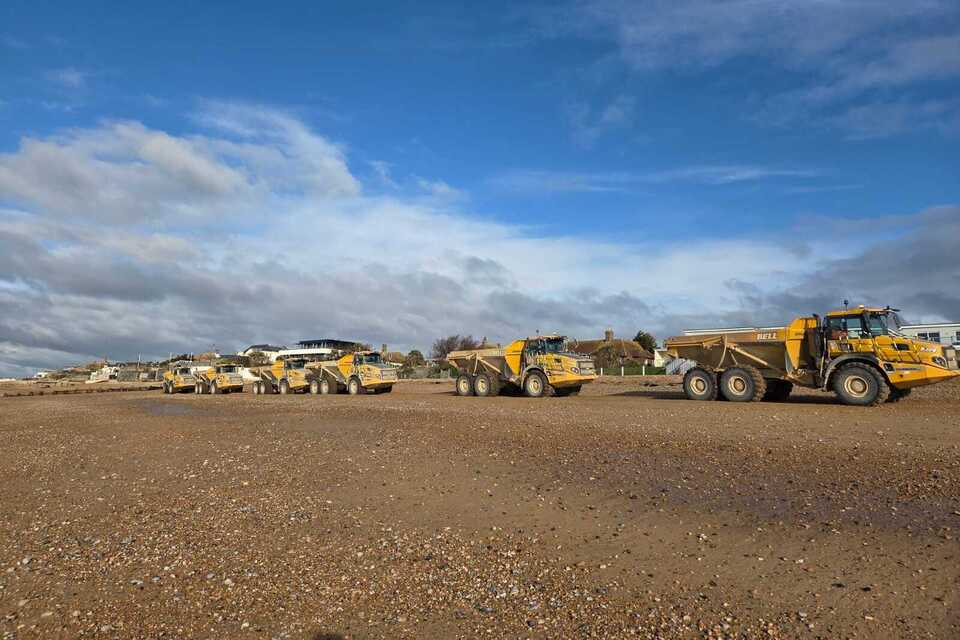
The operation, known as “shingle bypassing,” is a crucial part of maintaining the natural coastal defence system. Material that accumulates near Sovereign Harbour due to longshore drift is transported four miles along the coast using a fleet of tipper trucks making up to 96 trips a day. Over the course of the year, approximately 12,000 cubic metres of shingle will be added to Pevensey Beach.
This shingle acts as the frontline defence against coastal flooding, absorbing wave energy and reducing erosion. By redistributing it, the Environment Agency ensures protection is maintained not just locally, but along the wider stretch of coastline as sediment continues to move naturally.
Alongside the shingle works, preparations are under way for further upgrades. Seven lorry loads of timber have already arrived and will be used later this year to construct new wave screens along the Pevensey frontage — a £250,000 investment aimed at reinforcing existing defences.
On the ground, teams are also using a hybrid bulldozer to reshape and raise beach levels, cutting fuel use by around 30% compared to traditional machinery. The use of lower-emission equipment reflects a broader push to deliver infrastructure projects more sustainably.
The current phase of work, running from 2025 to 2027, is expected to protect more than 3,000 properties from flooding. It forms part of an £8 million investment announced under the government’s national flood and coastal defence funding programme.
Looking further ahead, the scheme will expand into a major long-term project covering 15 kilometres of coastline between Cooden Beach and Holywell. Planned works between 2027 and 2037 include upgrades to groynes and other coastal structures, before a longer-term strategy is implemented to address projected sea level rises of more than one metre by the end of the century.
In total, up to 18,000 properties could benefit from improved protection over the next 100 years.
Amber Carr, beach manager at Pevensey Bay, described spring as one of the busiest periods for coastal operations. She highlighted the importance of moving shingle to where it is most effective, rather than allowing it to accumulate near harbour structures.
Programme sponsor Nick Gray added that the works represent a key milestone in one of the UK’s most significant coastal flood defence projects, combining long-term planning with sustainable delivery methods.
The scheme is being delivered by the Environment Agency in partnership with local councils across East Sussex, with contractor VolkerStevin overseeing the current phase.
Despite the scale of the works, beaches will remain open, with visitors advised to follow safety guidance around operating machinery.
Extra context: coastal defence in Sussex
Sussex has one of the most actively managed coastlines in the UK due to its mix of shingle beaches, chalk cliffs, and heavily populated low-lying areas. Coastal defence here relies on a combination of:
- Shingle replenishment (beach nourishment): As seen at Pevensey, this is the primary defence, maintaining beach height to absorb wave energy.
- Groynes and timber wave screens: Structures that interrupt longshore drift and stabilise sediment.
- Sea walls and promenades: Common in urban areas like Eastbourne to provide hard-engineered protection.
- Cliff management: Particularly along chalk sections such as the South Downs, where controlled erosion is sometimes allowed.
Climate projections show sea levels along the south coast could rise by over one metre by 2100, significantly increasing flood risk. This is why schemes like the Pevensey to Eastbourne project are designed in phases — allowing adaptation over time as conditions change.
Sussex’s approach is often described as “adaptive coastal management” — combining engineering, environmental monitoring, and flexible long-term planning to balance protection, cost, and natural processes.