Britain’s economic policymakers are entering a familiar but increasingly uncomfortable position. As tensions from the Iran conflict ripple through global markets, both the government and the
Bank of England are urging caution, saying it is still too early to fully measure the economic fallout. Yet early warning signs are already emerging—and they are difficult to ignore.
A stark signal came from the Organisation for Economic Co-operation and Development, which downgraded the UK’s 2026 growth outlook more sharply than any other major economy, while simultaneously raising its inflation forecast. This combination of weaker growth and rising prices presents a serious challenge to the Labour government’s central promise: to restore public finances and improve services through stronger economic expansion.
At the same time, the Bank of England’s long-running battle against inflation risks being derailed just as progress had begun to materialize.
Energy shock exposes structural weakness
Britain’s vulnerability lies in its energy structure. Unlike countries such as France, where nuclear power dominates electricity generation, the UK remains heavily dependent on gas. As a result, the recent surge in gas prices—nearly doubling in a matter of weeks—has fed directly into electricity costs.
This has quickly filtered through the economy. Surveys point to the sharpest monthly rise in inflation expectations in decades, alongside a surge in costs reported by manufacturers and a noticeable drop in consumer confidence.
Households are already feeling the pressure. Fuel prices have risen at the pump, and farmers warn that food costs—especially greenhouse-grown produce like tomatoes, cucumbers, and peppers—will climb in the coming weeks.
Retailers are bracing for further disruption. Major chains have signaled that prolonged conflict could force price increases ranging from modest short-term rises to significant hikes later in the year. Meanwhile, consumer sentiment remains fragile, adding another layer of uncertainty for businesses.
Housing and borrowing pressures mount
The impact is also being felt in the housing market. Mortgage costs are rising, particularly for borrowers on variable rates, while lenders are withdrawing fixed-rate products in anticipation of further interest rate increases.
Economists warn that Britain has limited room to respond. Unlike previous crises, the government cannot easily ramp up borrowing without unsettling financial markets. At the same time, persistent inflation restricts the Bank of England’s ability to cut rates, even as unemployment begins to edge higher.
As one leading economist put it, the UK is entering this crisis “in a suboptimal position,” with policy flexibility severely constrained.
A different crisis, a different response
Policymakers are also cautious about repeating past strategies. During the energy shock triggered by the Russian invasion of Ukraine, the Bank of England raised interest rates aggressively—from near zero to 5.25% in just 18 months.
This time, the approach may differ. Officials suggest that while energy prices are rising, the broader inflationary impact could be more limited due to weaker economic conditions. So far, the increase in gas prices, while significant, has not matched the extreme surge seen in 2022.
Still, the risk remains that temporary energy shocks could become embedded in long-term inflation expectations—a scenario the Bank is keen to avoid.
UK economy in 2025: broader context
The current pressures come at a delicate moment for the UK economy in 2025. Growth has been sluggish, with GDP expansion hovering around low single digits following years of post-pandemic recovery challenges and trade adjustments after Brexit.
Key features of the 2025 UK economic landscape include:
- Persistent inflation: Although lower than its peak, inflation remains above the Bank of England’s 2% target, driven by energy, housing, and wage pressures.
- Weak productivity growth: Long-standing structural issues continue to limit output gains.
- Tight public finances: High debt levels restrict the government’s ability to use fiscal stimulus.
- Labour market shifts: Unemployment has begun to rise slightly, while wage growth remains uneven.
- Energy transition pressures: The UK is investing in renewables, but the transition is incomplete, leaving exposure to global gas markets.
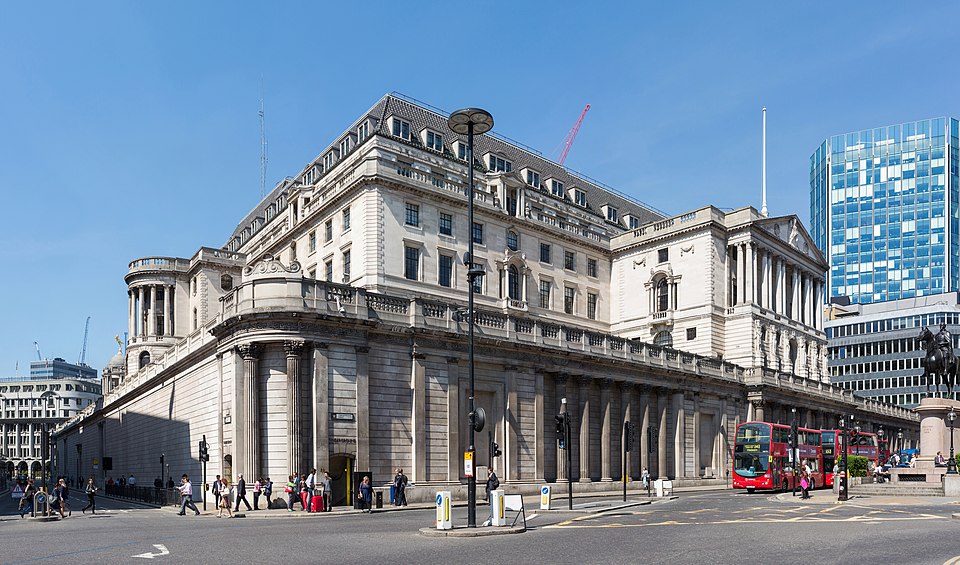
In this context, the Iran conflict acts less as a standalone shock and more as a stress test—highlighting existing weaknesses in the UK’s economic model. Photo by Diliff, Wikimedia commons.