The surname “Kozirod” belongs to the category of relatively rare surnames, which today are found only in a few countries around the world, including Poland, Germany, the USA, the UK,
Ukraine, and others. Currently, it is most common in Poland.
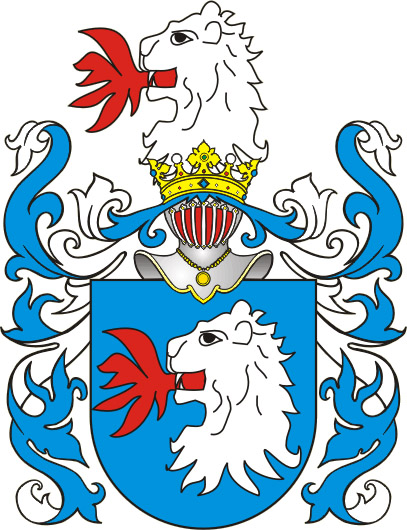
As revealed by this research, this surname is one of the oldest European noble surnames, whose meaning and origin have always sparked some debate among historians. Nevertheless, it remains a fact that bearers of this surname are part of one of the oldest European noble families, whose members, since 1395, had the right to use the Polish coat of arms Zadora.
Over the centuries, and in present-day Europe, several variations of this surname have existed, including Kozi Rod, Kosyrod, Caszirod, Kosirod, Kozirod, Kazirod, Kazierod, Kozerod. In the dictionary of the oldest Polish surnames, edited by Sofia Kowalik-Kaleta, Leonarda Dasevich, and Beata Radzewska-Zurek, which contains the most complete list of these surnames, it is noted:
“Kazirod – a lineage, the lineage of a person descending from a common ancestor, a people, a tribe, origin, birth, kind, type, first mention – 1395” [1].
Interestingly, if one compares the meanings of the two surnames mentioned on pages 65 and 76 of this dictionary, the surnames Kazirod and Kozirod mean the same thing [2].
Regarding the meaning of the surname, a modern specialist in the origin of Polish surnames, Stankevich, holds a slightly different opinion and notes in his dictionary:
“Kazirod – from the root kaz-, compare ‘to speak,’ ‘to issue commands, to tell stories,’ anciently ‘to preach,’ ‘to pollute,’ anciently ‘to spoil,’ as well as from the name Kazimierz” [3].
In the work of historian Kowalik-Kaleta, concerning the history of the oldest Polish surnames of the 12th–15th centuries, the surname Kozi Rod (1404) is mentioned, along with a certain Johannes Kosyrod de Pyser [4]. Information about this person is also contained in the lists of students of Kraków University for the year 1404 [5]. Judging by the prefix “de,” which was common in European nobility, Johannes Kozirod de Pyser was of aristocratic origin.
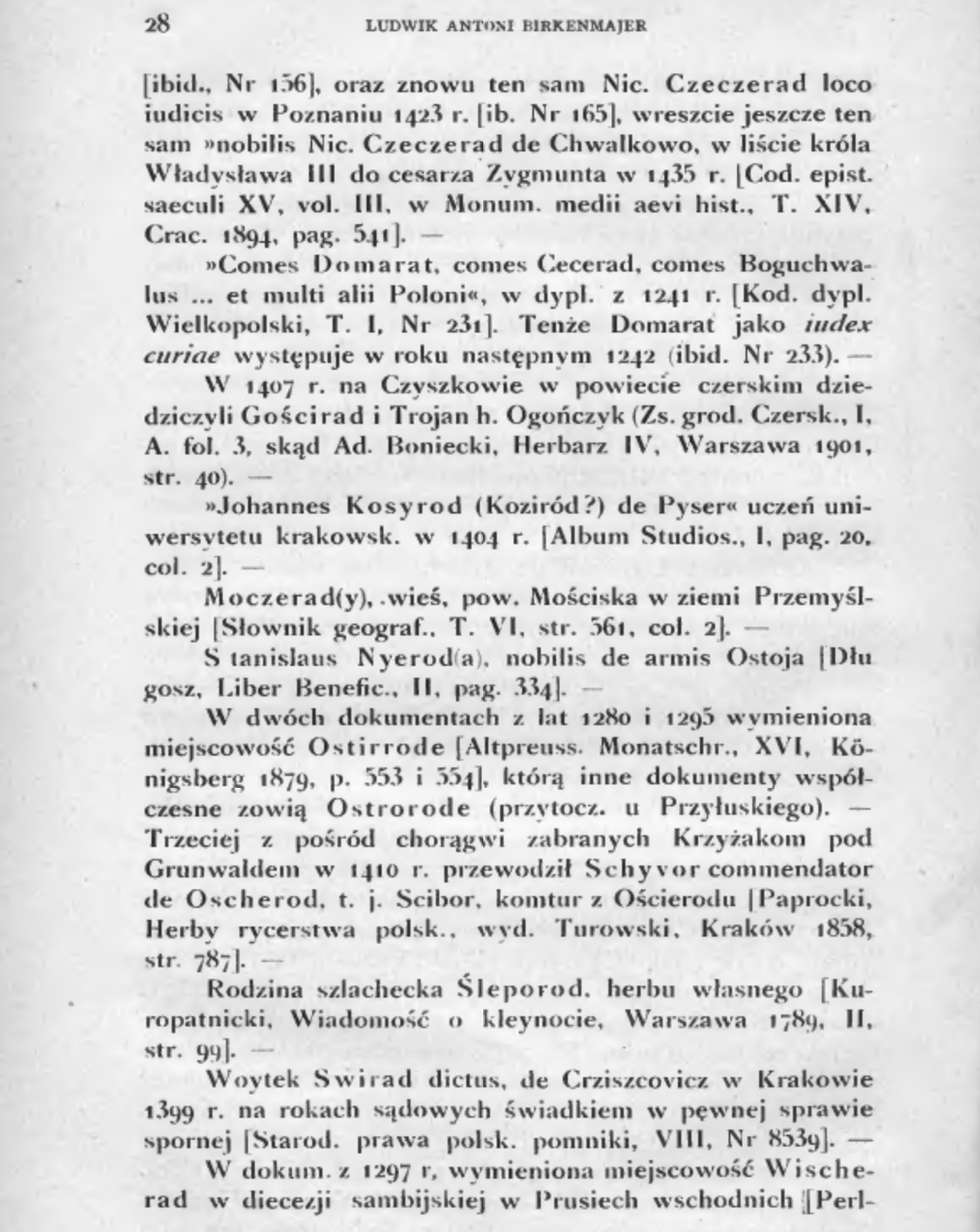
The surname de Pyser also appears in lists of noble families of Flanders, which for centuries was under French rule [6]. This surname can be found, for example, in lists of members of the religious court in Ghent [7]. In Flanders, it was believed that the surname de Pyser originated from the Polish town of Pyser (Peisern, Pyzdry), which contained the ancestral seat of the family [8]. This town in the 16th century was home to many noble (szlachta) families [9].
An interesting historical record of a member of the Kozirod family is the mention of the “altar servant” Mikolaj Kazirod (Mikolaj Caszirod). An altar servant, or “altarnik,” was a cleric responsible for a specific altar and received income from it. For some reason, young nobles teased Mikolaj both in the church and near his home. Historians note that one reason for this conflict was the “German origin” of this surname. During a raid by a group of nobles on the Kozirod house, a bathing barrel and other property were destroyed. At the court session, the prosecutor demanded 10 grivnas from the hooligans, a severe punishment, as the life of a townsman in Greater Poland at that time was “valued” at 6 grivnas [10].
Later, the surname de Pyser became quite common in many countries of Europe and the world, including England, where it was recognized as “originally English,” as well as in the USA. One can, in particular, refer to the mention of the surname Pyser in the publication The Oxford Dictionary of Family Names in Britain and Ireland [11].
Despite the existence of various versions regarding the origin of this surname, the starting point of its history is the year 1395, when the surname Kazirod was first mentioned in written sources. This mention is connected with the reference to the ancient Polish coat of arms Zadora, dated the same year, as well as the description of noble families entitled to bear it, in which the surname Kazirod appears, as noted by specialists in Polish heraldry, Tadeusz Gajl and Lech Milewski, in their fundamental work ‘Herbarz Polski’ [12].
It is worth noting that in the list of noble surnames, Kazirod is listed alongside well-known surnames that have survived to this day in Poland and Lithuania, such as Kiszkaylo, Konarski, Krestowski, Kurowski, Lanskhorowski, Lange, and others [13].
In 1395, the surname Kazirod also appears in another medieval source, this time German. The Latin text, found in the publication ‘Die ältesten grosspolnischen Grodbücher’, reads:
“We, the lords issuing judgment (in the case) of Hankon Kazirod, together with Nicholas son of Yashkon, formerly a miller, namely Vincent Stzalkowski, Johan Klandowski, Andreas Gorazdowski, Petrus Lansky, taking into account the letter of Lord Domarati, formerly a Polish captain, as he asserts, we award to this (Mr.) Kazirod, in accordance with his (Domarati) letter, one-third of the sum from Nicholas, son of Yashkon, from the (one) mill in front of the castle, which belonged to Yashkon. The court took place after the day of Zofia 1395: (present) Johan Klandowski, Vincent Burgrave, Toma Koshanka, Petrus Gorziszki” [14].
Members of the Kazirod lineage are also mentioned in many later sources. For example, in 1404, there is mention of a certain Jan Kazirod, who lived in the town of Pyser along with his brothers and sisters. In 1402, in the genealogy description of the Grzybowski family, a conflict involving Jan Kazirod of Grzybów is noted, in which he accused another Polish noble of non-noble origin and of bearing the Godzawa (Lily) coat of arms [15].
In 1479, the mayor of the town of Klobuk was a certain Andrzej Kazirod, who later held positions as a juror and advisor (1485) [16]. Starting from the late 15th century, a key marker of belonging to the nobility was no longer land ownership, but descent from noble ancestors. In many cases, it was necessary to painstakingly collect documentary evidence and prove noble origin. In Greater Poland, for example, it was required to provide the testimony of six witnesses, including witnesses from the maternal and paternal grandmother’s families.
The history of the Kazirod noble family can also be traced into the 16th century. In Józef Krzepel’s study “Landowning Families in the 15th–16th Centuries”, a landowner Kazirod of the Zadora coat of arms is mentioned as living in the Strzyków community of the Mazovian Voivodeship [17]. Today, this is a small town located on the Warsaw–Berlin route. It should be noted that the settlement area of members of this noble family of the Zadora coat of arms was the region of the modern Silesian and Lesser Poland Voivodeships in the Republic of Poland.
As is well known, Polish heraldry has one distinctive feature that sets it apart from other heraldic systems in the world. In Western Europe, for instance, coats of arms could be used only by individual families, whereas in Poland, they were shared by dozens, sometimes hundreds, of surnames. In Polish heraldry, a coat of arms is not inseparably linked to the individual owner but serves as a connecting link between relatives or landowners who lived in neighboring territories and fought under the same banner.
Therefore, an important part of the male members’ activity in the Kazirod family involved participating, together with representatives of 164 other families of the Zadora coat of arms, in various military campaigns and battles. According to legend, the origin of the Zadora coat of arms, which depicts a lion breathing fire from its mouth, is as follows: during battles between the Germans and Romans, the latter used such helmets to frighten their enemies. In one of these battles, a brave German warrior named Zadora killed a Roman, removed his helmet, and presented it to the monarch. In honor of this act, he received a coat of arms featuring a silver lion breathing fire from its mouth.
This coat of arms was widespread in the regions of Kraków and Sandomierz, and after the 1413 Union, in Lithuania. Initially, it was believed that the coat of arms had French or German origins. Indeed, the blue fire-breathing panther—a combination of dragon and lion—was a symbol of the Spanheim dynasty, which had large holdings in what is now Austria and Bavaria. Later, the blue panther on a white or silver background became the coat of arms of the family of the Count Palatine von Ortenburg, who lived in Kraiburg, and then the coat of arms passed to the Wittelsbachs. Today, the image of the fire-breathing panther can be seen on the coat of arms of the city of Ingolstadt and the federal state of Bavaria.
The Austrian theory of the origin of the Zadora coat of arms is considered plausible. Today, the image of the silver panther breathing fire adorns the coat of arms of the Austrian state of Styria and its capital, Graz. The black panther on a white background appeared in 1163 on the seal of Ottokar III, Margrave of Styria. When Styria united with Austria in 1192, the Holy Roman Emperor forbade the Babenbergs from using this coat of arms, preferring the older symbol of Carinthia. Consequently, the Styria coat of arms was changed, and the panther became silver on a green background. The fire-breathing panther can also be found in the coat of arms of the Austrian-adjacent region of Rottal-Inn in southern Bavaria.
It should be noted that the heraldic panther was always depicted as “incensed,” that is, enraged and breathing fire. Such a panther, along with the swan and red rose, was an emblem of Kings Henry IV and Henry VI, as well as the English House of Lancaster. In European heraldry, the panther often featured characteristics of a lion, dragon, or bull.
Alongside the Austrian version, there is also an Italian version of the origin of the coat of arms, and possibly even of the Kazirod family. Interestingly, many bearers of the Polish Zadora coat of arms originated from Italy. For example, members of the Carvaziano family moved to Kraków in 1324, where they founded their own bank and built a brewery. Several decades later, these Italians received the right to use the Polish Zadora coat of arms. Many other aristocratic surnames also trace their origins to the province of Como in northern Italy, including families such as Casarotti, Casarotto, Caserotto, and Casiraghi [18].
Italian historians claim that the surname Caserotto may derive from a nickname for someone who made cheese. The surname Casarotti is typical for the Veneto region, especially Verona, and also in Lombardy and Piedmont. Casarotto is also common in Veneto, including Verona, Vicenza, and Padua, as well as parts of northwestern Lombardy and northeastern Piedmont. The surname Caserotto is rare and characteristic of the Trentino region [19]. A similar surname by pronunciation and regional origin is Casiraghi. Documents indicate that this family originates from the village of Casirago, named after an unknown nobleman, although the surname’s origin is considered unknown. The Casiraghi coat of arms visually resembles the Zadora coat of arms. Today, Casiraghi is a well-known family of entrepreneurs from Bolzano, with some members being part of the ruling family of the Principality of Monaco.
The first prominent bearer of the Zadora coat of arms was Zbigniew of Brzezia (1360–1425) – Crown Marshal and Kraków Starost. A close ally of the Polish King Władysław Jagiełło, he served as an envoy to the Holy Roman Emperor and King of Hungary, Sigismund of Luxembourg. In 1408, Zbigniew of Brzezia led the Polish army sent to assist the Grand Duke of Lithuania, Vytautas, who was at war with the Grand Duchy of Moscow. In 1410, during the Battle of Grunwald, he commanded the 34th banner of the Crown Marshal, and in 1413 he participated in signing the Horodło Union act between Poland and the Grand Duchy of Lithuania [20].
Among other notable bearers of the Zadora coat of arms are Przedsław Łańskoroński, who, according to the chronicle of Grzegorz Grabiański, was the first Cossack Hetman of Ukraine and “successfully fought the Ottoman Cossacks many times,” as well as Maciej Łańskoroński, Castellan of Kyiv (1762–1772), Senator of the Sejm Józef Lubelski (Kozirod) (1884–1943), and other prominent figures of eastern Poland and Ukraine [21].
Returning to the history of the Kozirod family, today about 550 people in Poland bear the surnames Kazirod and Kozirod, which very likely indicates that seven centuries ago, they were one family. Many bearers of the surname, living in different countries, maintain this belief as part of an oral tradition passed down through generations. In the former Soviet Union, about 100 bearers of the surname live, where a variant “Kozerod” became common. When in the 1960s my grandfather’s surname was changed from Kozirod to Kozerod, and my father bore the latter surname, the family considered it a mistake by the Soviet civil registry. Later, it turned out that many such “errors” occurred, likely due to Soviet officials eliminating the Ukrainian sound “ы” (“i”) in such surnames, making them sound more Russian.
Despite the surname’s prevalence in Poland, the UK, and the USA, there are other theories of its origin that may shed light on the migration of its bearers from Western to Eastern Europe. German historians, for instance, consider Kazirod an ancient German surname dating back to the 13th–14th centuries. In Dr. Hermia Reichert’s foundational work Die deutschen Familiennamen nach Breslauer Quellen des 13. und 14. Jahrhunderts, the surname appears among other German surnames under the section “Nicht bestimmbar,” meaning “origin unknown.” In this section, it appears alongside other unusual German surnames such as Wingirsberg, Einstein, von Grekov, de Zarr, and others. The author does not consider this surname to have Eastern European or Slavic origins [22].
The earliest written mention of the surname Kozirod in the archives of the former Russian Empire, as far as we have found, dates to 1722. In a document titled *“Reports on the Hundreds of the Poltava Regiment regarding tobacco sowers, mills, apiaries, wineries, and inns for 1722,” it is noted: “Father Hryhoriy, Beliky deputy, two mills, with three stone mills and two mortars; in the same mill of Petro Kozirod a millstone” [23].
In another archival file from the same settlement—village of Beliky, now in Kobelyaky District, Poltava Oblast—titled “Register of Cossacks, regimental, hundred elders, banner and ensign companions with a list of military campaigns they participated in…” it is noted: “Petro Kazirod sent a Cossack in 1724 on the Terkiv Campaign.” This shows that the same Petro is referred to as both Petro Kozirod and Petro Kazirod, emphasizing that “Kazirod” and “Kozirod” are variants of the same surname [24].
The lands around the Beliky fortress belonged to Poland for a long time and held strategic significance on the southeastern border of the Polish-Lithuanian Commonwealth, of which they became part after the Union of Lublin in 1569. Starting in 1571, these lands belonged to the Cossack Omelyan Ivanovych. In the early 17th century, much of the territory around Beliky fortress became the property of the Polish noble S. Hursky [25]. In 1643, they passed to the nobleman, Ruthenian Yuriy Stefanovych Nemyrich [26], who had the right to bear the Klamry coat of arms, converted from Orthodoxy to Protestantism, and received a high-quality education at the Sorbonne, Oxford, Amsterdam, and Leiden.
Beliky fortress gained special importance in the first half of the 17th century, when it was surrounded by a high earthen rampart and equipped with underground structures that survived until the 20th century. Apparently, this period may correspond to the appearance of the Kazirod family at the fortress, likely relocating from southern Poland, as archival mentions from the 16th–17th centuries occur most frequently in that region. Oral family history states that after living in Beliky, the Kozirod family moved north in the 18th century to the Mashevsky District of Poltava Oblast. The family’s new base became the village of Ivanivka, which included a separate farmstead called Kozirodovka. Information about this farmstead can be found in several written sources, including the book “Settlements of Poltava Region as Part of the Governorates (1784–1796)” [27].
Sources indicate that the Kozirodovka hamlet existed for more than 100 years. According to data from 1895, its population was considered part of the parish of the Church of St. John the Theologian. One source from that period noted: “In 1895, 1,701 parishioners of both sexes attended services. By 1902, the parish included the villages of Ivanovka, Grigorovka, Sukhoi Tagamlyk, Manoilivka, Nekhvoroščanka, the settlement near Grigorovka, and the hamlets of Popasny, Volcha Balka, Kolodiazhna Balka, Oseevka, Kozirodovka, with a total of 2,624 parishioners of both sexes [28].”
Paradoxically, despite Kozirodovka being part of the Orthodox parish, by the end of the 19th century, the Kozirod family did not practice Orthodoxy. They remained separate and preserved their family traditions based on Protestantism. Family members were evangelists, studied the Gospel, were highly critical of Orthodox priests, and held private religious evangelical services at home. By the late 19th century, some family members had become quite wealthy. In particular, my great-grandfather, Viktor Kozirod, owned a large estate given to him by his father-in-law, Yakov Zakharovich Beydik, who was listed among “Forbes’ hundred in Russia at that time”—his name appears in the list of the wealthiest landowners of the Russian Empire [29]. Viktor Kozirod and his wife managed 20 hectares of land. Their estate has survived to the present day and is now the community club in the village of Dmytrivka, Mashevsky District, Poltava Oblast.
Following their wishes, the newlyweds also received from the father-in-law land, a pond, and a family business—a mill—since milling had been the Kozirod family’s occupation for many centuries. After the 1917 Revolution and the establishment of the communist regime, many members of the Kozirod and Beydik families, considered landlords and “exploiters of the working people,” were executed by the Bolsheviks. Viktor Kozirod and his family survived only by moving to Poltava, taking work as ordinary factory workers, and thus blending into the working-class environment.
It should be noted that, by coincidence or design, nearly all documentary references to the Kozirod family in Polish, Ukrainian, or other archives are connected to milling. Evidently, a family tradition of operating mills was passed down through generations over the centuries.
Analysis of modern Polish sources shows that today most members of the Kozirod-Kazirod family live in southern Poland. In the area of the city of Kielce, the center of the Świętokrzyskie Voivodeship, located 100 kilometers north of Kraków, 96 people bear the surname Kazirod, while across all of Poland, there are approximately 500. Credit should be given to the Polish registration authorities, who have demonstrated far greater accuracy in recording surnames than their counterparts in the Russian Empire and USSR; the Kozirod variant is extremely rare in Poland, appearing in only 39 cases [30].
Overall, the history of the Kozirod de Piser family represents one of the largely unexplored chapters in the history of European aristocratic families. Archival information about members of this family living in various countries is often fragmentary and must be corroborated by other sources from archives across Europe. This topic warrants further research, is fascinating, and helps shed light on the history of a small European family bearing one of Poland’s most famous coats of arms, “Zadora,” whose members contributed significantly to the formation of the Polish state, its ideology, and its culture.
Literature
- Zofia Kowalik-Kaleta, Leonarda Dacewicz, Beata Raszewska-Zurek Slownik Najstarszych Nazwisk Polskich Pochodzenie Jezykowe Nazwisk Omowionych w Historii Nazwysk.- Warszawa: Instytut Slawistyki Polskiej Academii Nauk, 2007.- Tom.1.-С.65.
- Ibid., С.-65, 76.
- Janucz Stankiewicz Genealogie, przodkowie, badania genealogiczne, forum dyskusyjne. URL:
http://www.stankiewicze.com/index.php?kat=44&sub=807
- Zofia Kowalik-Kaleta Historia Nazwysk Polskich na tle spolecznym i obyczajowym (XII-XV wiek). Warszawa: Instytut Slawistyki Polskiej Academii Nauk, 2007.- Tom.1.-С.175. URL:
http://rcin.org.pl/Content/39455/WA243_18875_2631015-T1_HIS-NAZW-POL_0000.pdf
- Stromata Copernicana : studja, poszukiwania i materjały biograficzne.- Krakow: Polska Akademia Umiejetnosci, 1924.- C.38. URL:
http://kpbc.ukw.edu.pl/dlibra/plain-content?id=39512
- Recherche des antiquitez et noblesse de Flandres, contenant l'histoire généalogique des comptes de Flandres, avec une description curieuse dudit pays, la suite des Gouverneurs de Flandres by Philippe de L'Espinoy, Dulieu de Charnay. – Vefue Marc Wyon, 1631.- P.778. URL:
- Ibid. -P. 817. URL:
- More: http://www.daveron.plus.com/other/pizernam.htm
- M. Pawlikowski, Sądownictwo grodzkie w przedrozbiorowej Rzeczypospolitej, Strzałków 2012, tenże, Sądownictwo ziemskie w przedrozbiorowej Rzeczypospolitej, Strzałków 2012.
- Acta capitulorum nec non iudiciorum ecclesiasticorum selecta. Vol. 2, Acta iudiciorum ecclesiasticorum dioecesum Gneznensis et Poznaniensis (1403-1530) by Boleslaw Ulanowski. Krakow, 1902. URL: https://genealodzy.pl/PNphpBB2-viewtopic-t-2813-start-0.phtml
- The Oxford Dictionary of Family Names in Britain and Ireland by Patrick Hanks,Richard Coates,Peter McClure. – Oxford: OUP, 2016.- P. 2155.
- Tadeusz Gail, Lech Milewski Herbarz Polski. – Warszawa, 2013.-Тоm.II. URL:
http://gajl.wielcy.pl/herby_nazwiska.php?lang=en&herb=zadora
- Ibid.
- Die ältesten grosspolnischen Grodbücher... by Jozef von Lekszycki.- S.Hirzel, 1889. – Vol.2, С. 53. URL:
https://archive.org/stream/dieltestengross00leksgoog#page/n73/mode/2up
- Genealogia Grzybowskich z Przewozu, Skorkowic, Dabrowy i Reczna. URL:
http://grzybowski.genealogiapolska.pl/showmedia.php?mediaID=372
- Album studiosorum Universitatis Cracoviensis.Ab anno 1400 ad annum 1489. (Ed.) B. Ulanowski. -Cracoviae 1887, ss. XII + 294. URL:
https://books.google.com.ua/books?id=Z7xWAAAAYAAJ&q=kazirod&dq=kazirod&hl=ru&sa=X&redir_esc=y
- More: Iozef Krzepela Rody Ziemianskie XV I XVI wieku. – Krakow, 1930.- T.1.-C.84. URL:
http://prusowie.pl/dane/Rody_ziemianskie_XV_i_XVI.pdf
- More Origine del cognome Caserotto
URL: https://www.cognomix.it/origine-cognome/caserotto.php
- Ibid.
- More:Paweł Jasienica: Myśli o dawnej Polsce. Warszawa: Czytelnik, 1990, s. 236; Statuta, Prawa Y Constitucie Koronne Łacinskie Y Polskie z Statutow Łaskiego Y Herborta Y Z Constituciy Koronnych Zebrane, Kraków 1600, s. 749.
- More: JosefLubelcki(Kozirod)(1884-1943). URL:
https://pl.wikipedia.org/wiki/J%C3%B3zef_Lubelski
- Die deutschen Familiennamen nach Breslauer Quellen des 13. und 14. Jahrhunderts, Dr. Hermaiiu Reichert.- Breslau: Verlag von M.&H.Marcus, 1908.- Heft 1, s. 87.
URL: https://archive.org/stream/diedeutschenfam00reicgoog/diedeutschenfam00reicgoog_djvu.txt
- More: Труды Полтавской Ученой Архивной Комиссии. Выпуск 2.- Полтава, 1905.-С.21. URL:
http://histpol.pl.ua/ru/kniga-pamyati/kniga-pamyati-i-skorbi/kniga-skorbi-tom-3?id=8577
- Козиродівка хх. при с. Івановка, Машівська волость // Адміністративно-територіальний поділ Полтавщини. – Полтава, ТОВ «Асми», 2012. - С.186.
- В. О. Мокляк, В. А. Павленко ІВАНІВКА с., Карлівський р-н. Православної Церкви громада. Іоанно-Бого-словська церква. URL:
http://history-poltava.org.ua/?p=3515
- Землевладельцы Российской империи и их имения: 1870-1918. URL: http://genealogia.baltwillinfo.com/ukr/01.pdf
https://nazwiska-polskie.pl/Kozir%C3%B3d
Dr Oleh Kozerod, Ph.D., Doctor of Letters, member of Royal Historical Society
Photo by Tadeusz Gajl, Wikimedia commons.