A drone strike on a British military base in Cyprus this week has reignited political debate over the United Kingdom’s long-standing military presence on the island. The incident has intensified
concerns that Cyprus could be pulled deeper into escalating tensions linked to the Iran conflict.
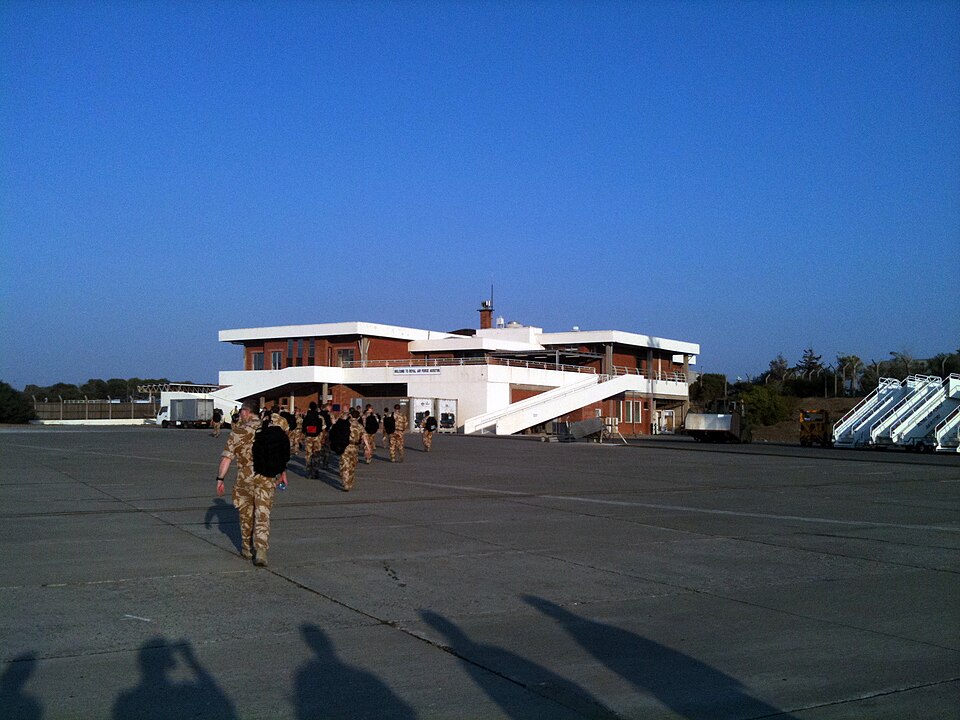
The drone struck the British air base at Akrotiri on Monday. Security officials believe it was launched by Hezbollah, the Lebanese group backed by Iran. No injuries were reported, but the strike triggered heightened security measures and forced evacuations of nearby civilians.
For decades, Cyprus has hosted two British sovereign military territories — Akrotiri and Dhekelia — remnants of the island’s colonial past. When Cyprus gained independence from Britain in 1960, the United Kingdom retained control of these areas, which together cover roughly 99 square miles along the southern and eastern coasts.
The bases remain among Britain’s most strategically important military installations overseas, supporting operations across the Middle East for years. Around 7,000 British military personnel and their families live on the bases, alongside approximately 12,000 Cypriots in surrounding communities.
Political pressure builds in Cyprus
While Cyprus has not formally demanded the closure of the bases, political pressure to reconsider their status is growing following the drone attack.
President Nikos Christodoulides said Friday that reviewing the status of the bases could not be ruled out, though he emphasized that decisions of such importance would not be made hastily during a crisis.
Foreign Minister Constantinos Kombos also struck a cautious tone, saying any decision regarding the bases must be approached carefully and not driven by immediate tensions.
However, the debate has become increasingly visible in public discourse. The pro-government newspaper *Phileleftheros* published a sharply worded editorial calling for the bases to leave Cyprus, arguing they now pose a risk to national security rather than protection.
Diplomatic tension with London
The issue intensified after remarks by British Prime Minister Keir Starmer over the weekend. Starmer did not initially rule out the possibility that the Cyprus bases could be used in potential U.S. or Israeli military operations against Iran.
The comments angered officials in Nicosia, who feared Cyprus might become a target if its territory were used in a wider regional conflict. The British government later clarified that the bases were not being used for such operations.
To ease tensions, London dispatched Defence Secretary John Healey to Cyprus for talks. President Christodoulides also met with MI6 chief Blaise Metreweli on Friday, though details of the discussion have not been made public.
Christodoulides later acknowledged that Starmer’s comments had caused “irritation” within the Cypriot government.
Colonial legacy under scrutiny
Legal experts in Cyprus argue the drone strike highlights a deeper issue: the continued existence of British sovereign territory on the island more than six decades after independence.
Some scholars say the arrangement represents a lingering colonial structure that may conflict with modern interpretations of international law and the principles of the United Nations Charter.
They also point to Britain’s 2025 agreement to transfer sovereignty of the Chagos Islands to Mauritius — following international court rulings that the UK’s colonial-era separation of the territory was unlawful — as a possible precedent.
Former Cypriot attorney general and Supreme Court judge Costas Clerides suggested that the legal framework governing the Cyprus bases could eventually be revisited to align more closely with international law.
A complicated political reality
Despite the growing debate, Cypriot officials privately acknowledge that challenging Britain over the bases would be politically complex.
Cyprus itself remains divided between Greek Cypriot and Turkish Cypriot administrations, and the unresolved conflict continues to shape the country’s diplomatic priorities.
For now, the British government insists the bases remain fully lawful under international law and has given no indication that it plans to reconsider their status.
Still, the drone strike has opened a sensitive conversation in Cyprus — one that could continue to influence regional diplomacy long after the immediate crisis fades. Photo by Wikimedia commons.