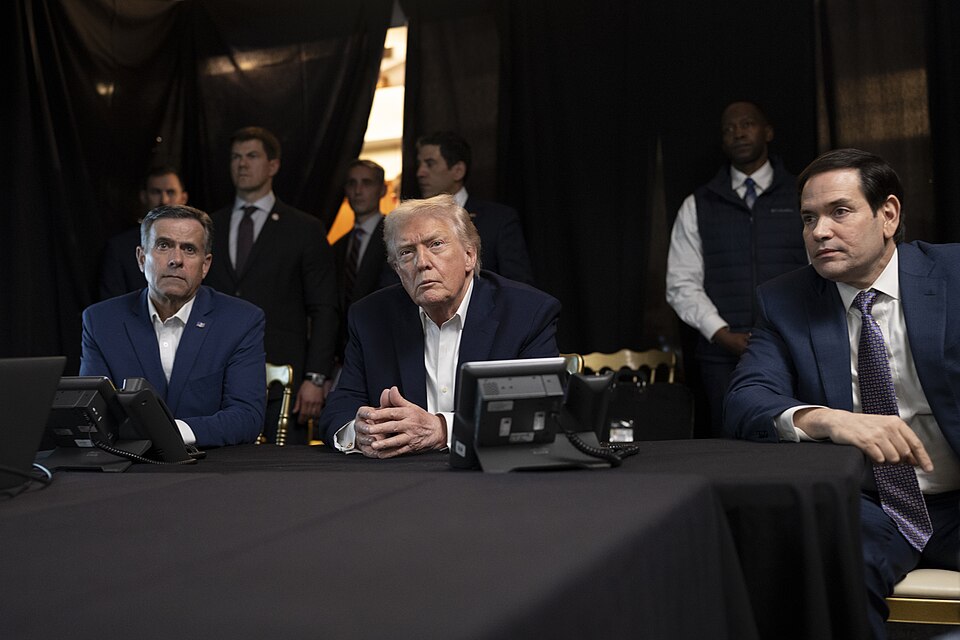
President Donald Trump and Secretary of State Marco Rubio have offered sharply different explanations for why the United States joined Israel’s military campaign
against Iran, fueling political backlash at home and raising fresh questions about how the conflict began.
Speaking to reporters on Tuesday, Trump said he authorized U.S. strikes because he believed Iran was on the verge of launching attacks of its own. That justification contradicted remarks Rubio made a day earlier, when he suggested the U.S. acted out of concern that Iran would retaliate against an anticipated Israeli assault.
“We knew there was going to be an Israeli action,” Rubio said Monday. “We knew that would precipitate an attack against American forces. And if we didn’t preemptively go after them, we would suffer higher casualties.”
Trump, however, pushed back against claims that Israel drove Washington into the war. Meeting German Chancellor Friedrich Merz in the Oval Office, the president said he believed Iran would strike first regardless.
“We were having negotiations with these lunatics,” Trump said. “It was my opinion that they were going to attack first. If we didn’t do it, they were going to attack first.”
Iran has described the U.S. strikes as unprovoked.
Political backlash grows
The conflicting narratives have intensified criticism from both Democrats and parts of Trump’s conservative base, some of whom accuse the president of launching a “war of choice” or allowing Israel to dictate U.S. policy.
Conservative commentator Matt Walsh said Rubio’s remarks suggested Washington was dragged into the conflict. “So he’s flat out telling us that we’re in a war with Iran because Israel forced our hand,” Walsh wrote on X.
Podcast host Megyn Kelly echoed similar doubts, arguing that the U.S. should not be fighting another country’s war. “This feels very much to me like it is clearly Israel’s war,” she said.
The criticism comes at a sensitive political moment, with Republicans fighting to retain control of Congress ahead of November’s midterm elections.
White House in damage-control mode
The debate has forced the administration into damage control. Trump on Tuesday answered questions in public for the first time since the U.S.-Israeli air campaign began three days earlier, after initially limiting his comments to videos and selected interviews.
The president said he believed Iran was close to launching attacks following talks held last Thursday in Geneva, though he offered no public evidence. Iranian officials had previously described those negotiations as positive, with further meetings planned.
Pressed on Tuesday about his earlier remarks, Rubio sought to unify the administration’s message. “The bottom line is this,” he told reporters on Capitol Hill. “The president determined we were not going to get hit first. It’s that simple.”
Diplomacy faltered before strikes
According to two senior administration officials, U.S. envoys Steve Witkoff and Jared Kushner had recently met Iranian representatives in Geneva, with Oman acting as mediator. The Americans repeatedly urged Iran to abandon uranium enrichment, the officials said.
Instead, Iran proposed a plan that would allow higher levels of enrichment at the Tehran Research Reactor, which U.S. officials viewed as a stalling tactic.
“They were unwilling to give up the building blocks they would need to preserve to get to a nuclear bomb,” one official said. Iran has long denied seeking nuclear weapons.
Envoys told Trump that a deal resembling the 2015 nuclear agreement was still possible but would likely take months. The president ordered U.S. forces into action the following day. Airstrikes began on Saturday.
As the war continues, the administration’s shifting explanations risk deepening political divisions at home, even as tensions in the Middle East escalate. Photo by Official White House Photo by Molly Riley, Wikimedia commons.