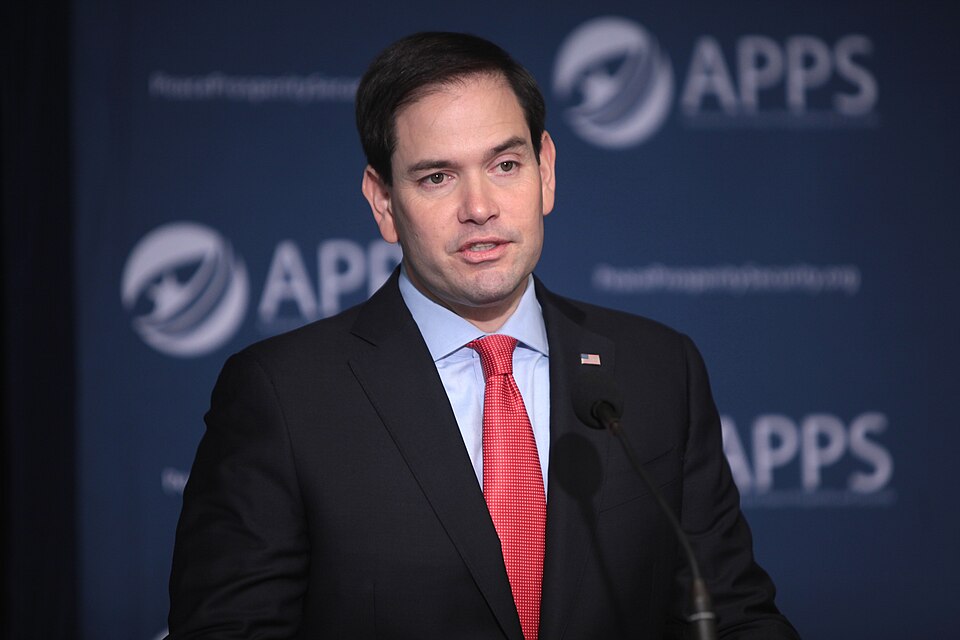
U.S. Secretary of State Marco Rubio arrived in Bahrain on Thursday for the final stop of a Middle East tour aimed at securing support from Gulf allies for the Trump administration’s
preliminary agreement with Iran.
Rubio’s visit comes as Gulf Arab leaders express concerns that the emerging U.S.-Iran deal could grant Tehran significant concessions, potentially altering the region’s security balance and affecting vital energy routes.
After arriving in Manama on Wednesday night, Rubio is scheduled to meet Bahraini officials as well as representatives of the Gulf Cooperation Council (GCC), which includes Saudi Arabia, the United Arab Emirates, Qatar, Kuwait, Oman and Bahrain. The Bahraini capital is also home to the headquarters of the U.S. Navy’s Fifth Fleet.
The three-day Gulf tour marks Washington’s first high-level diplomatic outreach since the United States and Iran announced a framework agreement last week intended to end their recent conflict.
During earlier stops in the UAE and Kuwait, Rubio sought to reassure regional partners that the proposed accord would not compromise their security interests. Several Gulf states came under Iranian attack during the U.S.-Israeli conflict, heightening concerns about Tehran’s future influence.
“We’re not going to do anything that undermines the security of our allies, our longstanding allies in the region,” Rubio told reporters in Kuwait.
However, uncertainty continues to surround the agreement. U.S. President Donald Trump said this week that Iran had accepted indefinite nuclear inspections, a claim Tehran has publicly rejected. The disagreement has fueled doubts about the durability of the fragile understanding reached between the two countries.
Washington and Tehran have also presented differing accounts on key issues, including economic incentives for Iran, oversight of the Strait of Hormuz and the impact of Israel’s military campaign in Lebanon.
All six GCC member states maintain close security ties with the United States and provided varying levels of logistical support during the recent conflict. Several were also affected by Iranian missile and drone strikes.
Regional officials remain particularly concerned about provisions in the draft agreement that reportedly place no restrictions on Iran’s ballistic missile program and include a proposed $300 billion reconstruction package. Critics fear the arrangement could strengthen Tehran’s regional position and increase its influence over critical oil shipping routes.
Rubio said he is not asking Gulf nations to contribute financially to reconstruction efforts, despite indications in the draft memorandum that regional partners could ultimately share part of the burden.
Privately, some Gulf governments have expressed disappointment with the interim deal, fearing it could pave the way for broader U.S.-Iran normalization. Many Sunni-led GCC states view Shi’ite-majority Iran as their primary regional rival.
In Bahrain, those concerns are especially pronounced. The kingdom’s Sunni-led monarchy governs a Shi’ite-majority population and has long worried that a wealthier and less isolated Iran could seek to expand its influence and stir domestic unrest. Photo by Gage Skidmore from Surprise, AZ, United States of America, Wikimedia commons.