Regular rail freight services through the Channel Tunnel are set to make a long-awaited comeback after a landmark, government-backed deal aimed at
transforming how goods move between the UK and Europe.
British businesses could soon be loading their exports directly onto trains bound for France, Germany, Italy and Spain, following an agreement that will see Network Rail and its property arm Platform4 take long-term control of the Barking Eurohub site in east London. The site, currently owned by Legal & General, is set to benefit from around £15 million of private investment to turn it into a major international logistics hub.
Announced on 25 February 2026, the deal is being hailed as a critical step towards restarting regular intermodal freight services through the Channel Tunnel. These trains carry goods in containers that can move seamlessly between rail, road and sea, offering a faster and more sustainable alternative to lorries and ships.
If delivered as planned, the project could reshape UK-EU trade. Scottish whisky, British white goods and consumer products could head straight to European customers by rail, while fresh fruit and vegetables from continental growers could arrive directly into London’s wholesale food markets.
Beyond trade, ministers say the benefits will be felt on Britain’s roads. Shifting freight from trucks to trains would ease congestion on key routes such as the Dartford Crossing and the M20 and M2 corridors, helping to cut pollution, reduce road damage and tackle the growing problem of potholes in the south-east.
Growing rail freight is a central plank of the government’s wider rail reform agenda. Once Great British Railways is established, it will have a legal duty to promote freight use, with ministers setting formal growth targets for the sector.
Rail Minister Lord Hendy described the agreement as a turning point for the industry. He said the deal would “reinvigorate rail freight”, open new trade routes to
Europe and provide a faster, greener way of transporting goods, while supporting jobs and economic growth across the UK.
Industry leaders have also welcomed the move. Network Rail’s chief executive said securing Barking Eurohub was essential to restoring regular cross-Channel freight services and ensuring the rail network plays a leading role in a more sustainable transport system.
At present, only a small fraction of UK-Europe freight moves by rail through the Channel Tunnel, largely limited to specialist bulk flows for single customers. The vast majority travels by sea before being moved inland by road, adding to congestion and emissions.
Supporters argue the Barking Eurohub investment could unlock that untapped potential, establishing a flagship logistics hub and giving businesses a viable, low-carbon alternative for moving goods in and out of the country.
Local leaders say the impact could be transformative. The redevelopment is expected to strengthen Barking and Dagenham’s industrial base, support hundreds of businesses and create new jobs, while boosting links to international markets and reinforcing the area’s role within the Thames Freeport.
The timing may be crucial. Rail freight is forecast to grow by at least 3% a year until 2033, despite freight train movements having nearly halved over the past two decades. Recent figures already point to a recovery, with freight volumes rising 5% in 2024–25 and intermodal traffic up 4% in the summer quarter.
The Barking Eurohub deal also comes as the government pushes to expand cross-border rail links more broadly, including new international passenger connections and the prospect of fresh competition on European routes.
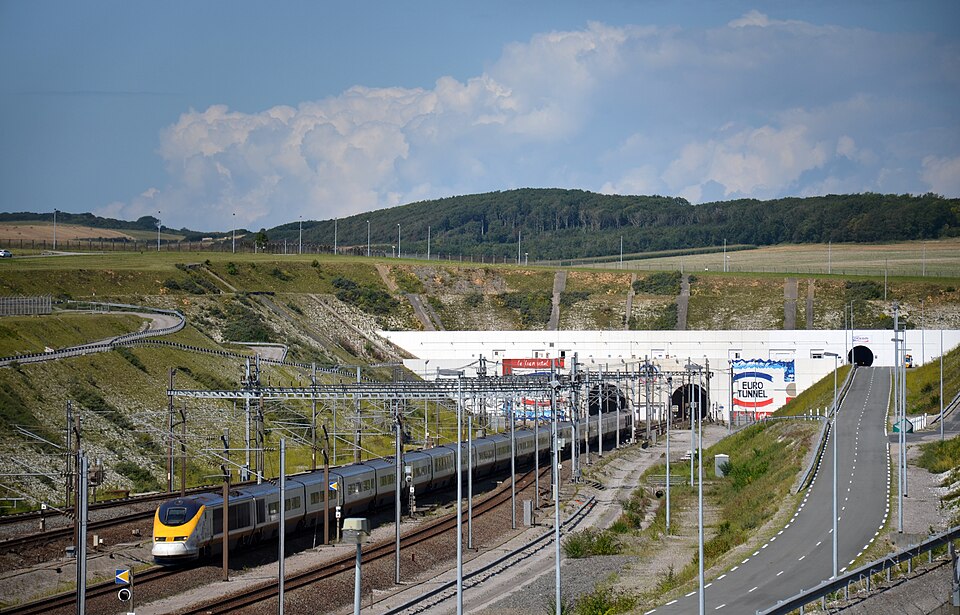
For rail freight, long overshadowed by road haulage and shipping, the message from ministers and industry alike is clear: the Channel Tunnel is open for business again — and this time, it’s freight that could lead the charge. Photo by Billy69150, Wikimedia commons.