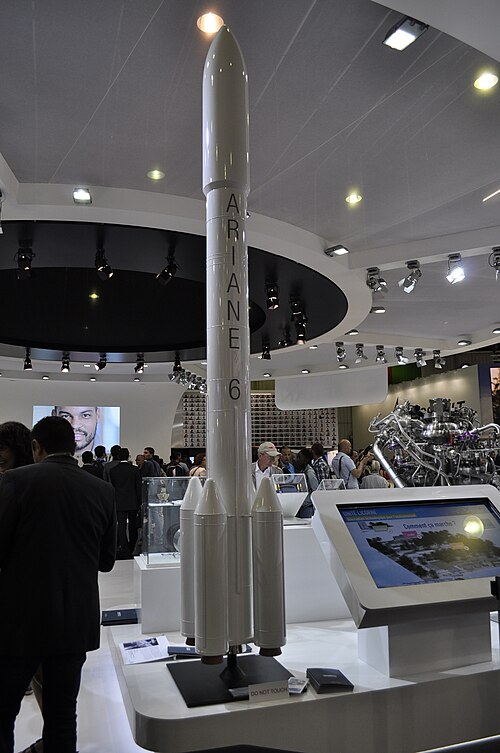
Ariane 6 has successfully placed two new Galileo navigation satellites into orbit, marking another milestone for Europe’s next-generation launcher and its flagship satellite
navigation programme.
At 02:01 local time on 17 December (06:01 CET), the Ariane 6 rocket lifted off from Europe’s Spaceport at the Guiana Space Centre in Kourou, French Guiana. Operated by Arianespace, the launcher deployed Galileo satellites SAT 33 and SAT 34 into a medium Earth orbit at an altitude of around 22,900 kilometres.
The mission, designated VA266, was Ariane 6’s fifth launch overall and its fourth commercial flight. It was also the seventh launch conducted from the Guiana Space Centre in 2025. The rocket flew in its Ariane 62 configuration, equipped with two solid rocket boosters.
The satellites were launched for the European Space Agency (ESA) on behalf of the European Commission and the EU Agency for the Space Programme (EUSPA). Once operational, SAT 33 and SAT 34 will enhance the accuracy, resilience and availability of the existing Galileo constellation.
Often described as “Europe’s GPS,” Galileo provides positioning, navigation and timing services to more than 2.3 billion users worldwide. Its dual-frequency signals enable near-metre accuracy in real time, while advanced services such as signal authentication and the High Accuracy Service support commercial and governmental applications. The programme is a cornerstone of the EU’s space strategy, designed to ensure strategic autonomy and technological sovereignty.
Ownership of Galileo rests with the European Union, with the European Commission overseeing programme management. EUSPA acts as service provider and interface with users, while ESA is responsible for system design, development and launch procurement. France’s space agency CNES contributes to performance assessment and operates the Galileo Search and Rescue service, which relays distress signals from emergency beacons around the globe.
The successful mission further consolidates Ariane 6’s role as Europe’s primary heavy-lift launcher. Designed to replace Ariane 5, the modular rocket is intended to guarantee Europe’s independent access to space while supporting a wide range of institutional and commercial missions. Photo by Tiraden, Wikimedia commons.