From spring through autumn 2026, the Ashmolean Museum presents 'Soma Surovi Jannat: Climate Culture Care', a powerful new exhibition that places climate
justice, cultural memory and human vulnerability at its heart. Part of the Ashmolean NOW series, the exhibition brings contemporary voices into conversation with the museum’s historic collections—and does so with rare urgency.
This exhibition marks several milestones. It is the first UK solo exhibition by Soma Surovi Jannat, and the first solo presentation in a UK museum by an artist currently based in Bangladesh. Born in 1990 in Dhaka and professionally known as Surovi, the artist draws deeply on lived experience, research and observation to explore how climate change intersects with social inequality.
Developed following a residency at the Ashmolean in 2023, 'Climate Culture Care' brings together around 40 works created between 2023 and 2025. These include delicate yet confronting works on paper, a nearly 30-foot-long scroll, and a striking ephemeral wall drawing completed directly within the gallery. Curated by Mallica Kumbera Landrus, the Ashmolean’s Keeper of Eastern Art, the exhibition weaves together artistic practice, historical collections and contemporary global concerns.
At the core of Surovi’s work is the Sundarbans—the world’s largest mangrove forest, stretching across southern Bangladesh and India’s West Bengal. Interlaced by hundreds of rivers, the Sundarbans is home not only to endangered wildlife such as the Bengal tiger, but also to more than thirteen million people. Rising sea levels, intensifying cyclones and environmental degradation threaten both ecosystems and livelihoods, yet strong cultural and economic ties keep communities rooted to this fragile landscape.
Surovi captures this tension with sensitivity and precision. Her work does not present the Sundarbans simply as a site of catastrophe, but as a place of beauty, resilience and identity. Through finely detailed imagery, she asks viewers to consider whose lives are most exposed to climate change—and why.
Several works were inspired directly by encounters with objects in the Ashmolean’s collection. *Resensitizing the Brown Narrative* (2023), for example, draws on historic clay figures representing Indian castes, prompting reflections on colour, identity and the ways South Asian bodies have been historically framed and categorised.
A quieter but no less poignant series, 'Where Every Leaf Holds a Tale' (2023–24), focuses on the mangrove forests themselves. Across eight works on paper, Surovi examines the complex root systems that protect coastlines and absorb carbon, while also reflecting on plants’ sensory intelligence. The intricate compositions—echoing the miniature painting traditions of the subcontinent—invite close looking, mirroring the winding forms of the Sundarbans’ islands.
Scale and ambition come together in 'Between the Sea and the Sky, Who Holds the Ground?', a scroll stretching almost ten metres. Divided into multiple sections, it depicts humans, insects, animals and plants bound together in a shared precarity. Nearby, 'She Carries the River in Her Skin' (2026), drawn directly onto the gallery walls, turns attention to women and children, who are often disproportionately affected by climate change. Inspired by the feminist perspectives of Nalini Malani, the composition unfolds like a wave, with five boats symbolising different climate-driven challenges faced by women in South Asia.
Throughout the exhibition, Surovi resists portraying marginalised communities as passive victims. Instead, her figures—sometimes fragmented, often surreal—assert dignity, memory and agency. In 'In a Timeless Sweet Land' (2023), inspired by childhood holidays in northern Bangladesh, she turns to nostalgia and personal history, reminding viewers that environmental loss is also a loss of home, continuity and joy.
By the exhibition’s end, the message is unmistakable. Climate change is not an abstract future threat—it is a lived reality, unevenly distributed and deeply human. Surovi’s work asks viewers to reflect on their own relationship with nature and to recognise the shared responsibility of protecting it.
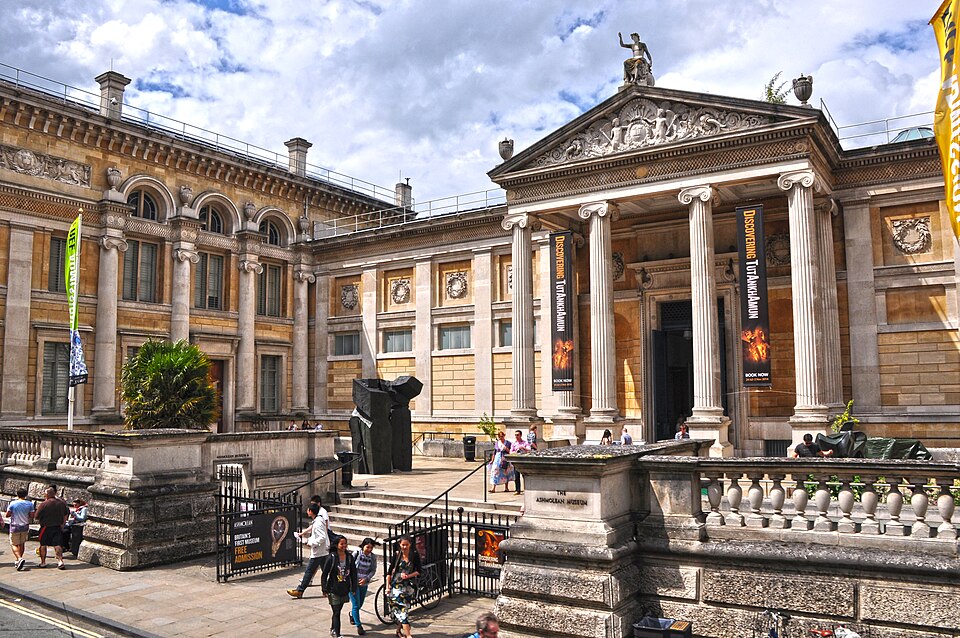
As Ashmolean Director Xa Sturgis notes, the exhibition opens space for meaningful dialogue about Bangladesh, contemporary South Asian art and global ecological concerns. Supported by partners including the British Council Bangladesh and Sotheby's, 'Climate Culture Care' stands as a compelling example of how museums can connect art, history and the most pressing issues of our time. Photo by Lewis Clarke, Wikimedia commons.
Exhibition Details
Exhibition: 'Soma Surovi Jannat: Climate Culture Care'
Dates: 28 March – 1 November 2026
Venue: Gallery 8, Ashmolean Museum, Beaumont Street, Oxford OX1 2PH
Admission: Free