Latvia has uncovered a tunnel beneath its border with Belarus, prompting Riga to intensify its efforts against criminal networks accused of organising the illegal movement of migrants into
the European Union.
The discovery comes as Latvia tightens security along its 173-kilometre frontier with Belarus, amid growing concern that organised smuggling networks are exploiting the border to funnel migrants into the EU's Schengen area.
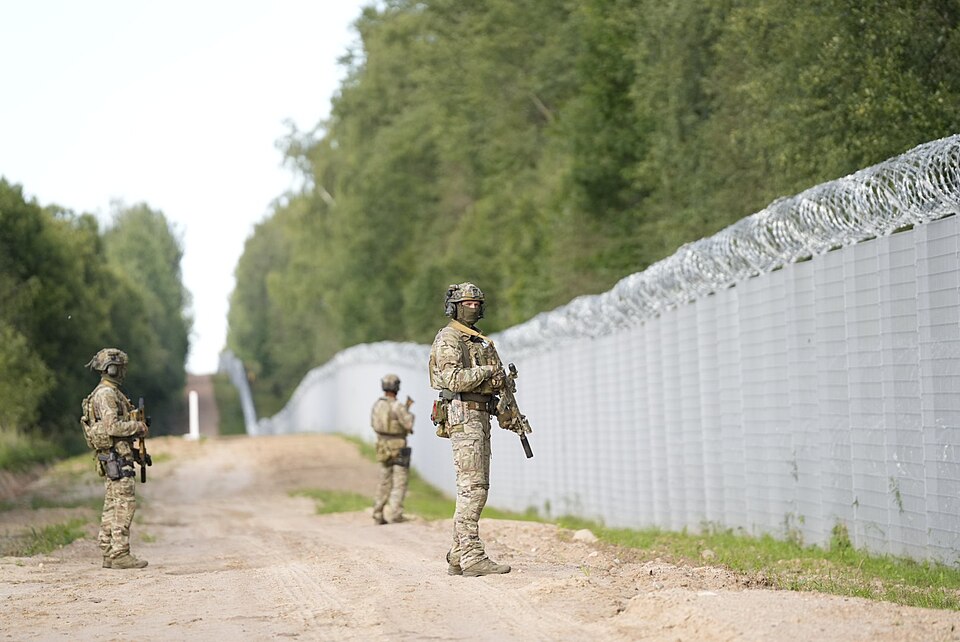
Latvian authorities said the tunnel was part of a wider pattern of increasingly sophisticated efforts to move people across the border. The government has responded by bringing the Border Guard, police, armed forces and security services into closer coordination, while expanding the use of drones to identify and intercept migrants at an early stage.
"The protection of Latvia's eastern border will be strengthened," Interior Minister Janis Dombrava said at a joint press conference with Prime Minister Andris Kulbergs. He said authorities would intensify surveillance and improve cooperation between security agencies to detect illegal crossings.
The announcement follows a tense incident last month when Latvian soldiers used tear gas and fired a warning shot to prevent a group of migrants from crossing into the country from Belarus.
Riga says the challenge extends beyond the migrants themselves. Prime Minister Kulbergs accused criminal organisations of arranging the movement of people through Belarus and into Latvia, using the country as an entry point to the wider, border-free Schengen zone.
"They migrate to where it's easier to enter the EU. So we must not be the easiest place," Kulbergs said.
The Latvian government has launched what the prime minister described as "Operation Werewolf", aimed at dismantling the infrastructure behind the smuggling routes. The operation is expected to focus not only on those moving migrants across the border, but also on transport networks and locations inside Latvia where migrants can be sheltered or transferred onwards.
Kulbergs said the authorities intended to strike at the entire chain supporting the crossings.
"If everything goes according to plan, we are confident that we will already deal a serious enough blow to the system," he said, warning organisers that the government intended to dismantle their operations.
Latvia has increasingly portrayed irregular migration from Belarus as a security challenge rather than solely a migration issue. Kulbergs previously described the situation as a "hybrid threat", saying the government had responded by doubling the number of guards deployed along the eastern frontier.
The latest measures come against a wider European backdrop of renewed concern over irregular migration. European governments have been under pressure following a recent arrival of tens of thousands of migrants from Morocco to Spain's North African exclave of Ceuta, although most have subsequently left.
Latvia also plans to deepen cooperation with Estonia, Lithuania and Poland as it seeks to disrupt routes leading from Belarus into the EU.
The regional dimension is significant. Lithuania reported in July that its authorities had also discovered a tunnel allegedly used by migrants to cross from Belarus.
For Riga, the message is increasingly clear: the eastern border is being treated as both a migration frontier and a security line, with authorities determined to make Latvia a less attractive route for organised people-smuggling networks. Photo by Saeima, Wikimedia commons.