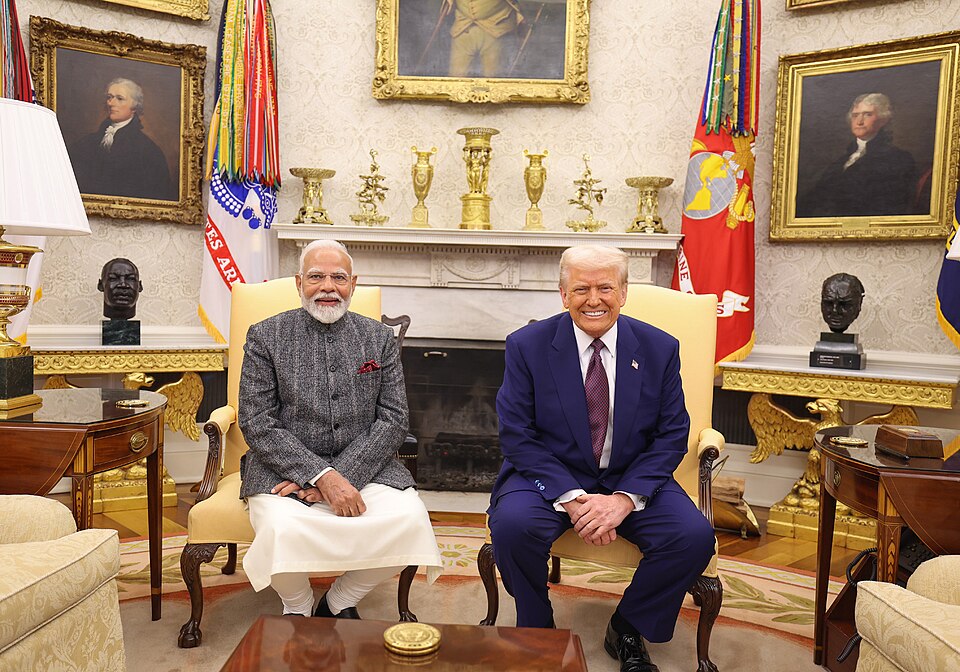
In a significant shift in global trade and energy politics, U.S. President Donald Trump announced on Monday that the United States and India have reached a
comprehensive trade agreement that dramatically lowers tariff barriers and reshapes elements of their economic relationship.
Under the understanding outlined by Trump after a call with Prime Minister Narendra Modi, U.S. tariffs on Indian goods will be reduced to 18% from previously punitive levels that had effectively reached as high as 50% due to a combination of reciprocal duties and penalties tied to India’s purchase of Russian oil.
The tariff reduction comes as part of what Trump described as “a trade deal between the United States and India,” aimed at easing months of bilateral tensions and boosting economic cooperation. A White House official confirmed that the U.S. will also lift a separate 25% penal tariff imposed on Indian imports for continuing to buy Russian crude.
Pivot on energy and market access
Trump framed the agreement as a breakthrough on multiple fronts. He stated that India has agreed to stop buying Russian oil and instead boost purchases from the United States — and potentially from Venezuela — as part of a larger effort to support U.S. energy exports and weaken Moscow’s economic base.
In a social media post, Modi welcomed the tariff reduction and thanked Trump, though his own message made no explicit mention of halting Russian oil imports — underscoring that details of India’s energy shift could involve transition arrangements rather than an immediate cut-off.
Trump also said Modi committed India to “BUY AMERICAN at a much higher level,” with projected purchases of up to $500 billion worth of U.S. energy, technology, agricultural goods, and coal. In return, India is expected to reduce its own tariffs and non-tariff barriers on U.S. products, potentially lowering them to zero — a move that could open Indian markets further to American manufacturers and exporters.
Market and political impact
The announcement sparked immediate market reactions, with U.S.-listed shares of major Indian companies climbing after the news emerged.
Analysts say the deal not only eases trade friction but also signals a broader geopolitical realignment. Washington has long pressured New Delhi to limit its reliance on discounted Russian oil — an issue tied to Western efforts to undercut Russian revenues amid the ongoing Russia-Ukraine war.
However, Moody’s Ratings has cautioned that an abrupt cessation of Russian oil imports could disrupt India’s energy markets, suggesting any transition would likely be gradual to avoid inflationary pressure and supply challenges.
Details still emerging
Despite the public announcements, key technical details — including effective dates for tariff changes, legal texts of the agreement, and the exact timeline for ending Russian oil purchases — have not yet been released by either government. White House officials have not issued the formal proclamations required to enact the tariff adjustments.
India’s commerce and foreign ministries had not provided immediate responses to requests for comment at the time of reporting, and Moscow’s embassy in Washington also remained silent on the developments. Photo by Prime Minister's Office, Wikimedia commons.