Sir Keir Starmer and senior European leaders have hit back at Donald Trump after the US president threatened sweeping tariffs against Nato allies in an escalating dispute over Greenland,
warning that economic coercion between allies risks damaging transatlantic unity.
The controversy erupted after Mr Trump announced plans to impose tariffs of up to 25% on goods from the UK and several European nations unless Denmark agrees to negotiations over the sale of Greenland — a move that has been widely condemned across Europe.
Speaking on Saturday, the former US president said the UK would face a 10% tariff on all exports to the United States from 1 February, rising to 25% from 1 June, unless Washington reached an agreement to purchase Greenland from Denmark. Similar tariffs were threatened against Denmark, Norway, Sweden, France, Germany, the Netherlands and Finland.
Mr Trump justified the move by claiming the countries had “journeyed to Greenland, for purposes unknown”, and warned that “strong measures” were needed to protect global security.
Downing Street swiftly rejected the proposal. Sir Keir Starmer described the tariff threat as “completely wrong” and said the UK would raise the issue directly with the US administration.
“Our position on Greenland is very clear,” the prime minister said. “It is part of the Kingdom of Denmark, and its future is a matter for the Greenlanders and the Danish people.”
He added that Arctic security is a shared Nato responsibility and warned that penalising allies for collective defence efforts undermines the alliance itself.
European leaders echoed the criticism. Sweden’s Prime Minister Ulf Kristersson said his country would not be “blackmailed”, while French President Emmanuel Macron said Europe would not give in to “intimidation” and pledged coordinated talks among EU partners.
Finland’s Prime Minister Petteri Orpo warned that tariffs would benefit no one, and Norway’s Prime Minister Jonas Gahr Støre wrote bluntly on social media: “Threats have no place among allies.”
The European Union moved quickly to close ranks behind Denmark. European Commission President Ursula von der Leyen and European Council President António Costa issued a joint statement expressing “full solidarity” with Denmark and the people of Greenland.
They warned that tariffs would undermine transatlantic relations and risk a “dangerous downward spiral”, stressing that dialogue — not economic pressure — must remain the foundation of US-EU relations.
EU foreign policy chief Kaja Kallas also cautioned that internal divisions among Nato allies would only serve the interests of China and Russia. “They are the ones who benefit from discord,” she said.
The dispute comes amid heightened military focus on the Arctic. Earlier this week, the UK confirmed it had sent a military officer to Greenland at Denmark’s request to join a reconnaissance group ahead of an Arctic endurance exercise. Downing Street stressed this did not amount to a deployment.
Mr Trump, however, framed the situation in stark terms. In a post on Truth Social, he claimed that Denmark had put global security at risk and insisted it was “time for Denmark to give back”, warning that China and Russia were seeking influence over Greenland.
Across the UK political spectrum, the tariff threat triggered alarm over potential economic consequences. Conservative leader Kemi Badenoch said the move would place an unnecessary burden on British businesses, while Liberal Democrat leader Sir Ed Davey accused Mr Trump of “punishing” the UK. Reform UK leader Nigel Farage also acknowledged the tariffs would hurt the British economy.
Trade groups have raised similar concerns. The British Chambers of Commerce warned that if the proposed tariffs are layered on top of existing duties, they could hit UK exporters harder than previous US trade measures. William Bain, the organisation’s head of trade policy, said the impact could be severe if the tariffs are “stacked” rather than replaced.
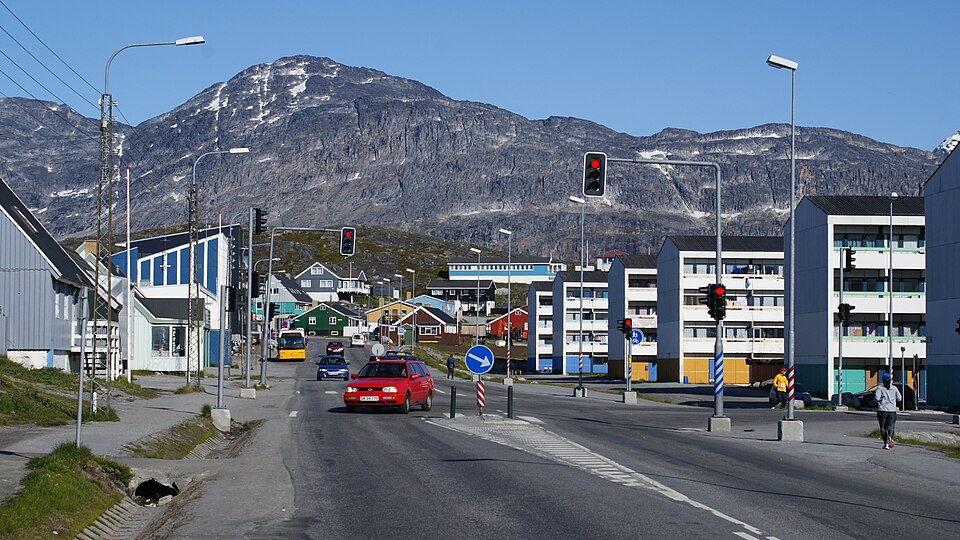
Meanwhile, public opposition is growing in Greenland and Denmark. Hundreds gathered in Nuuk over the weekend in support of self-governance, while thousands more protested across Denmark against any US takeover of the Arctic territory.
Since the US began openly discussing the annexation of Greenland earlier this year, the UK has intensified talks on Arctic security. Sir Keir has raised the issue in conversations with Mr Trump, Danish Prime Minister Mette Frederiksen and Nato Secretary General Mark Rutte.
For now, European leaders are standing firm — insisting that Greenland’s future will be decided in Copenhagen and Nuuk, not Washington, and that economic threats have no place among allies. Photo by Algkalv (talk), Wikimedia commons.