Belarus has released 123 political prisoners, including Nobel Peace Prize laureate Ales Bialiatski and prominent opposition figures, in a deal that saw the United States agree to ease sanctions
on the country’s lucrative potash industry.
The mass release followed talks in Minsk between Belarusian President Alexander Lukashenko and John Coale, a special envoy of US President Donald Trump. US officials said Washington would lift sanctions on potash, a key fertiliser ingredient for which Belarus is one of the world’s leading producers.
It marks the largest single release of political detainees by Mr Lukashenko since the Trump administration began engaging with the long-serving authoritarian leader earlier this year. Western governments had largely isolated Mr Lukashenko over his suppression of dissent and his support for Russia’s invasion of Ukraine.
Among those freed is Mr Bialiatski, co-winner of the 2022 Nobel Peace Prize and founder of the Vyasna human rights group. A longtime advocate for political prisoners, he was jailed in July 2021 and later sentenced to 10 years on charges widely condemned by rights groups as politically motivated.
Also released were Maria Kolesnikova, a leading figure in the mass protests that followed Belarus’s disputed 2020 election, and Viktar Babaryka, who was arrested that year as he prepared to challenge Mr Lukashenko at the polls.
US officials told Reuters the renewed engagement with Minsk is aimed at loosening Belarus’s dependence on Russian President Vladimir Putin, a strategy that has been met with deep scepticism by Belarus’s opposition.
Mr Coale described his two-day talks with Mr Lukashenko as “very productive,” according to the state news agency Belta, and said his goal was to normalise relations between Washington and Minsk.
“We’re lifting sanctions, releasing prisoners. We’re constantly talking to each other,” he said, adding that the relationship was moving from “baby steps to more confident steps.”
The previous high-level meeting between US officials and Mr Lukashenko, in September 2025, coincided with the easing of some sanctions and the release of more than 50 political prisoners, who were allowed to leave for Lithuania.
Since July 2024, Belarus has freed more than 430 political prisoners in what many observers see as a calculated effort to repair ties with the West.
The United States and the European Union imposed sweeping sanctions on Belarus after the violent crackdown on protesters following the 2020 election, which led to the imprisonment or exile of nearly all prominent opponents of the regime. Sanctions were tightened further after Belarus allowed its territory to be used as a staging ground for Russia’s 2022 invasion of Ukraine.
Belarusian opposition leader Sviatlana Tsikhanouskaya said the latest deal showed sanctions were having an impact.
“The freeing of political prisoners means that Lukashenko understands the pain of Western sanctions and is seeking to ease them,” she told the Associated Press.
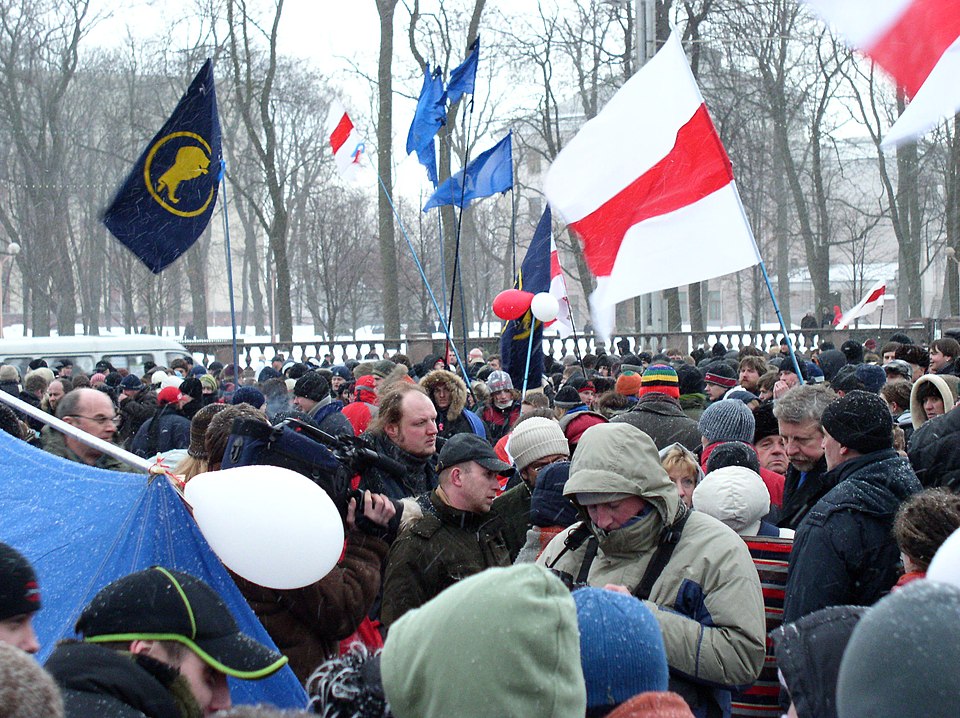
“But let’s not be naive,” she added. “Lukashenko hasn’t changed his policies, his crackdown continues and he keeps on supporting Russia’s war against Ukraine.” Photo by Alex Zelenko, Wikimedia commons.