UK Defence medical personnel have played a key role in strengthening NATO’s medical readiness during Exercise Vigorous Warrior 26, the Alliance’s largest multinational medical training
exercise, held in Estonia from 8 to 20 June.
Hosted every two years by a different NATO member nation, Exercise Vigorous Warrior brought together more than 2,000 personnel from 32 Allied and partner countries to test and enhance medical support capabilities in a realistic operational environment.
The UK deployed a 50-strong Tri-Service medical contingent, supported by additional military personnel, to train alongside NATO allies and partners across the full spectrum of operational healthcare delivery.
Brigadier Chris Wright, Head of Medical Operations and Capability, said:
“Exercise Vigorous Warrior provides an invaluable opportunity for UK Defence Medical personnel to train alongside our NATO allies and demonstrate our contribution to collective defence.
“Medical support is critical to operational effectiveness. By exercising casualty care, patient movement and medical logistics in a realistic multinational setting, we are enhancing our ability to support personnel on operations and strengthening interoperability across the Alliance.
“No nation can meet every challenge alone. Exercises like this ensure our people, systems and processes are ready to work together whenever NATO is called upon to act.”
The UK contribution included an Aeromedical Staging Unit from RAF Tactical Medical Wing and Army Reserve personnel from 144 (Parachute) Medical Squadron, part of 16 Medical Regiment.
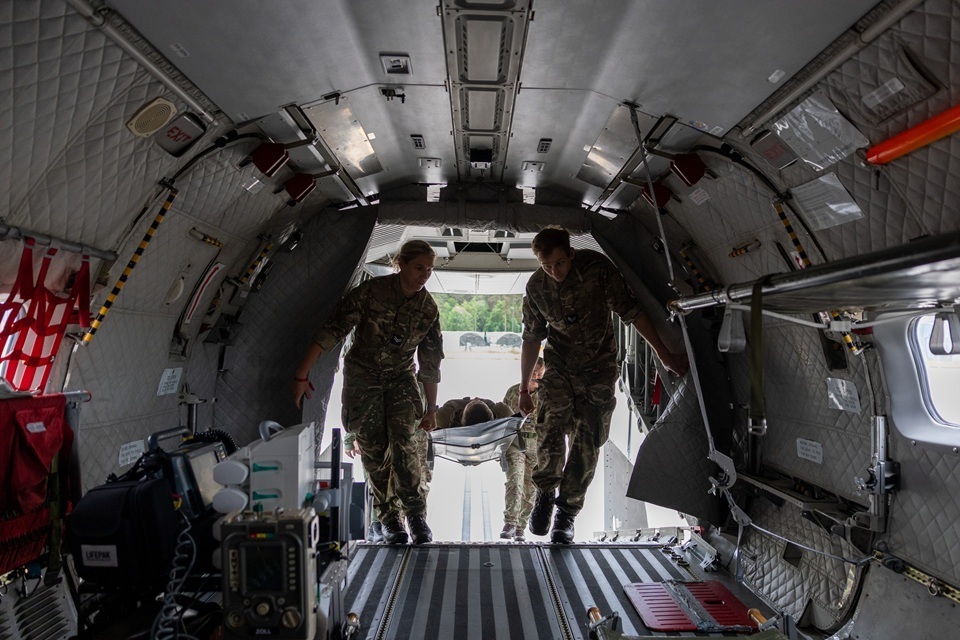
Personnel exercised Role 1 medical capabilities, providing immediate frontline care, including life-saving treatment, stabilisation and primary healthcare support. The team also contributed to wider patient care, evacuation and movement activities throughout the exercise.
During the training, UK personnel tested Mercury, the UK’s frontline medical application, which enables access to patient records in remote and disconnected environments. They also observed emerging technologies, including unmanned aerial and ground systems designed to support casualty evacuation.
Medical Communications and Information Systems specialists, supported by Army Reserve medical personnel, helped employ NATO’s new Medical Management Application, improving patient tracking and coordination across multinational medical networks.
UK Defence Medical personnel further supported operations at the Patient Evacuation Coordination Centre and deployed five nurses to reinforce a German-led medical facility. The UK also led a three-day NATO Chemical, Biological, Radiological and Nuclear (CBRN) Emergency Medical Treatment course for 24 students from 15 nations, supported by instructors from Canada, the United States and the Czech Republic.
Throughout the exercise, participating nations coordinated medical support across the entire patient care pathway, from point of injury through stabilisation, evacuation and definitive treatment. Training activities included casualty management, blood resupply, medical logistics, aeromedical evacuation and civil-military cooperation.
Reflecting lessons identified from recent conflicts, the exercise also emphasised collaboration between military medical teams and civilian healthcare providers during crisis and contingency operations.
For UK Defence Medical personnel, Exercise Vigorous Warrior 26 provided a valuable opportunity to refine operational skills, validate medical capabilities and strengthen the partnerships that underpin NATO’s collective defence and readiness.