The UK aviation industry is set for a significant lift-off after the government announced a £43 million investment in green aviation projects, aimed at driving economic growth, supporting skilled
jobs and accelerating the move towards cleaner flying.
Unveiled on 20 January 2026, the funding will support research and development projects across the UK that help deliver net zero aviation by 2050, while ensuring the sector can continue to grow in line with climate targets.
The investment comes as the government presses ahead with plans to expand capacity at Heathrow, Gatwick and Luton airports. Later today, the Transport Secretary will chair talks with airlines, airports, engineers and technology firms to explore how cutting-edge innovation can decarbonise aviation while boosting connectivity and competitiveness.
Backing innovation and high-skill jobs
Up to £43 million will be made available to businesses, universities and research organisations, with competitive funding rounds opening from February. The projects supported will focus on breakthrough technologies such as zero-emission aircraft, hydrogen propulsion and sustainable aviation fuels (SAF).
Low-carbon fuel production alone is expected to contribute up to £5 billion to the UK economy by 2050, and ministers say the new funding will unlock millions of pounds in private investment. This, in turn, will support highly skilled jobs in engineering, science and advanced manufacturing.
The programme will also fund research into reducing the wider climate impacts of flying, including trials to better understand how **contrails** – condensation trails that can contribute to global warming – might be avoided or minimised.
Laying the foundations for zero-emission flight
As part of the investment, the Civil Aviation Authority will begin developing the regulatory framework needed for the widespread adoption of hydrogen fuel, working alongside pioneering companies and universities preparing for the next generation of zero-carbon aircraft.
Some funding will also help strengthen the global supply and tracking of sustainable aviation fuels in regions such as **Africa and the Caribbean**. This will improve participation in international carbon-offsetting schemes and ensure UK airlines are not placed at a financial disadvantage compared with carriers operating in countries with fewer monitoring requirements.
Government commitment to green aviation
Transport Secretary, Heidi Alexander, said: “We’re backing UK businesses by powering up green aviation. Our £43 million investment will deliver the cutting-edge technology of the future, grow the economy and support highly skilled jobs as part of our mission to deliver national renewal.
Zero emission aircraft, hydrogen fuels and other emerging technologies are vital to reduce the climate impacts from flying and will enable us to deliver our airport expansion plans to boost connectivity and grow the economy’.
The announcement builds on wider government support for the sector. The Sustainable Aviation Fuel Bill, due to come into force later this year, will guarantee a set price for UK SAF producers, providing long-term certainty for investors. This is backed by an additional £63 million to accelerate new SAF production plants and £2.3 billion over the next decade through the Aerospace Technology Institute programme.
Together, ministers say, the measures will help secure the UK’s position as a global leader in green aviation – delivering cleaner flights, thousands of skilled jobs and a future-ready aviation industry.
The Hydrogen in Aviation Alliance said: “The funding for green aviation projects announced today will help ensure the UK leads the future of flight. Hydrogen-powered aviation is at the heart of this ambition and is essential to decarbonising aviation while ensuring the sustainable growth of our industry.
We welcome the government’s support for pioneering businesses developing zero emission aviation technologies, alongside its commitment to enabling the Civil Aviation Authority to put in place the right regulations for the use of hydrogen fuel.
These are important steps on the journey to making hydrogen-powered flight a reality and securing a competitive, sustainable future for UK aviation”.
Duncan McCourt, Chief Executive of Sustainable Aviation, said:
“We know that aviation is one of the most challenging sectors to decarbonise and, as we continue on the road to net zero by 2050, industry action combined with government investment are required.
This funding will help turn ambition into operational reality across key decarbonisation pathways, helping to deliver carbon-neutral skies”.
Tim Alderslade, Chief Executive of Airlines UK, said:
“Today’s investment in zero and lower emission technology is playing an important part in delivering a sustainable future for UK aviation, a process well underway with the launch last year of the sustainable aviation fuel mandate and imminent passage of the SAF revenue certainty mechanism into law.
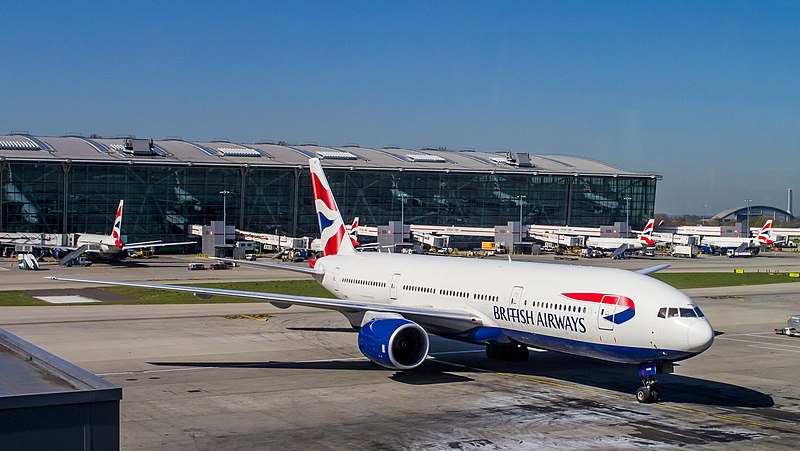
The ongoing work of the Jet Zero Taskforce, bringing government, industry and experts together to drive progress, is a critical part of our collective efforts to ensure net zero remains a reality for our sector”. Photo by Ed Webster, Wikimedia commons.