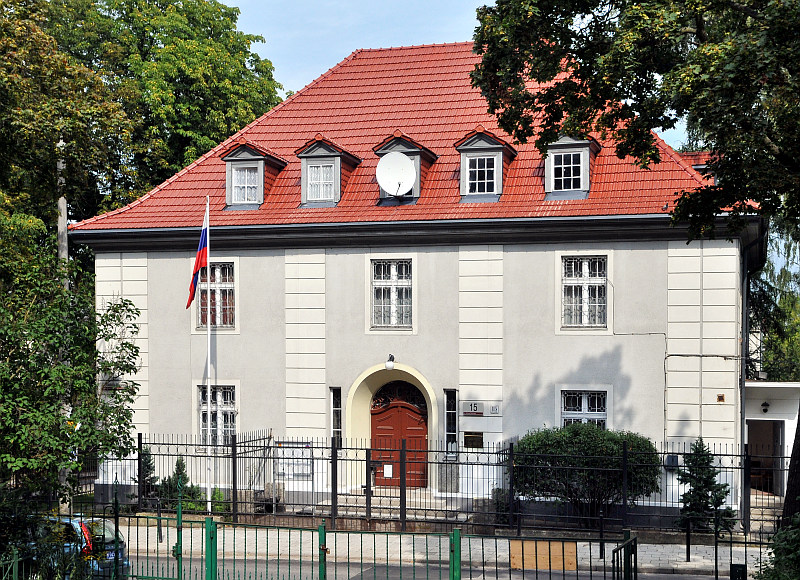
Russia has refused to hand over a consulate building in the northern Polish city of Gdańsk, despite an order from Warsaw to close the facility following an alleged act of sabotage
linked to Moscow.
Poland’s foreign ministry ordered the consulate to cease operations by the end of 23 December, requiring all staff to leave the country. The decision followed an investigation into the sabotage of a rail line last month, which Polish authorities say was carried out by agents acting on Russia’s behalf.
Moscow disputes Poland’s authority to reclaim the building and insists it retains legal rights to the property. Russian officials say they will leave one “administrative and technical employee” at the site after the closure deadline to “ensure the inviolability” of what they describe as Russian-owned premises.
The villa on Batorego Street has been used by Soviet and later Russian diplomats since 1951, when Poland’s communist-era authorities allowed the Soviet Union to occupy the building free of charge, according to broadcaster TVN. Russia previously operated a consulate elsewhere in Gdańsk dating back to the era of Tsar Peter the Great, but that building was seized by Nazi Germany in 1941 and destroyed during the Red Army’s advance in 1945.
“We believe this is our property,” Andrei Ordash, chargé d’affaires at the Russian embassy in Warsaw, told TVN. He said the building was transferred to the Soviet Union in the early 1950s as compensation for property lost during the Second World War.
Gdańsk officials reject that claim, describing Russia’s position as “incomprehensible.” City authorities say available documentation does not support Moscow’s ownership argument and point to land and mortgage registers listing the property as belonging to Poland’s state treasury.
In 2013, the city began charging fees for use of the building, but the Russian consulate refused to pay. Gdańsk estimates unpaid charges from 2013 to 2023 at around 5.5 million zloty (€1.3 million), with interest adding a further 3 million zloty.
Deputy mayor Emilia Lodzińska said on Monday that the city would pursue legal action to reclaim the property. “After obtaining a court ruling favourable to the Polish side, bailiff proceedings will be carried out, resulting in the seizure of the property,” she said, adding that the city would act within the framework of the rule of law.
City officials noted that the building will lose its protected status under the Vienna Convention on Consular Relations at midnight on 23 December. Even so, they estimate that recovering the property through the courts could take two to three years.
Once transferred to the state treasury, the building’s future use will be assessed, said Emil Rojek, deputy governor of the Pomerania province. He said authorities would first evaluate its technical condition and safety before deciding whether it should be used by state institutions or redeveloped for commercial purposes.
The dispute echoes earlier cases. In 2022, shortly after Russia’s full-scale invasion of Ukraine, Warsaw seized a former Russian diplomatic compound following a long-running legal battle. Plans to hand the site to the local Ukrainian community were abandoned due to its poor condition, and it is now set to be redeveloped as housing for municipal employees. That same year, Poland’s State Forests authority seized another Russian-owned property after rent went unpaid.
Since last year, Poland has successively closed all three Russian consulates on its territory in response to what it describes as a campaign of sabotage by Moscow. After the Gdańsk consulate shuts its doors, only Russia’s embassy in Warsaw will remain. Russia has retaliated by ordering the closure of all Polish consulates on its territory. Photo by Lisarlena, Wikimedia commons.