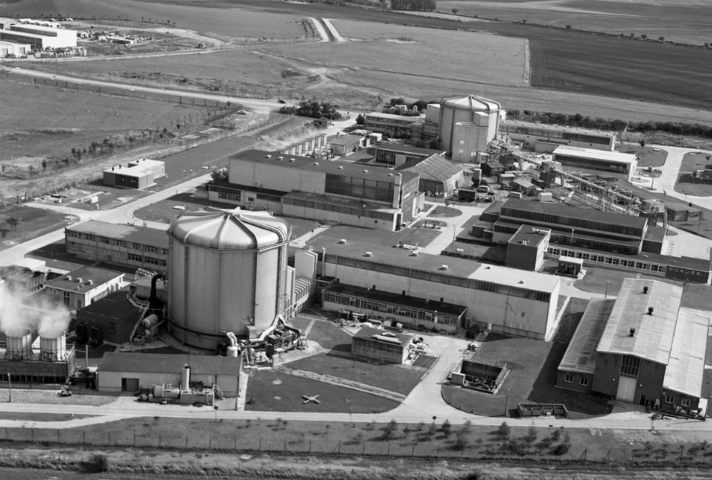
The Harwell site is marking its 80th anniversary in 2026, celebrating eight decades of scientific discovery, technological innovation and specialist expertise that have helped shape Britain’s
nuclear sector and established Oxfordshire as one of the country’s leading centres for science and research.
Founded in 1946, Harwell has undergone a remarkable transformation. What began as a pioneering centre for atomic research evolved into a major source of expertise in nuclear science, radiological safety, energy technology and healthcare. Today, the site has entered a new chapter under Nuclear Restoration Services (NRS), part of the Nuclear Decommissioning Authority (NDA) group, with its work focused on safely dismantling and restoring the UK's nuclear legacy while supporting future scientific and economic opportunities.
From atomic research to national scientific leadership
Harwell’s earliest decades coincided with the development of Britain’s civil nuclear programme. The site became home to some of the UK’s first research reactors and specialist laboratories, providing scientists with the facilities needed to explore atomic energy and develop technologies that would influence the country’s energy strategy and scientific capabilities for generations.
Its contribution extended well beyond reactor research. Harwell became an important centre for radiological protection and safety, helping develop procedures and expertise that contributed to standards used both in Britain and internationally. The culture of safety established during those formative years remains a fundamental principle of the site’s work today.
Over the decades, researchers at Harwell also contributed to developments in areas including advanced fuels, fusion and emerging energy technologies. The breadth of this work demonstrated the site's ability to adapt as scientific priorities and national energy needs changed.
Science with an impact beyond the nuclear sector
Harwell’s influence has also been felt far beyond nuclear energy. Its facilities and expertise contributed to the development of radioisotopes and radiopharmaceuticals, supporting medical treatments and diagnostic applications. Other innovations originating from or developed at the site have found applications across industry and technology.
This combination of scientific research and practical innovation helped establish Harwell as an internationally recognised centre for multidisciplinary research.
Today, however, one of the site's most important responsibilities is addressing the legacy of its own pioneering past.
A new mission: restoring the nuclear legacy
NRS Harwell is now focused on the complex task of decommissioning ageing nuclear facilities safely and responsibly on behalf of the NDA.
The work involves dismantling historic facilities, managing radioactive and hazardous materials, removing redundant infrastructure and restoring land for future use. It requires highly specialised knowledge, meticulous planning and a safety-first approach developed through decades of experience.
The scale of the transformation is already substantial. More than one million square feet of facility footprint has been removed, while 1.6 million square feet of land has been cleared. In addition, 23 hectares have been delicensed and released for redevelopment.
These achievements are helping to transform areas once associated with nuclear research into space for a new generation of science, technology and enterprise.
Creating the Harwell of the future
The decommissioning programme has played an important role in enabling the continued development of the Harwell Science and Innovation Campus. The internationally recognised campus is now home to hundreds of organisations and supports thousands of jobs across science, technology, engineering and research.
In this sense, Harwell’s story is not simply one of closing down old nuclear facilities. It is also a story of regeneration — turning the physical and intellectual legacy of eight decades of research into an environment capable of supporting the next generation of innovation.
The site’s current mission therefore connects its past with its future. The same culture of technical excellence and scientific problem-solving that characterised Harwell’s early years is now being applied to some of the UK's most challenging decommissioning projects.
Celebrating 80 years of people and innovation
Harwell’s anniversary has also provided an opportunity to recognise the scientists, engineers, technicians and other specialists whose work has shaped the site throughout its history.
An ITV Meridian mini-series has recently explored Harwell’s eight-decade journey, offering a behind-the-scenes look at the people, projects and scientific achievements that have contributed to its enduring legacy. The programme highlights how a site created during the early years of Britain’s atomic research programme became a major centre for scientific innovation and, ultimately, a leader in nuclear restoration.
Eight decades after its establishment, Harwell remains a site in transition — but its purpose has never stopped evolving. Its history reflects some of the most significant developments in British science and energy, while its present-day work demonstrates how the responsible management of the nuclear past can help create opportunities for the future.
As NRS continues its decommissioning programme, Harwell is entering its ninth decade with a role that is very different from the one it had in 1946, but with the same commitment to scientific expertise, safety and innovation that has defined the site throughout its history.
Gary Reid, Site Director, said: “Harwell’s 80-year legacy is a testament to the dedication and expertise of everyone who has worked here.
From groundbreaking research to today’s focus on safe decommissioning and innovation, the site has always been at the forefront of progress. We’re proud of our history and excited about what the future holds”.